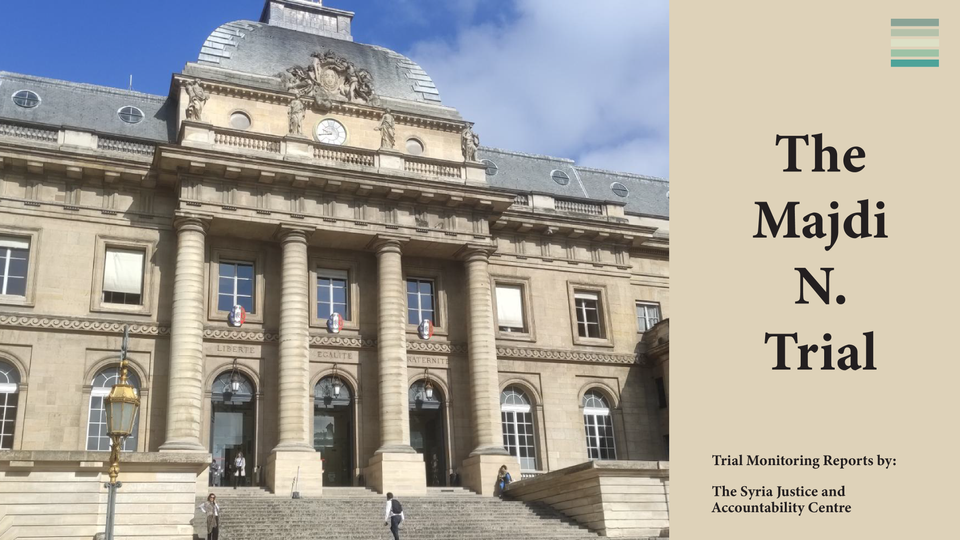
Inside the Majdi N. Trial #32: Decision on the List of Questions Asked to the Judges and Jury to Evaluate Majdi N.’s Guilt
TRIAL OF MAJDI N.
Court of Assize – Paris, France
Trial Monitoring Summary #32
Hearing Date: May 23, 2025
CAUTION: Some testimony may include graphic descriptions of torture, rape or other violent acts.
Note that this summary is not a verbatim transcript of the trial; it is merely an unofficial summary of the proceedings.
Throughout this summary, [information located in brackets are notes from our trial monitor] and “information placed in quotes are statements made by the witness, judges or counsel.” The names and identifying information of witnesses have been redacted.
[Note: SJAC provides a summary of the proceedings while redacting certain details to protect witness privacy and to preserve the integrity of the trial.]
[Note: Rather than publishing the trial reports of the Majdi N. case in chronological order, SJAC has organized them thematically and coherently based on the content of the hearings, making the material more accessible by highlighting key issues and connections across the proceedings.]
SJAC’s 32nd trial monitoring report details parts of day 15 of the trial of Majdi N. in Paris, France. On this trial day, Presiding Judge Lavergne presented a first list of questions to be asked to the Judges and the Jury, and the Parties debated their positions. Following deliberation, the Court presented a new list of 20 questions, four of which concerned the charge of complicity in war crimes of recruitment of minors into an armed group and 16 of which concerned the charge of participation in a group formed or an agreement established with the intent to prepare for war crimes.
Day 15 – May 23, 2025
Afternoon Session
Proceedings resumed at 12:57 PM.
Presiding Judge Lavergne presented a first draft of the questions that ought to be asked to the Jury. The following discussion between the parties resulted in reformulating the questions.
Regarding the charge of recruitment of minors as a war crime, Civil Parties’ Counsel Bailly explained that the term conscription amounted to forced recruitment, whereas enrollment was voluntary. Considering the current state of law [that does not ban voluntary enlistment of children above 15], the questions asked to the Court should be whether minors under 15 years were enlisted, and minors above 15 subjected to conscription. The Defense agreed with this distinction. The Prosecution argued that the protocol on the involvement of children in armed conflicts banned voluntary enlistment of minors under 18 and made no distinction between minors above 15 or under 15 years old.
On the same charge, Defense Counsel Kempf mentioned the Lubanga Case in which the International Criminal Court presented, in a 600-page decision, precise evidence that demonstrated widespread conscription of children. Counsel Kempf regretted that the present Court did not take the means to go into that level of detail. He finally noted that Lubanga was sentenced to 14 years in prison.
Regarding the charge of participation in a group formed with the intent to prepare for war crimes, the Prosecution suggested establishing an exact list of the crimes at stake. The Prosecution also argued that the question of whether such a group was formed to commit war crimes should be asked prior to the question of whether Majdi N. was an accomplice in that group. The Defense claimed that the questions should rather focus on Majdi N.’s acts that allegedly contributed to crimes committed by the group.
Proceedings were suspended at 1:30 PM and resumed at 4:44 PM.
Presiding Judge Lavergne read the new list of 20 questions to be asked to the Jury agreed upon by the Court; four questions concerned the charge of complicity in war crimes of recruitment of minors into an armed group, and 16 questions concerned the charge of participation in a group formed or an agreement established with the intent to prepare for war crimes.
The questions all related to the timeframe between January 1st, 2013 and sometime in 2016 in which the alleged crimes were committed. The crimes were all allegedly committed from the territories of Syria and Turkey and in connection with a non-international armed conflict. Taking this into account, the questions can be summarized as such:
COMPLICITY IN WAR CRIMES OF RECRUITMENT OF MINORS
Question 1: Recruitment of children under 15
Is it established that the group Liwa Al-Islam, which became Jaysh Al-Islam, has conscripted or enlisted children under the age of fifteen?
Question 2: Complicity of Majdi N. in recruitment of children under 15
Is the Accused Majdi N. guilty of having facilitated—by aid or assistance—the preparation or commission of the war crime specified in Question No. 1, by knowingly aiding and assisting the perpetrators of the conscription or enlistment of children under the age of 15, notably by contributing to recruitment and/or training efforts, and by participating in the dissemination of propaganda intended to recruit and indoctrinate minors for their involvement in the military activities of the armed group Liwa Al-Islam which became Jaysh Al-Islam?
Question 3: Conscription of children above 15
Is it established that the group that Liwa Al-Islam, which became Jaysh Al-Islam, has conscripted children aged 15 to 18?
Question 4: Complicity of Majdi N. in conscription of children above 15
Is the Accused Majdi N. guilty of having facilitated—by aid or assistance—the preparation or commission of the war crime specified above in Question No. 3, by knowingly aiding and assisting the perpetrators of the conscription of children aged 15 to 18, notably by contributing to recruitment and/or training efforts, and by participating in the dissemination of propaganda intended to recruit and indoctrinate minors for their involvement in the military activities of the armed group Liwa Al-Islam which became Jaysh Al-Islam?
PARTICIPATION IN A GROUP FORMED WITH THE INTENT TO PREPARE FOR WAR CRIMES
A total of eight different questions were asked for each war crime, as to whether it was established that a group was formed or an agreement established between members of the group Liwa Al-Islam, which became Jaysh Al-Islam, to prepare for the war crimes of:
(1) Deliberate attempt on life committed against persons protected under international law
(2) Deliberate attempt on physical or psychological integrity
(3) Conscription or enlistment of children under the age of fifteen
(4) Conscription of children aged fifteen to eighteen
(5) Deliberate attacks against civilians, particularly in Damascus
(6) Kidnapping and unlawful detentions committed against persons protected under international law
(7) Humiliating and degrading treatment inflicted on persons of the opposing party, seriously undermining their physical or mental integrity
(8) Pronouncing of convictions and execution of sentences without a prior judgment rendered by a regularly constituted court
In relation to these questions, another eight questions were asked to assess the participation of Majdi N. in the group formed or the agreement established to commit each of these eight war crimes, by contributing notably through his activities as spokesperson, intelligence officer, and strategic adviser to Jaysh Al-Islam's leadership.
Proceedings continued with the requisition of the Prosecution.
___________________________
For more information or to provide feedback, please contact SJAC at [email protected] and follow us on Facebook and Twitter. Subscribe to SJAC’s newsletter for updates on our work