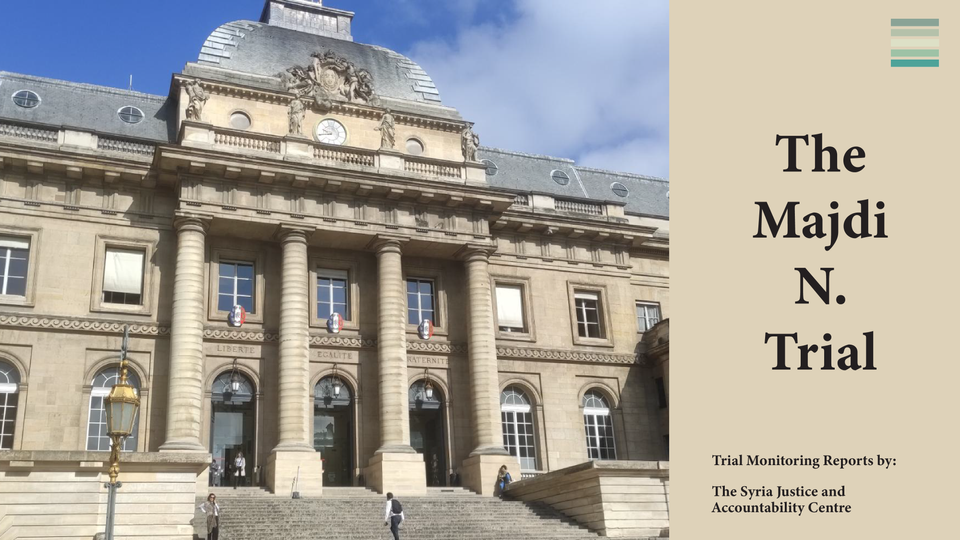
Inside the Majdi N. Trial #30: Interrogation of the Accused’s Involvement in Trainings in International Humanitarian Law for Jaysh Al-Islam's Fighters
TRIAL OF MAJDI N.
Court of Assize – Paris, France
Trial Monitoring Summary #30
Hearing Date: May 21, 2025
CAUTION: Some testimony may include graphic descriptions of torture, rape or other violent acts.
Note that this summary is not a verbatim transcript of the trial; it is merely an unofficial summary of the proceedings.
Throughout this summary, [information located in brackets are notes from our trial monitor] and “information placed in quotes are statements made by the witness, judges or counsel.” The names and identifying information of witnesses have been redacted.
[Note: SJAC provides a summary of the proceedings while redacting certain details to protect witness privacy and to preserve the integrity of the trial.]
[Note: Rather than publishing the trial reports of the Majdi N. case in chronological order, SJAC has organized them thematically and coherently based on the content of the hearings, making the material more accessible by highlighting key issues and connections across the proceedings.]
SJAC’s 30th trial monitoring report details parts of day 13 of the trial of Majdi N. in Paris, France. On this trial day, Majdi was questioned about three documents found on his computer related to trainings for Jaysh Al-Islam fighters in international humanitarian law. Most notably, the Court wondered why the trainings made references to Sharia law. Majdi N. explained that fighters were motivated by religion, and links could be made between legal rules and religious concepts to make the content of the training more legitimate to them. The Civil Parties’ Counsels questioned the fact that Majdi N. could have been a whistleblower but did not denounce acts committed by Jaysh Al-Islam. Majdi N. explained in which context he had presented himself as a whistleblower, namely after two friends of his were shot dead. Following that, he intended to build a case against Jaysh Al-Islam in Turkey.
Day 13 – May 21, 2025
Presiding Judge Lavergne referred to a document entitled “rules of war in international humanitarian law” that Majdi N. had left comments on and asked why the Accused stored the document on his computer. Majdi N. had no particular explanation but stressed that the document was a basis for training fighters. The author of the document was [redacted name] F84, a researcher from the Jaysh Al-Islam Policy Office headed by [redacted name], F7. Majdi N. added that he himself also held a position related to legal and media issues in this Office but was not sure of its exact title.
The comments written by the Accused on the document appeared on the last page. Most notably, Majdi N. wrote that the language used in the document seemed too complicated for the audience, which consisted of fighters and not lawyers. He also noted that civilians who did not participate in hostilities could not be killed, even on the regime side. Majdi N. further commented that Mujaheddins [i.e. Jihad fighters] who talked to the media should report that Jaysh Al-Islam knew international law, unlike the Syrian regime which committed violations. Presiding Judge Lavergne understood that combatants should denounce crimes of the regime but were much less clear regarding their own actions. Majdi N. disagreed with Presiding Judge Lavergne’s view and stressed that he clearly urged combatants to not kill prisoners.
The Accused added that since he had left a lot of negative comments on the document written by F84, he also wanted to give some positive feedback. Presiding Judge Lavergne asked why Majdi N. could not displease F84, and the Accused explained that he was a religious scholar much older than him and had to show respect. Moreover, F84 wanted to use all possible religious arguments to encourage Jaysh Al-Islam’s commanders to implement international law. Majdi N. did not intervene in those questions, since F84 had a PhD in religious sciences, and it would have been inappropriate to position himself as his equal.
Proceedings were suspended at 01:00 PM. Majdi N.’s interrogation resumed at 5:01 PM the same day.
Another document drafted by the Accused was sent to all combatants of Jaysh Al-Islam. It stated that everyone should pay close attention to avoid pitfalls that could be considered violations of international humanitarian law, which included subjecting prisoners to any physical or moral harm and filming or registering them. The document also stated that conscription of minors under 18 was banned, that injured or sick people should be treated well, and no discourse of sectarian character should be proclaimed. Presiding Judge Lavergne questioned the Accused on the objective of the document, and Majdi N. depicted a general context in which sectarian divisions were strong. ISIS used to target “Nusaïri” [a word designating Alawi], which could refer to civilians, and such terminology had to be avoided because the targets were military, Majdi N. explained.
The document further stated that before launching attacks on hospitals or historical monuments, it had to be indicated that the regime transformed those locations into military barracks and that several warnings were issued before the attacks. To illustrate this point, Majdi N. referred to a video on the targeting of Harasta medical center. He explained that he was contacted by the legal advisor of the Free Syrian Army (FSA) [redacted name], F20, who told him that Jaysh Al-Islam had committed no violations, but the way it was presented, namely that hospitals were targeted, could lead to criticism.
Civil Parties’ Counsels’ Questioning of Majdi N.
Counsel Baudouin claimed that Majdi N. was trying to present himself as a champion of the defense of international humanitarian law. But if his true intention were genuinely to uphold those principles, it would have been simpler to reproduce the content of international documents and not use convoluted language. That gave the impression that the document was in fact more of a precautionary text, to provide a set of talking points aimed at avoiding acknowledgment of what happened—namely, that international humanitarian law was violated. Majdi N. considered it a very interesting question and regretted the tangible distrust toward him. He argued on the inefficacy to simply claim that international humanitarian law should be implemented, stressing that fighters often had religious motivations and were receptive to concepts such as Halal and Haram [permissible and illicit], but not to legal categories. Majdi N. added that fighters also trusted someone wearing a military uniform more than a civilian who came from outside Jaysh Al-Islam.
Counsel Baudouin emphasized that evidence pointed to the fact that international humanitarian law had not been respected by Jaysh Al-Islam. Majdi N. replied that when he heard someone accusing Jaysh Al-Islam of a crime, he asked the group if it was true or not. If it was not true, he published a denial. As a response to Presiding Judge Lavergne on the protocols of the Geneva Call on defending non-conscription of minors and security of civilians, Majdi N. said he had read them.
Counsel Pasmentier asked the Accused if he knew the rules that prohibited starving the civilian population, which Majdi N. did not. Since he presented himself as a whistleblower, Counsel Pasmentier asked if Majdi N. was alerted to the fact that the population faced difficulties finding food at a time when Jaysh Al-Islam was controlling the import and storing of food in warehouses. Majdi N. responded that he presented himself as a whistleblower in a certain context, namely after a friend and his brother were shot in Ghouta in April 2018. Majdi N. helped their other brother to file a complaint and collect evidence on the crime, but legal action did not move forward in Turkey. Concerning Jaysh Al-Islam’s warehouses, Majdi N. said he was in Turkey at that time and when he asked the group, they denied. “If that were true, of course it would be truly shameful and unacceptable,” Majdi N. added, stressing that information on warehouses storing food was shared by the media and he could not be sure if it was reliable. Counsel Pasmentier noted that the Accused had very little information, and Majdi N. repeated that he did not originate from Ghouta.
Counsel Zarka asked the Accused what teaching materials he used for training sessions. Majdi N. said he could consult many materials but stressed that it was only an introductory course on international humanitarian law. He added that having studied law at university did not make him a lawyer, and giving such trainings did not make him an expert. Majdi N. clarified that he gave trainings on English, management, and international humanitarian law. Counsel Zarka asked why Jaysh Al-Islam financed Majdi N.’s studies, and the Accused responded they did so because he asked.
When questioned about the frequency of those trainings, Majdi N. explained that around 20 sessions were organized. Counsel Zarka wondered why no trainings on international humanitarian law were organized in the northern camps, and Majdi N. repeated that he only went there for a frogmen training. Counsel Zarka retorted that he had acknowledged being supervisor of the training camp in the north, and Majdi N. replied that he was not the chief of that camp but had a specific mission targeting frogmen that took place in the Euphrates River.
Prosecution's Questioning of Majdi N.
Majdi N. said that [redacted name] was not F84’s real name, but [redacted name] noted that F84 was a religious scholar and that Zahran Alloush referred to another [redacted name], who was mufti of Jahbat Al-Nusra. Majdi N. confirmed they were two different people. Prosecutor Thouault noted that the document on international humanitarian law drafted by Majdi N. indicated rules combatants had to commit to, but also communication guidelines for media leaders of Jaysh Al-Islam. Majdi N. stressed he was not a media leader and asserted that he gave no instructions, but only advice. Prosecutor Thouault retorted that the document used the imperative form, and Majdi N. responded that in Arabic, imperative was also used to give advice.
Prosecutor Havard noted a distinction in the document between minors aged under 15 and above 15 and wondered if Jaysh Al-Islam permitted recruitment of children above 15. Majdi N. stressed that Jaysh Al-Islam did not accept recruits under 18. Prosecutor Havard clarified what Majdi N. had written, namely that international humanitarian law banned the recruitment of children under 18 and that Syria ratified a protocol banning the recruitment of minors under 15. Majdi N. said that legal advisor F20 had explained this to him. Prosecutor Havard concluded that it was an absolute interdiction that he well knew.
Defense Counsel’s Questioning of Majdi N.
Counsel Kempf mentioned a third document listing 15 rules fighters had to follow which was not examined by the investigators. He wondered if legal sources needed to be transmitted to combatants on the field, and Majdi N. said it was of course not necessary, and that’s what he had told F84. Counsel Kempf further asked why a document presenting rules of war was referring to God. Majdi N. argued that the aim was to be closer to the understanding of combatants. The Accused explained that fighters needed a religious motivation, especially those who were putting their life on the line, since people who had no religious dimension would feel like they were dying for nothing. Counsel Kempf noted that in the third document, Majdi N. considered it important to specify that violating these rules may lead to criminal prosecution before international courts. Majdi N. said he did so to protect rebels in Syria and reported a fear among fighters of being categorized as war criminals by the regime.
Presiding Judge Lavergne mentioned a document related to a communication campaign targeting fighters and asked who oversaw propaganda at Jaysh Al-Islam. Majdi N. said it was [redacted name], F82, not him, and he was also not the one who drafted this document. Counsel Ruiz noted that the source of this document had not been established.
At the request of the Defense, a deed of commitments from the Geneva Call was presented. It listed several rules related to the interdiction of child recruitment and, more generally, the treatment of children in warfare. Majdi N. expressed that he was upset that Jaysh Al-Islam decided not to sign this document.
Presiding Judge Lavergne asked exactly what the Accused knew about people detained by Jaysh Al-Islam, and Majdi N. said he only knew the version Jaysh Al-Islam gave him. Presiding Judge Lavergne asked what type of information he could have access to. Majdi N. said that Jaysh Al-Islam prisons were generally under control of the Unified Judiciary Council, and Jaysh Al-Islam had a quota of prisoners. Like all factions in Ghouta, it was up to Jaysh Al-Islam to decide if they wanted to exchange the prisoners they had control over. Majdi N. added that Jaysh Al-Islam had no prison under its control, besides a military prison that held Jaysh Al-Islam soldiers.
“What about all those people who pretended to be detainees of Jaysh Al-Islam?” Presiding Judge Lavergne asked. Majdi N. said it was the first time he heard such a thing and believed that what was spread on social media came from Jaysh Al-Islam's enemies, and possibly the regime. Presiding Judge Lavergne concluded that he considered them fake news, and Counsel Ruiz argued that it had to be placed in the Syrian context back then in which much fake news was spread. Majdi N. said he had no access to confessions made by detainees and could not remember if he sometimes received videos of people who had been interrogated or tortured. Following that, Presiding Judge Lavergne displayed a video of an interrogation, and Majdi N. noted that the person had a Druze accent and did not know how the document landed in his personal files. Presiding Judge Lavergne concluded that a Druze had nothing to do with Jaysh Al-Islam and could have been a regime affiliate. Counsel Kempf stressed that it was the investigator’s task to verify the source and date of documents so as to not lose time at trial.
The Defense requested the projection of another video of a speech given by Majdi N. in Ghouta on March 3, 2013, and the Accused commented that it was a speech on attacking Damascus. Presiding Judge Lavergne inquired about the type of weapon Majdi N. was carrying on the video and the location of the security centers in central Damascus that were targeted by Jaysh Al-Islam, which Majdi N. did not know since he was not specialized in cartography. Majdi N. explained the fact that technical elements were still found on his computer by his desire to have basic knowledge in this domain. Majdi N. added that military operations were very secret, so they brought him to film the video, but he had no additional information on the operation. When questioned by Counsel Ruiz if such a practice was usual, Majdi N. said he was often asked similar requests until he left Ghouta on May 28, 2013. Majdi N. declared that he also had nothing to say on the video edit, since a filmmaker handled it, and added that he did not see videos before they were released.
Proceedings were suspended at 8:32 PM.
___________________________
For more information or to provide feedback, please contact SJAC at [email protected] and follow us on Facebook and Twitter. Subscribe to SJAC’s newsletter for updates on our work