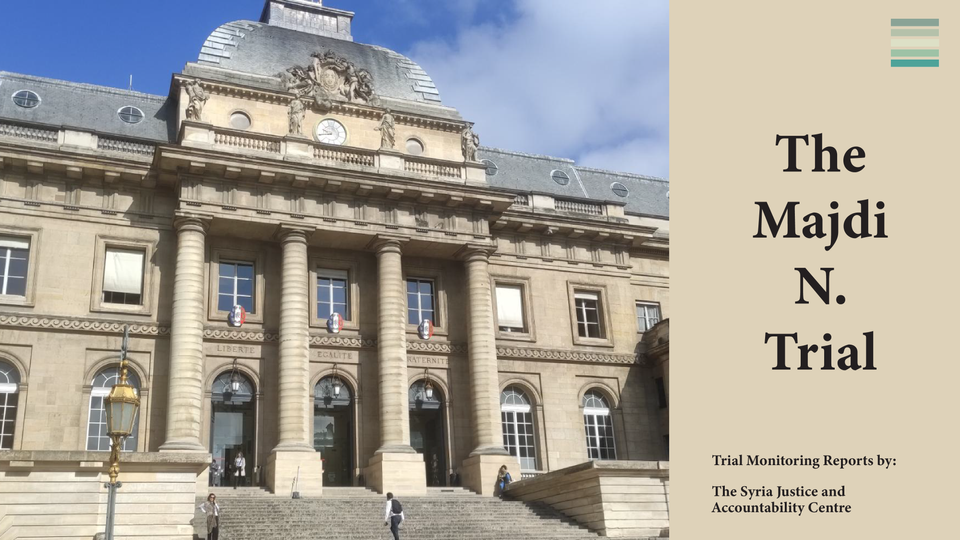
Inside the Majdi N. Trial #29: Interrogation on Majdi N.’s Role in Propaganda and the Recruitment of Minors
TRIAL OF MAJDI N.
Court of Assize – Paris, France
Trial Monitoring Summary #29
Hearing Dates: May 12 and 13, 2025
CAUTION: Some testimony may include graphic descriptions of torture, rape or other violent acts.
Note that this summary is not a verbatim transcript of the trial; it is merely an unofficial summary of the proceedings.
Throughout this summary, [information located in brackets are notes from our trial monitor] and “information placed in quotes are statements made by the witness, judges or counsel.” The names and identifying information of witnesses have been redacted.
[Note: SJAC provides a summary of the proceedings while redacting certain details to protect witness privacy and to preserve the integrity of the trial.]
[Note: Rather than publishing the trial reports of the Majdi N. case in chronological order, SJAC has organized them thematically and coherently based on the content of the hearings, making the material more accessible by highlighting key issues and connections across the proceedings.]
SJAC’s 29th trial monitoring report details parts of days 6 and 7 of the trial of Majdi N. in Paris, France. On these trial days, Majdi N. was questioned about the precise role he had in training camps in rural Damascus and northern Syria. Based on this material, the parties also inquired about the Accused’s knowledge of the presence of minors within Jaysh Al-Islam's ranks. Most notably, a propaganda video showing minors working in a factory producing military clothes was displayed, and the Civil Parties’ Counsel stressed that this also could be considered conscription of children. The Accused was questioned about the case he ought to have built against Jaysh Al-Islam in Turkey, and the Civil Parties’ Counsels suggested that this was duplicity, since Majdi N. declared on other occasions that he would always remain loyal to the group. The Prosecution questioned the Accused about his implication in the work of Jaysh Al-Islam's psychological war unit and, more generally, in propaganda. The Prosecution also inquired about the role of Majdi N. in the Media Office and whether he was the one giving instructions. Majdi N. declared that as a spokesperson, he was always informed about an event after it occurred and was not involved in preparation of any kind. He asserted that he would have left the group had he known about any crimes.
Days 6 and 7 – May 12 and 13, 2025
Proceedings resumed at 4:00 PM.
Civil Parties’ Counsels Questioning of Majdi N.
Counsel Bailly asked the Accused if a spokesperson was an important position, and Majdi N. believed so. Counsel Bailly mentioned a quotation of Zahran Alloush who declared to have sent [outside Syria] the most famous among Jaysh Al-Islam. Counsel Bailly again asked if the role of spokesperson was important, and Majdi N. commented that the question should rather be asked to Zahran Alloush.
Referring to a declaration by the Accused about the importance of a media war, Counsel Bailly asked Majdi N. if he could define this concept. Majdi N. declared that it referred to methods that let the truth resonate. Counsel Bailly then inquired about a document called “Rationalization of Jihadist communication,” which suggested solutions to regain the trust of the people, such as launching a large-scale awareness campaign on three different types of governance. Majdi N. responded that, if he remembered well, the document had nothing to do with Jaysh Al-Islam, and he received it from someone who was a supporter but not a member of the group.
Counsel Bailly referenced a document found on Majdi N.’s computer about the objectives of recruitment, which mentioned a camp for the Aidun [English: returnees; Arabic: عائدون]. Majdi N. explained that it concerned Syrians living abroad, the aim being to bring young Syrians back to their home country. But the plan was not implemented, Majdi N. added. Counsel Bailly described the conditions listed to join the camp, namely that it ought to last 30 days without the people being able to leave, and that the recruit should ideally be single. When questioned why no condition of age was set, Majdi N. said that this went without saying. Counsel Bailly further noted that the ID card of the father had to be provided if the recruit was a minor, deducing [the camps] could accept underaged people. Majdi N. commented that he had seen this conversation [referring to ID cards of fathers] and did not know who was involved in it. He repeated that he saw the recruitment announcement and the first condition for recruitment was age.
Counsel Bailly requested the projection of two videos. The first one, dated December 25, 2012, was an Al-Jazeera documentary on Al-Shafuniyah الشفونية in rural Damascus, in which Majdi N. appeared in a training camp wearing a headband. The voice-over explained that people could come here every two to three months to take a training. Counsel Bailly noted the designation “Zone Commander” and wondered whom that referred to. Majdi N. replied that it referred to Zahran Alloush or to commanders of camps, who usually did not get along well with people from the media sector. Majdi N. added that following this video, the regime launched an intense bombing. That is why the military department within Jaysh Al-Islam did not like to show anything in the media, as it could lead to reprisals, Majdi N. concluded. Presiding Judge Lavergne summarized that this was a propaganda video that enabled the regime to geolocate the camp in Al-Shafuniyah.
The second video created in January 2017 and extracted from Majdi N.’s computer showed a military parade of Jaysh Al-Islam. Majdi N. said he remembered the video. He explained that they had established a cell for whistle-blowers within Jaysh Al-Islam and used this video from Turkey to build a case related to war crimes committed by the group. Majdi N. said that he worked on this file for a year and a half but regretted that the Turkish authorities declared that they could not prosecute a case that had no link with Turkey.
Counsel Bailly noted that children building weapons were visible on the video, and Presiding Judge Lavergne asked the Accused if he acknowledged that. Majdi N. responded that the factory was not Jaysh Al-Islam’s property and that the group had made an agreement [with the factory]. Counsel Bailly understood that Jaysh Al-Islam had a subcontracting agreement with a private company that employed child labor. Presiding Judge Lavergne asked the Accused if he requested explanation from Jaysh Al-Islam when he saw this video. Majdi N. confirmed he questioned the Commander he was usually in communication with, [redacted name], F82, adding that it was the factory that was responsible for these people. When questioned by Presiding Judge Lavergne, Majdi N. said the video was for propaganda purposes and confirmed that he had deduced that the people in the factory were children. Presiding Judge Lavergne wondered what Majdi N. exactly asked to F82, and the Accused said he wanted to know who these people in the factory were. F82’s response was that it was a civilian factory and Jaysh Al-Islam had only signed an agreement with them.
Majdi N. commented that all these conversations were via Telegram, and would prove his innocence, but they were not added to his case file. Majdi N. further explained that he always had been very cautious to keep track of everything, since there were political adversaries. Defense Counsel Kempf intervened to read the request they had sent to obtain the Telegram data [See Trial Report #11 for details by the Chief Investigator W6 on why the Telegram data were not added to the proceedings]. Majdi N. added that conversations available on WhatsApp represented less than 10% of the amount of data on his Telegram account. Prosecutor Havard retorted that W6 had explained how Majdi N. had backed up his Telegram account on January 4, 2020, so that the Defense had access to all his conversations. Majdi N. responded that he sometimes made screenshots but never came to the idea of archiving his Telegram conversations.
Counsel Bailly noted a message in which Majdi N. declared that he would always stand in solidarity with Jaysh Al-Islam and commented that it was contradictory to being a whistleblower. Majdi N. said that once again, he had been misunderstood and regretted that Counsel Bailly presented his role as whistleblower with sarcasm. Majdi N. confirmed he built a case against Jaysh Al-Islam, but until today stood with the group, as well as with other factions of the Syrian revolution, because they defended the people against the worst criminals of this century, such as the regime, ISIS, etc. Counsel Bailly responded that nobody denied that, but there was a contradiction between filing a complaint and remaining loyal, which Majdi N. admitted.
Counsel Bailly explained that article 8-2 (e) VII of the Rome Statute not only banned conscription and enlistment of children into armed forces, but also using them to participate actively in hostilities, as cooks, spies, messengers, etc. Counsel Bailly added that a case law decision dating to July 8, 2009 also included in the definition of child conscription military training in camps that children were not allowed to leave.
Referring to Zahran Alloush’s declaration that he did not care about democracy, Majdi N. argued that the translation was not clear and that he himself had wished to delete this sequence, even though he understood Zahran Alloush’s position regarding the context back then. Referencing [redacted name], F72’s declaration that any spokesperson had a crucial role, Counsel Bailly asked Majdi N. once again if he believed that his role was important. Majdi N. replied that, from the media perspective, it was important.
Majdi N. declared that he did not know the number of people detained or arrested in Ghouta. Counsel Bailly mentioned a conversation in which the Accused said that 2,800 people had been arrested in Ghouta. In the same conversation, Majdi N. asked his interlocutor, his political science professor, for his help in preparing a speech to reassure foreign powers. Majdi N. responded that as a spokesperson, he of course aimed at giving a positive image of Jaysh Al-Islam, and he did ask his professor for advice. Counsel Bailly asked if this was a kind of duplicity, which Majdi N. did not agree with.
Counsel Bailly further referenced a video testimony of [redacted name], F77 [brother of Civil Party [redacted name] W20], in which F77 alluded to this duplicity. In the video, F77 described what he knew about Majdi N.’s trajectory within the group. F77 pointed to Majdi N.’s command of two different discourses, namely the extremist and moderate ones. According to F77, Majdi N. spread hatred and resentment. F77 asserted that Majdi N. recruited a lot of adults and children and carried moral responsibility for certain crimes. He knew the deepest secrets of the group. F77 was himself detained and subjected to torture [by Jaysh Al-Islam]. Majdi N. commented that he did now agree with F77’s view on duplicity.
Counsel Zarka inquired about Majdi N.’s trajectory after he left Ghouta and before he arrived in Turkey. Majdi N. replied that he stayed around two months at [Jaysh Al-Islam's] northern command headquarters without doing anything. He insisted that it was boring there. Counsel Zarka mentioned a conversation between two leaders of Jaysh Al-Islam, including Abu Hamza Al-Raqqi, which showed that Majdi N. spent time in the recruitment centers. When questioned what position he occupied there, Majdi N. responded that Zahran Alloush asked him to take the role of General Supervisor [مشرف عام], and added that there were no children. Majdi N. repeated that the military always had issues with people working in the media, and Zahran Alloush gave him this position to avoid problems.
Counsel Zarka mentioned another conversation Majdi N. had with [redacted name], in which the latter explained that young people were shocked to hear that Majdi N. was the head of the camp. Counsel Zarka noted that Majdi N. was necessarily aware of the presence of young people in the camp. Majdi N. asked what she meant with young people and stressed that the Arabic term Shabab [شباب] meaning young people can also refer to young adults, such as himself.
Proceedings were suspended at 6:50 PM and resumed at 7:10 PM.
Prosecution's Questioning of Majdi N.
Prosecutor Havard inquired about Jaysh Al-Islam’s links to other factions and Majdi N.’s role in propaganda. She first mentioned an article by [Swedish researcher] Aron Lund in which he mentioned that certain factions led by Jaysh Al-Umma rejected Jaysh Al-Islam’s authoritarianism and reported on Zahran Alloush’s declaration that Ghouta could not have “two heads on the same body.” Prosecutor Havard then referred to an article published in the newspaper Al-Quds Al-Arabi on January 4, 2015, in which Islam Alloush announced a purification campaign against the corruption of Jaysh Al-Umma, which manifested through crimes, trafficking, etc. Majdi N. responded that if it was written in quotation marks, it meant that he had said that. Prosecutor Havard mentioned the conversation with [redacted name] about the arrest of 1,400 members of Jaysh Al-Umma, and Majdi N. said that it seemed correct.
Prosecutor Havard noted that this attack was a decision made unilaterally by Jaysh Al-Islam even though a unified military command was established in August 2014. Prosecutor Havard wondered what the purpose of establishing unified, collegial bodies was, if Jaysh Al-Islam ultimately disregarded them. Majdi N. responded that he was in Turkey at that time and had no details and added that it was normal for him to communicate about the event. Prosecutor Havard also noted that Jaysh Al-Islam had closed all exits from Ghouta to block access to external support for Jaysh Al-Umma, and Majdi N. had no comment on that.
Prosecutor Havard also mentioned a conversation in which Majdi N. declared that they had conducted good work on intelligence and deduced that Majdi N. was well informed about how the attack had been organized. Majdi N. responded that his participation was after combat, and like always, he learned about an operation after it occurred. Prosecutor Havard further mentioned a statement of [redacted name], in which he declared that Jaysh Al-Umma’s fighters surrendered and were killed in the streets out of revenge. Majdi N. said he was in Turkey at that time and could not respond.
Regarding a conversation recording between [redacted name] and Majdi N., Prosecutor Havard noted the Accused’s declaration on Jaysh Al-Islam’s intent to delegate the management of the cities under their control to civil bodies. However, Jaysh Al-Islam was confronted with two issues related to ideology and criminality, which Majdi N. illustrated with the fact that a battalion of around 70 people committed sodomy. Majdi N. retorted that what was permissible here in France may be a criminal offense in another country, confirming that homosexuality was a crime at that time even under Syrian law. Presiding Judge Lavergne asked if people were executed based on this accusation, which Majdi N. did not know, since he was not a lawyer.
Prosecutor Thouault referenced two videos shared by the International, Impartial and Independent Mechanism (IIIM) dated December 1 and 8, 2012 in which Majdi N. appeared as spokesperson. She noted Majdi N.’s statement to the Investigative Judge in which he declared that he defended Jaysh Al-Islam against critics, and asked if Majdi N. worked with a psychological war unit to fulfill his task. Majdi N. confirmed, specifying that this unit was headed by a psychiatrist, and aimed at undermining the regime’s moral foundation and persuading his troops to surrender without fighting. When asked if this task could include the transmission of false information, Majdi N. said that he did not exclude that possibility.
Prosecutor Thouault mentioned an interview of a member of this psychological war unit shared by the French Human Rights League (FHRL). The member explained their mission of surveillance of four different actors, namely Syrian regime media entities, Jaysh Al-Islam, civilian publications, and armed groups. This person also mentioned the existence of a Telegram group which gathered around twenty leaders of Jaysh Al-Islam, including Majdi N., who responded that he did not remember. Prosecutor Thouault expressed her surprise about Majdi N.’s declaration in Court that he benefited from freedom in his role as a spokesperson. Majdi N. clarified that on the military aspect, he was free to share the information he received. However, on political issues, he was limited by Jaysh Al-Islam’s leaders. Prosecutor Thouault asked if anyone could give Majdi N. orders, and Majdi N. responded they could rather tell him to avoid specific subjects. Majdi N. explained that concerning military topics, he had room to maneuver but could show no initiative. He also mentioned that [redacted name], his deputy, used to redact the press releases.
Prosecutor Thouault then mentioned several messages retrieved from Majdi N.’s computer which showed that he was giving instructions and, notably, asked to read releases before their publication when some acts could be considered war crimes. Prosecutor Thouault asked if the Accused confirmed his general role of controlling releases. Majdi N. said he did not consider it an important task, but was rather giving advice. When asked why he remained spokesperson of Jaysh Al-Islam after having learned about such crimes, Majdi N. said he tried to take a different direction. Concerning war crimes, he tried to alert people about the fact that the use of certain words could allude to such violations. Prosecutor Thouault summarized that there were no war crimes, but only the way they were presented could suggest so, which Majdi N. confirmed.
Prosecutor Thouault inquired about Majdi N.’s role in the production of propaganda videos. Majdi N. said that he did not participate in every propaganda video and had no role in drafting the text. When questioned if the morale of combatants was important to win a war and, as such, media played a key role, Majdi N. said he believed so. Prosecutor Thouault noted Majdi N.’s suggestion to Zahran Alloush to have a television channel specifically for Jaysh Al-Islam, and asked the Accused to comment on this project. Majdi N. declared that this Court proved there was a shortcoming in media coverage. The group was not defending itself sufficiently when under attack. Majdi N. insisted that all information the Prosecution had found on the case came from the media. Prosecutor Thouault retorted that they had a disagreement on freedom of speech, and Majdi N. became irritated, asserting that he was among the most fervent defenders of freedom of speech. However, the media had the aim of conveying political messages. “As for the politicization of justice, I am against it,” Majdi N. concluded. When asked by Presiding Judge Lavergne to clarify, Majdi N. declared he found problematic the use of media content as judicial evidence. Prosecutor Thouault retorted that the rules of evidence are flexible in France, and Majdi N. should become Parliamentarian if he wished to change that.
Prosecutor Thouault asked if Majdi N. recognized himself in the portrayal of someone ready to defend his group at all costs, no matter what happens on the ground. Majdi N. repeated that he would have left the group and certainly would not have defended them, had he known the accusations were true. He added that one could not be certain of information communicated by [other] factions, taking the example of someone who wrote that Majdi N. was a jailer in Sednaya, which led to half the Syrian population believing that it was true. Majdi N. said that even NGOs relied on testimonies because they had nobody on the ground. Prosecutor Thouault commented that everyone was lying, except Majdi N., of course.
Proceedings were suspended at 8:33 PM, and the interrogation of Majdi N. resumed on May 13, 2025 at 11:55 AM.
Defense Counsel’s Questioning of Majdi N.
Counsel Ruiz reminded the Court of the charges brought against Majdi N. He then asked the Accused why he had written a résumé. Majdi N. responded that his aim was to be recruited in a research center, and as such, to show that he had close access to the field. Counsel Ruiz asked Majdi N. if he thought highly of himself, and Majdi N. replied that anyone writing a résumé had to present himself well to prove his abilities for the role. It was like the role of giving a good image of Jaysh Al-Islam as a spokesperson, Majdi N. continued. When questioned about the importance for an armed faction to have a good image abroad, Majdi N. said that without support, Jaysh Al-Islam would have stopped its activities. Money was used to buy weapons and logistical materials to defend Syrians against the regime.
Counsel Ruiz asked if Majdi N. intended to participate in the preparation of war crimes by giving his voice and identity to Jaysh Al-Islam. Majdi N. said that as far as he knew, no crime was committed and planning operations was not his mission, since a spokesperson speaks about facts after they occur. Counsel Ruiz asked if Majdi N. once received information about a crime Jaysh Al-Islam intended to commit, which Majdi N. strictly denied. Referring to Majdi N.’s testimony that he received around a hundred insults a day, Majdi N. said he first always tried to understand the people’s anger and answer politely, and second internally asked Jaysh Al-Islam for information on which he based his. Counsel Ruiz mentioned the fact that Majdi N. sometimes heard through walkie-talkies the military advances of Jaysh Al-Islam and asked the Accused if he agreed that fights between soldiers were not war crimes. Majdi N. shared this view.
Shifting to Jaysh Al-Islam's organizational chart, Majdi N. said that he worked with the Moral Guidance Office and that this department was also responsible for IT. Counsel Ruiz noted that 90 people were working in this department and wondered what the point was of having a spokesperson distinct from this department. According to Majdi N., the spokesperson had to be outside military zones, and the studios were in Turkey.
Counsel Ruiz noted that military information was not necessarily shared with everybody, and Majdi N. confirmed each section worked separately and added that he had direct communication with [redacted name], F82 and the General Command. Counsel Ruiz mentioned the existence of a section dedicated to recruitment and jihadist training, and Majdi N. confirmed that he did not work there.
Counsel Ruiz inquired about the recruitment campaign targeting the Aiduns [عائدون i.e. Syrians abroad who came back]. Majdi N. declared that there were Syrians who left the country and wanted to come back to participate in the revolution but had no resources to do so, so Jaysh Al-Islam intended to help them financially. Majdi N. said he could not remember a declaration aiming at recruiting children under 15. When asked about the existence of camps for minors, Majdi N. said he did not know of such a thing and added that the first condition written on recruitment posters was to be above 18. Regarding the Arabic term “Shabab,” Majdi N. repeated this was a common term referring to men, and not children.
Counsel Ruiz wondered if Majdi N. had sufficient religious authority to give speeches in mosques, or if it was the Imam’s prerogative. Majdi N. said he was not an imam and never gave sermons in mosques or anywhere else. Counsel Ruiz also noted that Majdi N. was not the most fervent believer the world had known. Majdi N. added that he only went to the mosque on Fridays, in uniform.
Proceedings were suspended at 12:38 PM.
___________________________
For more information or to provide feedback, please contact SJAC at [email protected] and follow us on Facebook and Twitter. Subscribe to SJAC’s newsletter for updates on our work