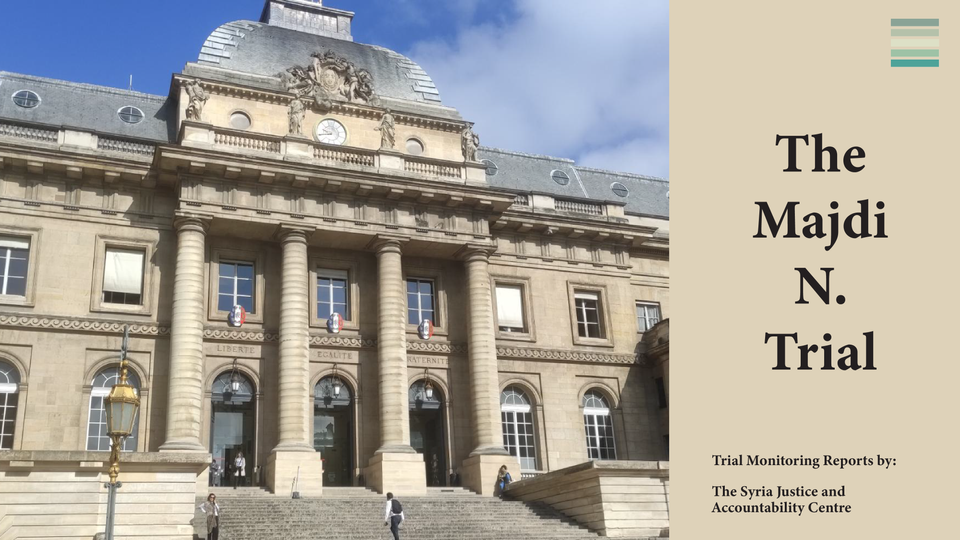
Inside the Majdi N. Trial #27: Testimony of Civil Party on Detention and Child Recruitment
TRIAL OF MAJDI N.
Court of Assize – Paris, France
Trial Monitoring Summary #27
Hearing Date: May 19, 2025
CAUTION: Some testimony may include graphic descriptions of torture, rape or other violent acts.
Note that this summary is not a verbatim transcript of the trial; it is merely an unofficial summary of the proceedings.
Throughout this summary, [information located in brackets are notes from our trial monitor] and “information placed in quotes are statements made by the witness, judges or counsel.” The names and identifying information of witnesses have been redacted.
[Note: SJAC provides a summary of the proceedings while redacting certain details to protect witness privacy and to preserve the integrity of the trial.]
[Note: Rather than publishing the trial reports of the Majdi N. case in chronological order, SJAC has organized them thematically and coherently based on the content of the hearings, making the material more accessible by highlighting key issues and connections across the proceedings.]
SJAC’s 27th trial monitoring report details day 11 of the trial of Majdi N. in Paris, France. On this trial day, Civil Party W21 declared to having seen Islam Alloush with a Jaysh Al-Islam delegation in Eastern Ghouta at the end of 2012 or the beginning of 2013. Moreover, W21 was detained three times by Jaysh Al-Islam and described his experience in prison. Most notably, W21 met Zahran Alloush during his third period of detention. Concerning child recruitment, W21 testified that he knew two boys of his neighborhood under 15 years old who had been trained by Jaysh Al-Islam and joined the group. Two of W21’s cousins, aged 14 and 16 years old, also joined the group. W21 further described how Jaysh Al-Islam commander Issam Al-Buwaydani once visited him at his home for propaganda purposes.
Day 11 – May 19, 2025
Morning Session
Proceedings began at 9:45 AM.
[Redacted name], W21 was born in , Eastern Ghouta and worked in documentation and journalism. During the revolution, he was detained for 10 days by the Syrian regime in Branch Al-Khatib. He was displaced by force out of Ghouta on April 1, 2018 [after an agreement between the regime and the armed factions]. W21 now works with [redacted information]the Syria Center for Media and Freedom of Expression (SCM).
Presiding Judge Lavergne’s Questioning of W21
In W21’s view, one could either be with or against Jaysh Al-Islam. W21 reported that he used to document and share on social media all that happened in Ghouta, and that did not please military factions, which arrested him several times. For its part, Jaysh Al-Islam arrested him three times.
At the end of 2012 or the beginning of 2013, W21 took part in a meeting in [redacted location] with a delegation of Jaysh Al-Islam first rank leaders, particularly [redacted name], commander of Jaysh Al-Islam, and [redacted name]e meeting’s objective was to send a message to the town’s important figures and to have the masses on their side. Many people attended the meeting, and it was the first time people saw Islam Alloush. W21 had already seen his face on social media and confirmed the Accused present in Court was the person he saw that day. W21 declared that Islam Alloush oversaw trainings at Jaysh Al-Islam, was responsible for the Media Office, and was the group’s spokesperson. W21 testified that he knew this information from Majdi N. himself, who used to present himself this way, and from Majdi N.’s assistant, [redacted name], F30, who was W21’s cousin on his father’s side. Islam Alloush used to keep activists under surveillance, chase them down, and arrest them, W21 added.
Presiding Judge Lavergne asked if there was a service in charge of surveillance which tracked online activists and the content of their posts. W21 confirmed, but did not know where the service was located. W21 knew two people who worked there, F30 and [redacted name], F31.
W21 testified that Jaysh Al-Islam stole much of his equipment and personal belongings. Within one and a half days, W21 recalled, they searched his house 17 times. W21 was arrested in 2013 and in 2014 and brought each time to the At-Tawba prison, where he was detained for less than a day. The third time, he was detained in several places for around 14 days. Blindfolded and handcuffed, W21 had no idea where he was brought and could only see where he was after 14 days. As such, W21 could not locate where he had been detained. After his first arrest, they released him, saying they had made a mistake with his name.
W21 was only subjected to violence at the time of his arrests. He considered it a warning to stop him from publishing online any further. W21 could not date his first two arrests but remembered the third one occurred on June 30, 2015, while he was covering a demonstration in [redacted location] in which civilians urged Jaysh Al-Islam to release their family members. Presiding Judge Lavergne wondered if W21 recalled the signs protesters were holding up. W21 did not, but he had taken pictures of them. W21 reported that Jaysh Al-Islam did not crack down on the demonstration but punished W21 and broke his material while he was filming. Civilians defended him, but W21 had to give them the video.
Questioned about the conditions of one of his arrests, W21 described that Jaysh Al-Islam fired shots at his door and searched his house, pulling him out. They beat him all over, put him in a vehicle, and continued hitting him until they reached the detention center. W21 knew several of the people who arrested him because they were from his region and remembered to have heard one of them saying, “[redacted name], we’ve brought him back!”—[redacted name] was the leader of Jaysh Al-Islam, W21 commented. That time, they arrested both W21 and his father. W21 confirmed he then learned that he had been arrested by Jaysh Al-Islam.
Presiding Judge Lavergne inquired about W21’s detention, and the Civil Party emphasized that Jaysh Al-Islam used exactly the same method as Assad. When W21 arrived in prison, they stripped him, told him to get down, squat, and then stand back up. After that, they dressed him again but tore off a button from his pants and put a hood over his face. Presiding Judge Lavergne asked whether these acts could be qualified as torture. W21 reported that they tortured him and beat him very violently. From the moment he was arrested until the 14th day, he was interrogated and subjected to violence. He had no fractures or injuries, but it was really very violent, W21 testified.
During interrogation, W21 reported, he was asked about his documentation of demonstrations, whom he gave his documents to, and why he worked with Razan Zeitouneh, F21. He was also asked about Souad Khabiyeh, a journalist who lived outside Syria. To gather information about his work, W21 continued, they opened his computers and accessed W21’s accounts with his passwords. W21 added that they even contacted people from W21’s networks. Replying to Presiding Judge Lavergne, W21 denied having been accused of homosexual relations but testified that they shared all sorts of accusations against someone on media, to then be able to kill him. The three accusations brought [against W21] were to have attempted to assassinate a leader of Jaysh Al-Islam, to have contact with Jahbat Al-Nusra جبهة النصرة and ISIS, and to be secular and an unbeliever. Each accusation had no connection with the other, W21 stressed.
Regarding places of detention, W21 affirmed he was first in At-Tawba. Then, his inmates in a collective cell informed him they were in Al-Kahf. At another occasion, the jailer who put him in his cell told W21 he was in Al-Batoon.
Presiding Judge Lavergne inquired about the state of the prisoners. All categories of ages were represented, W21 recalled, mentioning a prisoner who was 70 years old and another who was almost 20. W21 also saw no children in detention. The people who beat him were young, he added, and among the ones who arrested him, some W21 knew from his village were around 15 or 16 years old. In Jaysh Al-Islam's prisons, W21 emphasized, “all were young.” W21 said he could not forget a 20-year-old prisoner whose ribs had been broken and who could not breathe properly.
W21 recalled that he was detained less than a day in a collective cell and did not speak much with the other inmates there. He described that he was the seventh one to be placed in this cell, which was two square meters in size. W21 was then transferred to an individual cell that was so small that he could not lie down without bending his legs, and even like that, he had to be careful in case they opened the door.
Presiding Judge Lavergne asked if W21 was afraid of dying, which W21 affirmed, saying they played on his nerves and psychologically intimidated him. The guard told him, “People who come here never leave.” W21 reported torture, beatings, a lack of food, and small dark rooms. To block out all light and air, they hung a blanket [over the door]. The smell was nauseating, and it was very hard to breathe, W21 recalled. It was all mentally exhausting and depressing. When they took him out for interrogation, W21 continued, he was actually happy, because he could get a bit of air in his lungs. But when he came back, he was exhausted and beaten up. In interrogation, he could catch his breath, but right after that moment of relief, they would beat him again.
Presiding Judge Lavergne referred to W21’s hearing with the Investigative Judge, in which he relayed that his head had been shaved. W21 confirmed that as soon as someone was arrested, they would shave off his mustache, a symbol of masculinity and dignity, and give him a bald head. When they shaved W21’s mustache, W21 recalled, he would put his tongue under his lip, to make it easier for them and show them that he wasn’t bothered, so they also shaved his head. W21 asked if they could shave his beard too. The man responded, “We don’t shave the beard in Sunni tradition!” and insulted him. W21 said he didn’t pray the first few days and was not very religious. The Civil Party laughed in Court.
W21 thought he would never have been released without the pressure from social media. During his detention, W21 felt they were about to execute him. Before his release, W21 was allowed to wash himself, and was taken to an interrogation with Zahran Alloush, who insulted him while another one kept on beating him. W21 belonged to a family of 5,000 members, and Zahran Alloush told him that Jaysh Al-Islam had 15,000 members and could decimate them. W21 was surprised to see a Sheikh talking like that and employing such insulting terms. W21 was handcuffed, and when this interrogation began, they took off what was covering his head. That’s how W21 recognized Zahran Alloush, who talked for 30 minutes and told W21 he could do to him what he had done to Abu Ali Khabiyeh أبو علي خبية, F34. Responding to Presiding Judge Lavergne, W21 said that he then signed around 20 to 30 documents without seeing their content. W21 was promised amnesty on the condition to not publish on social media anymore.
W21 reported that shortly after his release, he was injured because of airstrikes and had to undergo surgery. While he was recovering at his home, commander Abu Issam Al-Buwaydani, who had since become head of Jaysh Al-Islam, came to visit him. Jaysh Al-Islam had surrounded the neighborhood. W21 said he was scared to death and laughed nervously. Wounded, in bed, he couldn't do anything. Al-Buwaydani entered, took a picture with W21, to show they were open-minded even toward people who criticized them. Presiding Judge Lavergne asked if that was a scam only aiming at giving themselves a good image, and W21 agreed on this interpretation.
Presiding Judge Lavergne asked W21 if he attended public executions, which W21 had not, explaining he had left [redacted location] for the center of Eastern Ghouta that was not under control of Jaysh Al-Islam, but of Faylaq Ar-Rahman فيلق الرحمن. Presiding Judge Lavergne asked if W21 saw people put in cages. W21 said it was a well known story, but he himself did not see them since he was forbidden from going to Douma. Still, many people from W21’s region saw the scene and told W21 about it, even before it was covered by the media.
Questioned about child recruitment, W21 affirmed he was 100% sure it existed in his region. People between 14 and 17 years old were in Jaysh Al-Islam’s offices and army. W21 mentioned one of his neighbors called [redacted name] who lived next door. He was a small boy aged 13 years old, and underwent a training course. When he came back, he wore a rifle that was as tall as him. W21 recalled another neighbor, F31, who was 14 years old and worked at the Media Office of Jaysh Al-Islam. W21 also mentioned two brothers from [redacted name] family who were aged 14 and 16 when they became combatants in Jaysh Al-Islam.
W21 reported that F31 died while serving for Jaysh Al-Islam. W21 posted a video on what had happened to F31 on his YouTube channel, adding that he used to publish all news of [redacted location] on this page consulted by expatriates. Several posts concerned teenagers under 18 years old who had died in the ranks of Jaysh Al-Islam. W21 testified that Jaysh Al-Islam considered that a man aged 18 was worth more than ten men aged 25 or older. Jaysh Al-Islam recruited boys aged 13 to 14, trained them on Sharia and combat, W21 declared, and they came back completely brainwashed [مغسول رأسه].
Presiding Judge Lavergne wondered why young people engaged in Jaysh Al-Islam. W21 alluded to the lack of food and basic products during the siege, while Jaysh Al-Islam was a wealthy faction that gave a salary and even food packages to their recruits. Presiding Judge Lavergne inquired about the brainwashing W21 had just mentioned. W21 felt each person who joined Jaysh Al-Islam stopped using his brain. W21 also mentioned threats he received from his cousin [redacted name], F30, who worked for Islam Alloush. Presiding Judge Lavergne asked how W21 knew his cousin worked for Majdi N., and W21 replied with a Syrian expression meaning “he could not see the forest for the trees.”
Presiding Judge Lavergne referenced a video showing a training center of the Moral Guidance Office مكتب التوجيه المعنوي. In response, W21 recalled he had posted a publication asking for Jaysh Al-Islam to liberate two of his underaged cousins, and Jaysh Al-Islam had replied with a video released a day after the 18th birthday of W21’s cousin, explaining W21 was a liar because this one cousin was 18 years old. The second cousin also appeared in the video, W21 continued, and it was obvious he was making statements under threat and was just a child. The boy said he was working with a military faction distributing food and fuel in Ghouta, but in reality, W21 testified, his family had nothing to eat.
Presiding Judge Lavergne wondered how people survived famine. W21 testified that people sometimes ate nothing for two or three days, and planted vegetables in their homes. Many people died of hunger, and W21 published articles about that. W21 confirmed Jaysh Al-Islam had food stocks and convinced people to join them through blackmail—if you came, you got food.
W21’s testimony was suspended at 11:19 AM for the hearing of expert psychiatrist E3 [See Trial Report #8]. Proceedings resumed at 1:30 PM.
Civil Parties’ Counsels Questioning of W21
Upon Counsel Bailly’s request, a video of a demonstration in [redacted location]ing signs with slogans such as “Tired of the Shabiha [Syrian militias loyal to Assad] and tired of the Sheikh of discord—where are the real men?” or “We want the detainees to come back.” W21 explained that the expression “Sheikh of discord” referred to Zahran Alloush. At the end of the video, W21 was assaulted while filming, and Jaysh Al-Islam seized all his equipment and never gave it back to him.
Counsel Bailly then read a speech from 2014 by Zahran Alloush in which he described the prison system he wished to establish in Jaysh Al-Islam. Zahran Alloush declared that the At-Tawba Center was both a security service and a prison and was similar to the Palestine Branch. He added that they tried to ensure that the prison would be seen as a message and made a point of respecting prisoners' rights. Zahran Alloush concluding by saying that prisoners who leave Jaysh Al-Islam prisons are in good health.
Counsel Bailly commented that Zahran Alloush drew inspiration from his own experience in Assad’s jails, vowing not to replicate the same abuses. Counsel Bailly also noted how he outlined the rights of detainees—at which the Civil Party burst into laughter—such as the right to eat, drink, and relieve themselves, etc. W21 stressed Zahran Alloush had not mentioned Al-Kahf or Al-Batoon. Good treatment existed nowhere, W21 emphasized, mentioning beatings, blows, lack of food—and when they did serve something, it was expired and inedible. W21 recalled spending a day in a collective cell with a young man, about 20 years old, who could barely breathe after all the beatings—he was dying, W21 insisted. Every person who was interrogated had to go through beatings. People were there to be tortured, plain and simple, W21 affirmed.
Counsel Bailly asked if shaving off hair and mustaches was a form of humiliation, and W21 explained the mustache was a symbol of dignity and, while cutting it off, they often said, “We’ve stripped you of your dignity.”
Counsel Bailly wanted clarification on W21’s arrest by Jaysh Al-Islam. W21 stressed they beat and trampled him while he was in his bed, injured, and Counsel Bailly said that it reminded him of the film Silvered Water ماء الفضة [that had been displayed in Court]. Questioned about his cell, W21 reported that he stayed there for 13 days and could not even see his own finger. There was no air circulation at all, he repeated. They put some kind of thick blankets over the hinges to keep light and air from getting in. W21 couldn’t even lie down properly, and still, they had even put a kind of pot there to use as a toilet. W21 drank water out of the pot, with a large cup he also used when he relieved himself. For interrogations, they would take him through some kind of tunnel to another prison, W21 recalled.
Replying to Counsel Bailly, W21 mentioned two days when they did not bring him anything to eat, and later, they finally brought something expired that was a very small portion. The food was terrible, W21 emphasized. W21 said sarcastically that what Zahran Alloush described in his speech must have been a hotel rather than a prison. To W21, there was no doubt Islam Alloush was informed, since he was a commander [من قيادة جيش الاسلام], and one of his missions was to polish Jaysh Al-Islam’s image.
Counsel Bailly inquired about the reasons beyond people’s arrests and W21 relayed the well-known story of a Syrian of Palestinian origin, [redacted name], whom Jaysh Al-Islam accused of being a sodomite. They threw him off a tower, because that was the punishment for homosexuals. W21 confirmed those accusations were fabricated to justify his execution. Counsel Bailly signaled that another witness in the case, [redacted name], alsoed that story, and could not be at the trial because he went back to Syria. W21 recalled that, after his release, he realized that Jaysh Al-Islam had justified his detention with the accusation of having attempted to assassinate a commander of Jaysh Al-Islam. But during his interrogations, they only questioned him about his activity related to documentation, W21 realized. W21 believed that they wanted to execute him and prepared an accusation to justify it. When questioned about his feelings when he met Zahran Alloush, W21 replied that his heart stopped beating.
Counsel Bailly then referenced an article in Arabic that was translated into French. The article mentioned a man called [redacted name], F79, [redacted information]the National , who had demanded the release of detainees held by Jaysh Al-Islam, particularly W21, as well as all others who had committed no crime. Islam Alloush reportedly denied via a tweet the arrest operation [against W21, among others] in Rif Dimashq and any violations committed by Jaysh Al-Islam, adding that Sheikh F79, was portraying himself as an angel of mercy by calling for the release of detainees.
Questioned about the reason Islam and Zahran Alloush denied his arrest, W21 replied it was to save time before the next press release. W21 confirmed it amounted to methods of organized crime, in which one person committed the crime, and the other covered it up.
Upon Counsel Bailly’s request, the picture taken during Issam Al-Buwaydani's visit to W21 was displayed. W21 commented he still bore the scars of his wounds at that time. When Al-Buwaydani had entered, he did not knock at his door and did not inquire about W21’s health, he just wanted to take photos to post on social media and pretend he cared about his opponents, W21 relayed. W21 believed he would be detained and was in a total panic.
W21 confirmed that polishing Jaysh Al-Islam’s image was important to obtain financial support. W21 declared that Jaysh Al-Islam members always wore military uniforms, and the uniforms differed between commanders and high-ranking officials.
Counsel Zarka inquired about Jaysh Al-Islam’s accusation campaigns in the media, and W21 affirmed they were common. Counsel Zarka asked if their aim was the death of the targeted individuals. In reply, W21 asserted that given the accusation brought against him, he was tortured in a different way. In the end, since they could not prove anything, they accused W21 of being an unbeliever and secular. W21 stressed that almost all Arab media channels published articles about his arrest, and in certain areas of Syria, people protested to demand his release. W21 believed he was finally released because of the scale of this media campaign. W21 concluded their objective during his imprisonment was to find something to condemn him to death.
W21 reported that he stopped using social media for around five to six months after his release and repeated they confiscated his equipment and made him sign agreements stating that he would never publish anything again. A patrol would pass around his house to remind him that they were always watching. Counsel Zarka wondered if W21 agreed with the expression “media army” used by witness [redacted name], W12 [see Trial Report #16], and W21 agreed—whenever he posted something about Jaysh Al-Islam, he received insulting comments and threatening letters.
Counsel Zarka referred to a propaganda document found on Majdi N.’s computer entitled ‘key talking points for interviews.’ W21 commented the commanders of Jaysh Al-Islam conducted this task together. He considered Islam Alloush a leader and stressed he was given that name because he was very close to Zahran Alloush. In Jaysh Al-Islam, anyone who carries the kunya Alloush is very important, W21 emphasized. Islam Alloush issued statements in classical Arabic that were completely different from what was actually happening in the prisons. There are even people who are still incarcerated, W21 added.
Prosecution's Questioning of W21
Prosecutor Havard asked if W21 remembered the reason for his arrest. W21 responded that as soon as he posted an article about detention centers, Jaysh Al-Islam came to arrest him, adding that anyone who published something that did not align with their narrative got arrested immediately. It happened as early as 2013, and public denunciations about the existence of prisons where Jaysh Al-Islam hold civilians already emerged at that time.
Regarding the demonstration W21 covered in June 2015, Prosecutor Havard quoted Majdi N.’s statement that people appearing in pictures and videos were relatives of ISIS members. W21 commented that among the detainees was his cousin who was accused of theft but was innocent, and had only spoken about Jaysh Al-Islam. His cousin’s mother participated in the demonstration [to urge for his release], like many other women, but W21 could not tell who they were, since they covered their faces. On the day of W21’s arrest, Zahran Alloush liberated around 20 people of W21’s town after a general amnesty. Prosecutor Havard commented he might have needed space.
Prosecutor Havard referred to a witness testimony heard during week three [May 12 to 16, 2025] of the trial in which he explained that civil organizations left Ghouta to regions under control of other factions because the pressure exerted by Jaysh Al-Islam was too strong. W21 replied he himself also left his town to go to such a place, and confirmed people could no longer bear the pressure.
Prosecutor Thouault referred to Majdi N.’s communications in classical Arabic and wondered if he had special credit because of his command of the language, which W21 confirmed. They would choose someone who mastered classical Arabic to work in the media.
Prosecutor Thouault mentioned an interview dated September 18, 2015 in which Majdi N. was asked about the protests in Ghouta, and he had claimed that the number of people was very low, since only about 2,000 people actually protested, whereas the population of the Ghouta was between 600,000 and 1 million people. Majdi N. added that freedom of expression was a healthy phenomenon, and Jaysh Al-Islam let people express themselves freely. “Absolutely not!” W21 replied. On the first day of the protests, not many people showed up because they were scared, W21 emphasized. On the second day, more people came, and on the third day, Jaysh Al-Islam attacked W21. Their aim was not just to repress a protest, but to accuse people wrongly and exterminate them.
Prosecutor Thouault described how, upon W21’s release, he was presented to Zahran Alloush and then taken to a large space with people from Jaysh Al-Islam and the media, where they declared that Jaysh Al-Islam supported W21’s release. W21 repeated he did not know the content of any of those papers he signed and confirmed Zahran Alloush interrogated him after he had just been beaten.
Prosecutor Thouault mentioned a publication by [redacted name] on July 11, 2015 of a photo of her nephew [redacted name] who had been killed by Jaysh Al-Islam and bore clear marks of torture on his body. She reported that Majdi N. responded with a tweet commenting that it was in prevention of an assassination attempt by [redacted name] on a commander. Majdi N. ended his tweet writing that Jaysh Al-Islam would continue to pursue criminals. W21 reported that the Unified Judicial Council once convicted some members of Jaysh Al-Islam for assassination of opponents, but Jaysh Al-Islam refused to carry out the execution. The easiest way for Jaysh Al-Islam to justify an assassination was for a Sheikh to issue a fatwa, and W21 mentioned the example of Sheikh [redacted name], who was condemned by the Unified Judicial Council.
Prosecutor Thouault mentioned a photo taken after the release of a doctor who used to criticize Jaysh Al-Islam [likely [redacted name], see below]. W21 knew him personally and affirmed the doctor was arrested at his home and then tortured. Prosecutor Thouault referred to an article published by Enab Baladi on W21’s arrest, in which Majdi N. completely denied Jaysh Al-Islam’s involvement and asked those behind it to explain the reasons.
Defense Counsel’s Questioning of W21
Counsel Ruiz started by stressing that W21, like most witnesses at the present trial, had spoken quite briefly about Majdi N., and reminded what exact charges were brought against the Accused [Trial Report #1 Counsel Ruiz wondered if among all the documents he gathered, W21 possessed any video, post, or tweet of Majdi N. announcing the upcoming commission of a war crime. W21 mentioned the statements Majdi N. published on his pages denying W21’s arrest and stressed there were photos and statements that prove the truth of these arrests. Counsel Ruiz insisted those posts were subsequent and explained that what the law required was a declaration before the commission of a crime. W21 responded Majdi N. was an accomplice and repeated he knew people under 15 years old who joined Jaysh Al-Islam. Counsel Ruiz concluded W21 had no elements dated prior to the crimes in which Islam Alloush announced their commission.
In the same vein, Counsel Ruiz asked if W21 possessed a video, a post, or a tweet of Majdi N. inviting children aged under 15 to enroll in Jaysh Al-Islam. W21 laughed, and mentioned a video where Majdi N. appeared as a trainer and affirmed he trained minors. W21 again mentioned F30 and F31. Counsel Ruiz repeated his question. W21 repeated he was sure that Majdi N. trained children and quoted a Syrian proverb meaning that those who live in an area are certain of what happens there.
Counsel Ruiz asked if W21 heard Majdi N. preaching. W21 responded that Majdi N. justified W21’s detention, so he participated in this crime. Counsel Ruiz noted that the post by Majdi N. on W21’s arrest was not signed by the Accused, and asked for a new translation by the interpreter. Concerning Dr. [redacted name], Islam Alloush had issued a statement saying that Jaysh Al-Islam was not responsible, so he was denying the crimes, W21 argued. W21 repeated he had seen Islam Alloush only once in [redacted location] with a group of people who talked about Jaysh Al-Islam.
Regarding W21’s statement to the Investigative Judge about a sermon at the [redacted name] mosque in [redacted location], Counsel Ruiz noted that he did not mention Majdi N. addressing people to recruit them. W21 insisted that he did mention that, and Counsel Ruiz remarked that W21’s testimony had slightly evolved.
Presiding Judge Lavergne read the French translation of the letter dated July 1, 2015 stamped by the Jaysh Al-Islam Security Directorate, which stated that W21’s arrest was linked to a failed assassination attempt on one of Jaysh Al-Islam's commanders in [redacted location] and an attack on a Jaysh Al-Islam checkpoint between [redacted location] and [redacted location]. The letter stated that the investigation was ongoing, and that the case was to be transferred to the judiciary. It was added that no connection existed between W21’s profession as a journalist and his arrest.
Presiding Judge Lavergne commented that Jaysh Al-Islam could not arrest journalists without consent of the Unified Judicial Council. Counsel Ruiz repeated that the document was not signed by Majdi N. Prosecutor Thouault intervened to stress W21 had never pretended that this document had been signed by Majdi N. Counsel Ruiz retorted that W21 just did.
Counsel Ruiz mentioned posts signed by Majdi N. which W21 had stored on a computer that was now broken and inquired if he managed to retrieve them. W21 stated he still had the hard drive, but could not repair it. W21 stressed he provided links for the Investigative Judge to verify them, but they turned out to be disabled. Counsel Ruiz said Majdi N.’s Facebook and Twitter accounts were still active and wondered why only the tweet related to W21 would have been deleted, since Majdi N. deleted nothing. W21 replied that, on the contrary, Jaysh Al-Islam removed many online posts, and W21 said he contacted many people to get the one displayed in Court today.
Counsel Ruiz quoted W21’s statement that Jaysh Al-Islam did not openly declare that they were looking for recruits. W21 responded that they published Anashids [Islamic vocal music or chants] to attract people, and everybody knew that they sought to recruit. W21 repeated that he was personally arrested and beaten by minors. The law requires concrete evidence that showed a public declaration made by Majdi N., Counsel Ruiz emphasized. If Jaysh Al-Islam recruited children, Majdi N. was involved too, W21 believed. Counsel Ruiz explained that to be part of the group was not sufficient, and added that no one pretended that Majdi N. was not in Jaysh Al-Islam.
Counsel Ruiz quoted W21’s words that there was no repression of demonstrations, to which W21 retorted that his arrest in itself was a pressure on the people. The fact that they shot at his door, dragged him out of bed, tortured people, etc. was a way to terrorize people [إرهاب للناس] and make sure protests would not happen again. Counsel Ruiz inquired about Majdi N.’s involvement prior to these protests and in the perpetration of possible war crimes. W21 repeated Jaysh Al-Islam first denied his arrest, before recognizing it.
Presiding Judge Lavergne asked Majdi N. if he knew W21, which the Accused denied. Presiding Judge Lavergne then asked if he knew someone called [redacted name], F30, who worked in the Media Office, which Majdi N. confirmed. Presiding Judge Lavergne stressed that Civil Party W21 was famous, and Majdi N. confirmed he appeared in the media. Presiding Judge Lavergne inquired about Majdi N.’s opinion on the posts [related to W21’s arrest], and Majdi N. said that he did as always and asked [redacted name], head of the Media Office in Douma, about what happened to W21. The Media Office responded that Jaysh Al-Islam was not involved, so he published the tweet, Majdi N. concluded. Presiding Judge Lavergne wondered how Majdi N. could have forgotten the tweet, and Majdi N. said it might have been published on his name, and stressed he could not remember details of every story.
Counsel Bailly asked Majdi N. if he had two different Twitter accounts, which Majdi N. confirmed, adding that he did not remember about the English language accounts. Counsel Bailly indicated that an English version was created in July 2014 and noted that all posts shared between the creation of the English account in July 2014 and the date of August 4, 2015 had been deleted. After this date, Majdi N. published very actively. Counsel Bailly asked the Accused to comment, but Majdi N. did not remember.
Prosecutor Thouault summarized the accounts in Majdi N.’s name the investigators had found: two Facebook accounts; one Twitter account that was still active but no longer updated; and four Twitter accounts that were deactivated. When questioned by Prosecutor Thouault about the existence of several accounts in his name, Majdi N. confirmed. Prosecutor Thouault wondered why several accounts had been closed, and Majdi N. said the administration of the social network made the decision. Prosecutor Thouault suggested that it might be explained by the violent nature of the content and concluded that there were other posts published as part of Majdi N.’s official capacity that the Court did not have access to. Majdi N. responded that it might be the case.
When asked by Counsel Ruiz about the size of the Media Office’s team, the Accused responded that there were 90 people in Ghouta and 200 in total.
Proceedings were suspended at 4:11 PM.
___________________________
For more information or to provide feedback, please contact SJAC at [email protected] and follow us on Facebook and Twitter. Subscribe to SJAC’s newsletter for updates on our work