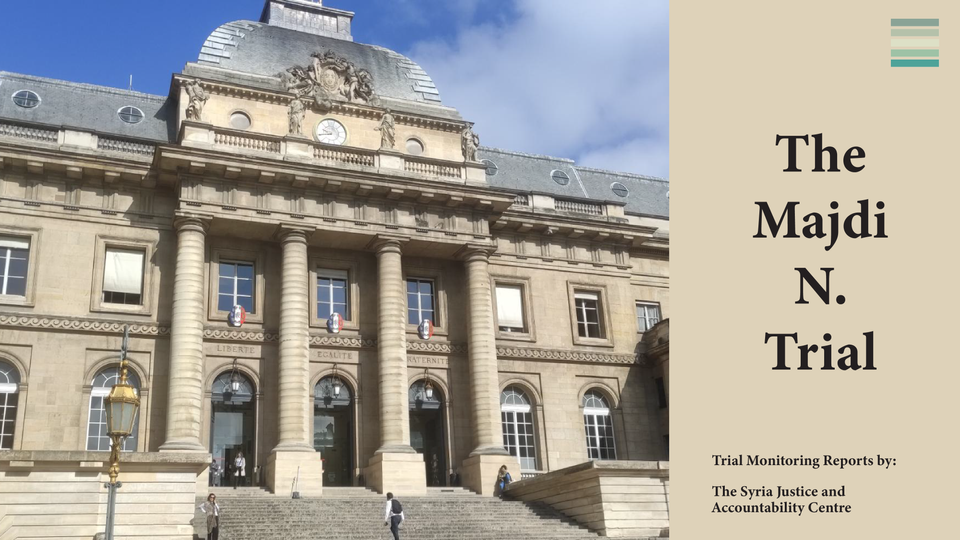
Inside the Majdi N. Trial #26: Testimony of Civil Party whose Human Rights’ Activities were Violently Targeted by Jaysh Al-Islam
TRIAL OF MAJDI N.
Court of Assize – Paris, France
Trial Monitoring Summary #26
Hearing Date: May 16, 2025
CAUTION: Some testimony may include graphic descriptions of torture, rape or other violent acts.
Note that this summary is not a verbatim transcript of the trial; it is merely an unofficial summary of the proceedings.
Throughout this summary, [information located in brackets are notes from our trial monitor] and “information placed in quotes are statements made by the witness, judges or counsel.” The names and identifying information of witnesses have been redacted.
[Note: SJAC provides a summary of the proceedings while redacting certain details to protect witness privacy and to preserve the integrity of the trial.]
[Note: Rather than publishing the trial reports of the Majdi N. case in chronological order, SJAC has organized them thematically and coherently based on the content of the hearings, making the material more accessible by highlighting key issues and connections across the proceedings.]
SJAC’s 26th trial monitoring report details day 10 of the trial of Majdi N. in Paris, France. On this trial day, Civil Party W20 reported that his brother was detained by Jaysh Al-Islam and witnessed torture and killings inside the prison. W20’s former professor was also arrested by the group. The Civil Party further testified that his office located in Eastern Ghouta was attacked several times by affiliates of Jaysh Al-Islam and described the events thoroughly. W20 declared that he saw Islam Alloush near the farm of Al-Safina around February 2013 and on another occasion in a mosque in Douma in early 2013. Considering the charges of child recruitment, W20 asserted he saw minors who were within Jaysh Al-Islam's rank. W20 also documented public executions.
Day 10 – May 16, 2025
Afternoon Session
Proceedings began at 4:20 PM.
[Redacted name], W20 began his testimony in French and then switched to Arabic. W20 was born in [redacted time]. He was a student in 2011 and, like all Syrians, he dreamt of a revolution.
Presiding Judge Lavergne’s Questioning of W20
W20 recounted that [redacted information] the [redacted location] Coordination Committee to organize protests, document the regime's and armed factions’ violations, and issue press releases on events. In 2011, W20 conducted a lot of interviews with Arab and local media and published posts on social media. At the same time, he started documenting violations, especially concerning people who were arrested or died in demonstrations. W20 [redacted information]  started working with Razan Zeitouneh, F21, in 2013.
From 2014 onward, a division between Islamists and secularists in the protest movement arose, W20 described, depicting himself as a peaceful activist. From the violations he observed, W20 believed that the prisons of the armed groups and of the regime were similar. W20 confirmed the armed groups generally behaved like the regime, but did not conduct bombings and perpetrated violations on a smaller scale. When questioned by Presiding Judge Lavergne, W20 explained the mosques played an important role in the revolution. There were around 80 of them in Douma.
Presiding Judge Lavergne inquired about W20’s family members. Three of his brothers were arrested by Jaysh Al-Islam: [redacted name], F75 in July 2014, [redacted name], F76 in 2015, and [redacted name], F77 in 2017. W20 himself was arrested in 2015 together with his brother F76. W20 explained that his brother F75 decided to leave Eastern Ghouta because his family was in Damascus, but Jaysh Al-Islam arrested him and put him in prison. After 20 days, the family found out that he was detained in At-Tawba.
W20 visited many farms in [redacted location] where Jaysh Al-Islam established [redacted name], and W20 went there with his other brother F77 [to search for their detained brother]. F75 was not there, and they were told to go to another location 200 meters away, where there were an office of Jaysh Al-Islam and a farm with guards. There, W20 saw his brother F75 for the first time [after his arrest]. Out of fear, F75 refused to answer W20’s questions. F75 remained there until [redacted time was released because Jaysh Al-Islam had no counts against him and had just launched an attack against Jaysh Al-Umma that led to more than 600 arrests.
W20 said he was shocked to hear what his brother F75 had been through and regretted that violations and torture committed by the Syrian regime against detainees were also perpetrated in liberated areas. It amounted to the violations from testimonies of former detainees of the Syrian regime W20 had heard. To him, the prison of Jaysh Al-Islam was built following the example of Sednaya, and cells were the same size in both. W20 believed that the detention conditions were the same.
When asked by Presiding Judge Lavergne, W20 said he did not know the name of the prison where his brother F75 was detained. There were many prisons called At-Tawba التوبة, Al-Batoon الباطون, or Al-Kahf الكهف, W20 said. In total, eight to nine prisons were known, and some others were secret. When asked about Al-Shafuniyah الشفونية, W20 said that Jaysh Al-Islam controlled several farms in that area as well as barracks called Fauj Al-Shafuniyah فوج الشفونية.
W20 recounted that his brother F75 saw people who had been tortured by the Sheikh of Jaysh Al-Islam. One person called [redacted name], F78 was killed by Jaysh Al-Islam because he was a magician, and Islam bans witchcraft [سحر]. Presiding Judge Lavergne asked what exactly his brother F75 witnessed, and W20 said his brother’s statement was based on what he directly saw and heard. People were beaten with whips and other tools W20 did not know about. W20’s brother had not been beaten because there were no heavy charges brought against him. W20 confirmed to Presiding Judge Lavergne that the treatment of prisoners differed depending on the reason for their arrest.
Presiding Judge Lavergne wondered if W20’s brother F75 had to follow religious courses to become a better Muslim. W20 first explained that his family [redacted information] and added that his brother F75 followed a re-education program to abide by Islamic principles even though he was already a good practicing Muslim and prayed daily. In prison, F75 started to read the Quran and changed.
W20 was arrested in April 2025 because of campaigns he launched with his colleagues of the Syrian organization [redacted name] to encourage people to file complaints against Jaysh Al-Islam for violations they committed in [redacted location]. W20 had dropped off several boxes around the town for residents to leave their complaints in. Jaysh Al-Islam broke a box next to the cultural center المركز الثقافي and searched for those responsible for the boxes, particularly W20 and his brother F76. Once arrested, F76 was called in for questioning the next morning at Jaysh Al-Islam's Security Office next to the Al-Baghadi mosque جمع البغدادي. F76 stayed there for two hours, and W20 was called in next and interrogated all day. Jaysh Al-Islam asked W20 a billion questions, about his ancestors, how much money he makes, who he knows outside Syria and at the UN, and so on. It was the last time W20 was arrested.
When questioned by Presiding Judge Lavergne whether Jaysh Al-Islam visited his home to seize computers, W20 explained he indeed faced three attacks. The first one was in 2015. W20 was preparing workshops on political rights for women of the town of [redacted location] planned to project the film called “Suffragette.” When Jaysh Al-Islam heard about that, they came to W20’s office and said [redacted name], F25 had banned the activity because gender mixing [اختلاط] was not permitted. W20 argued it was true that men and women were welcomed in the same room but separated. W20 also stressed he was from [redacted location] and knew the town’s customs and traditions. Jaysh Al-Islam insisted that Islam even banned songs in weddings or birds in houses and showed W20 many decisions related to such policies. W20 replied that none of them applied to his case, as he was preparing a social activity. W20 reported that they were very polite. He told them he would conduct the activity anyway and come to Jaysh Al-Islam’s office after that, but he was in reality very afraid. They advised him to not do so, left, and came back 30 minutes later with armed men, threatened W20 and tried to convince him to not conduct the activity because F25 would otherwise intervene himself.
In the afternoon, as women were arriving, W20 saw a group of people outside. Five minutes later, the group of men came in pairs to ask what they were doing, and declared it was against society. W20 ultimately asked them "Who are you to tell me such a thing?” Soon after, 50 people entered and beat W20, his brother, and the people attending, and stole W20’s computer. W20 recognized one man, who came back to W20’s office the same night to reveal to him that Jaysh Al-Islam was behind the beating. Jaysh Al-Islam then closed the office and, to avoid any reaction or demonstration against what they had done, they declared at the mosque that a car bomb had been found near the place. W20 informed many Syrian organizations about what had happened.
The second attack took place in 2016 in the office of W20’s organization, where several other associations worked. The office hosted a magazine called [redacted name] headed by [redacted name], W17 and Jaysh Al-Islam threatened them because of their publications. Around [redacted date], people came to warn W20 and his colleague that something was ongoing. They left the office, and 10 minutes later, a large group of people from Jaysh Al-Islam came, entered, and destroyed everything. They carried signs claiming W20 and his colleagues were secular and wanted women’s freedom, which was not permitted in their society. Things got worse; a picture of W20 was circulated in all Eastern Ghouta, and Jaysh Al-Islam members claimed in mosques that W20 was an unbeliever [ملحد ;the Arabic rather refers to an atheist but was translated in French as “mécréant,” ENG: unbeliever]. Jaysh Al-Islam was saying everywhere that W20 and his two colleagues would be caught and killed, so they remained hidden for a week in Ghouta, and the office was closed. W20 stressed it was hard to have his neighbors, parents, and everyone in town turn against him. He was afraid to walk at night, and afraid that someone would kill him in his sleep. He stayed in Ghouta for many more months but always felt under threat.
Once, W20 attended a conference with W17 on a women-related topic, and a picture of them was shared on social media, which Jaysh Al-Islam consulted a lot. Publications accusing W20’s office were released right after. In August 2016, W20 continued, people affiliated with Jaysh Al-Islam came again [to the same office] and broke everything. The scene was filmed by security cameras, and W20 said he has kept the video until the present day. They filed a complaint, and the news spread beyond Syria’s borders. Jaysh Al-Islam was afraid of media, W20 asserted.
Presiding Judge Lavergne inquired about child recruitment. According to W20, all factions in Eastern Ghouta used the same methods, and what was special with Jaysh Al-Islam is that the group exerted its authority over all the city's mosques. W20 testified that during war, people were more sensitive about religion and belief, so he believed Jaysh Al-Islam used these methods to attract young people who had nothing to do. People had the choice to either send their children away from Ghouta or stay [and have them engage]. The siege played a crucial role, pushing families to send their children to armed factions because there was nothing to eat, and the factions had considerable financial power. Presiding Judge Lavergne asked W20 if the context drove families to enlist, and W20 believed several factors contributed: the mosques; the leaders of Jaysh Al-Islam; and the propaganda. There were not many choices, he concluded.
When asked about child soldiers, W20 recalled having seen some on the streets twice. They wore military clothing and rifles, and took part in military parades in the city. Judge Lavergne wondered how he could know they were children, and W20 explained it was from their appearance. W20 believed they were from 14 to 16 or 17 years old. Presiding Judge Lavergne asked if W20 knew about centers dedicated to recruitment and training of children. W20 said people in Jaysh Al-Islam oversaw enlistment and there were centers in [redacte location]’s suburb. Training took place either in the barracks of Fauj Al-Shafuniyah or between Al-Shafuniyah and Al-Obb. W20 never visited training centers but went to the center of Al-Safina close to the office of Jaysh Al-Islam's military command.
That is where W20 saw Islam Alloush, whom he knew from the media. It was around February 2013, and Majdi N. was thinner than today at trial, W20 testified. Presiding Judge Lavergne stressed that W20 dated the encounter to March 2013 during his hearing with the Investigative Judge. W20 recalled that Islam Alloush was working on his computer behind his desk, and they did not speak much with one another. W20 asked him about the enlistment of children, and Islam Alloush shut down the topic immediately. He was a bit annoyed, but maybe it was just his nature, W20 thought. W20 stayed there for around 30 minutes.
When asked by Presiding Judge Lavergne, W20 said he saw Islam Alloush again in Al-Baghadi Mosque جامع البغدادي on Shukri Al-Quwatli شكري القوتلي Street in Douma early 2013. The mosque was full for the prayer. W20 did not talk with Islam Alloush, who wore a military uniform he always had on. Presiding Judge Lavergne inquired about any other information he had about the Accused, and W20 stressed that Al-Safina center, where he had seen Islam Alloush, was dedicated to missing persons in Douma. When asked by Presiding Judge Lavergne, W20 said he did not know if Islam Alloush had a guard. When asked if he had a form of authority or was just executing orders, W20 said Islam Alloush chose his name because of his closeness to the founder of Jaysh Al-Islam, which made everyone think he had a role. Everyone talked about him, and his photo appeared in the press, W20 testified.
Presiding Judge Lavergne read an excerpt of W20’s deposition before the Investigative Judge, where he had stated that almost all families had a member who joined Liwa Al-Islam, either out of conviction or for the money. W20 had stated that people quickly sensed that the faction was not here to protect them from the regime but to impose their ideology. W20 himself was against the militarization of the rebellion. Liwa Al-Islam received funding from abroad, Saudi Arabia, or the United Arab Emirates, while Turkey and Qatar tended to support the Muslim Brotherhood. They had leaders and new weapons, especially American ones coming from Turkey, like M16s. They paid salaries (around 100 U.S. dollars per month) in addition to providing food. The ranks of Jaysh Al-Islam swelled. In early 2013, they started to organize themselves militarily and administratively. Zahran Alloush became an emblematic figure. W20 added that Razan Zeitouneh had been arrested despite the fact that she had defended Zahran Alloush after he was arrested [by the Assad regime].
Presiding judge Lavergne commented that Liwa Al-Islam stood out from other groups, as its members wore an emblem, they had headquarters, recruitment, and training centers, and an office controlling and monitoring the population. W20 added that the Syrian regime was known for its informants, two of whom were appointed to write reports on him for Jaysh Al-Islam. One of them had written five pages about W20, his movements, whom he worked with, etc.
W20 explained to the Court that the administration of Jaysh Al-Islam monitored recruitment centers, communication centers, car repair shops, food supply locations, prisons, and security centers. One street in Douma gathered more than ten security centers. Starting in early 2014, Jaysh Al-Islam eliminated anyone who opposed its project. W20 reported that [redacted information] Mohamed Flitani محمد فليطاني, F33, member of the socialist party and former opponent of the Syrian regime, was arrested by Jaysh Al-Islam.
Presiding Judge Lavergne referenced W20’s mention to the Investigative Judge of having seen many children in Al-Safina center, which W20 forgot he had said. When asked how he could enter this center despite armed sentinels guarding the place, W20 said he entered normally and not secretly. W20 confirmed he saw Islam Alloush armed. Presiding Judge Lavergne quoted W20’s statement that when he traveled, Islam Alloush always had a vehicle with bodyguards, like all military leaders, and that during battles, he wore a headband with the Islamic profession of faith. Presiding Judge Lavergne asked if W20 was a direct witness of that. W20 clarified he only met Islam Alloush during his visit at Al-Safina center, and added that in Douma, all knew the leaders of Jaysh Al-Islam and their movements.
Responding to Presiding Judge Lavergne, W20 detailed the two situations in which he saw children who’d been recruited by Jaysh Al-Islam. The first time, he was visiting his sister and met a group of five to six children in uniform carrying weapons that were as tall as them. They belonged to the [redacted name] family, which was famous in [redacted location]. One of them was W20’s pupil before the revolution, and he told W20 he was doing Jihad. The scene took place near a chemical barrack of the regime that Jaysh Al-Islam intended to take over, and W20 added it was dangerous to be there, so close to the regime territory. W20 also saw children in diploma ceremonies. W20 testified they were between 14 and 16 years old and asserted that, from their appearance, they were certainly under 18.
W20 never attended public executions but documented at least five such events. Asked about the charges brought against those people, W20 recalled a lawyer accused of sodomy, Abu Ali Khabiyeh أبو علي خبية, F34, and a Sheikh from Douma accused of aggression against women who had all been executed. The worst case W20 had documented was F78, who had been accused of “black magic.” They cut off his head, W20 testified. Jaysh Al-Islam also conducted many executions against members of military factions from the [redacted name] and Khabiyeh families.
Presiding Judge Lavergne inquired about people put in cages, and W20 replied that all the city of [redacted location] had witnessed that. W20 himself saw it once and believed it was a media campaign, because people were taken around the city, photographed, and then placed again in prison.
Civil Parties’ Counsels’ Questioning of W20
Counsel Bailly wondered if documenting crimes was dangerous. W20 said he had to do that because he saw many massacres and promised himself he would do something against the perpetrators. He said to have lived a life full of threats he received from people who called themselves opponents of the regime, or from the regime itself. W20 declared that, until today, he has received many threats. Counsel Bailly mentioned dead animals thrown in W20’s office a month before Razan Zeitouneh’s kidnapping, and W20 confirmed, adding he remained hidden for a year after that and published nothing because he could himself be kidnapped anytime. It was difficult to come here today but was a way to achieve justice, W20 declared.
Counsel Bailly noticed that W20’s words were nuanced when explaining how he deduced that Islam Alloush was in the convoys but did not see him directly, or when testifying that none of the testimonies he gathered directly pointed at Islam Alloush’s presence during interrogations. W20 said he considered himself a trustworthy person and came to tell what he saw and documented, not to falsely accuse.
Counsel Bailly requested the projection of a video in which Majdi N., who was armed, explained that he was in a training camp of Jaysh Al-Islam. When questioned by Presiding Judge Lavergne, Majdi N. located the scene at the regiment of Al-Shafuniyah [فوج الشيفونية]. Majdi N. said his weapon was neither common nor prestigious, adding that snipers did not use such a weapon. W20 confirmed the scene took place in Eastern Ghouta but not in the camp of Al-Shafuniyah.
Counsel Bailly requested the projection of a picture of Islam Alloush and Zahran Alloush, in which children appeared in the background. Counsel Bailly asked why the children wore red headbands, and W20 believed they wore it during battles to distinguish themselves.
Prosecution's Questioning of W20
Referring to the box system W20 distributed around [redacted location] to collect grievances in early 2015, the Prosecutor wondered if there was a judicial system in place at that time. W20 said there was one which was dominated by Jaysh Al-Islam and used to commit atrocities. They inflicted horrors on civilians and no one could complain, W20 declared. The campaign W20 was running was a breath of fresh air. People wrote their complaints anonymously, and 90% of them were against Jaysh Al-Islam, he recalled.
Prosecutor Thouault wondered if W20 attended sermons in mosques in which Jaysh Al-Islam encouraged families to send minors into their ranks. [The answer was inaudible.] Presiding Judge Lavergne asked if W20’s second encounter with Majdi N. in the mosque took place during a recruitment sermon. W20 could not remember, saying sermons took place almost every day and some were dedicated to martyrs. Defense Counsel asked if Majdi N. was preaching. [The answer was inaudible.]
Presiding Judge Lavergne quoted a hearing in which W20 talked about Jaysh Al-Islam trainings for so-called “Cubs of Islam.” W20 had declared that the young and old alike were attracted and fascinated by American uniforms and guns. Families could enjoy privileges (food, wages). Training took place in remote areas and included sports and military training. New recruits were received at Al-Safina. The golden age of recruitment were the years 2012 to 2014. New recruits received a salary of 100 US dollars. W20 commented that 100 dollars represented 13,000 Syrian pounds back then and was a very acceptable pay. W20 himself received 150 dollars, even though he worked in a foreign-supported organization.
The Prosecutor requested the projection of screenshots representing fighters, including a child without a uniform. W20 commented that many children were killed in combat. The Prosecutor asked to project another picture dated May 2015. It depicted the main representatives of Syrian’s current government around Ahmad Al-Sharaa. When asked by Prosecutor Havard, W20 cited several names of those pictured and testified that Jaysh Al-Islam was now part of Syria’s defense administration.
Defense Counsel’s Questioning of W20
Counsel Kempf asked where Issam Al-Buwaydany was arrested and under what conditions. W20 said Jaysh Al-Islam had many resources and food products as well as money. Counsel Kempf stressed W20 did not reply to his question, and W20 confirmed Al-Buwaydany had been arrested in the United Arab Emirates.
Counsel Kempf asked what offense W20 accused Majdi N. of. W20 first did not respond, and an incident followed on a translation issue. Counsel Kempf detailed the two counts brought against Majdi N. and asked W20 from which one he considered himself a victim. W20 considered he was a victim of Jaysh Al-Islam, so was his family and particularly his brother. W20 did not consider himself a victim of child recruitment.
Counsel Kempf inquired about W20’s life in Eastern Ghouta. W20 said he left in 2018 after six years of siege and repeated he was arrested in March 2015 for a day. Kempf asked what responsibility Majdi N. carried in this arrest [response inaudible]. Regarding child recruitment, Counsel Kempf wondered if W20 took pictures of the poster he had mentioned pasted on street walls , and if that was part of his documentation work. W20 responded with a shrug, and Presiding Judge Lavergne intervened to say that it was certainly too risky to take pictures. Asked if he saw any sermons from Majdi N. inciting recruitment, W20 said he only saw him on videos of training for adults.
Counsel Kempf stressed that Majdi N. always denied having seen W20 in early 2013. When questioned about evidence of torture the witness had against Majdi N., W20 referred to his brother F75’s story. Counsel Kempf insisted that W20’s documentation work required verifying the declarations of his brother.
Counsel Ruiz wondered if children used to wear uniforms before the revolution. It was the case before 2003, W20 replied. Considering the colors of headbands, W20 repeated that they changed depending on battles and did not know if factions wore different colors. Counsel Ruiz wanted clarification on the ages of the children he met, and W20 repeated they were between 14 and 16 years old.
Proceedings were suspended.
___________________________
For more information or to provide feedback, please contact SJAC at [email protected] and follow us on Facebook and Twitter. Subscribe to SJAC’s newsletter for updates on our work