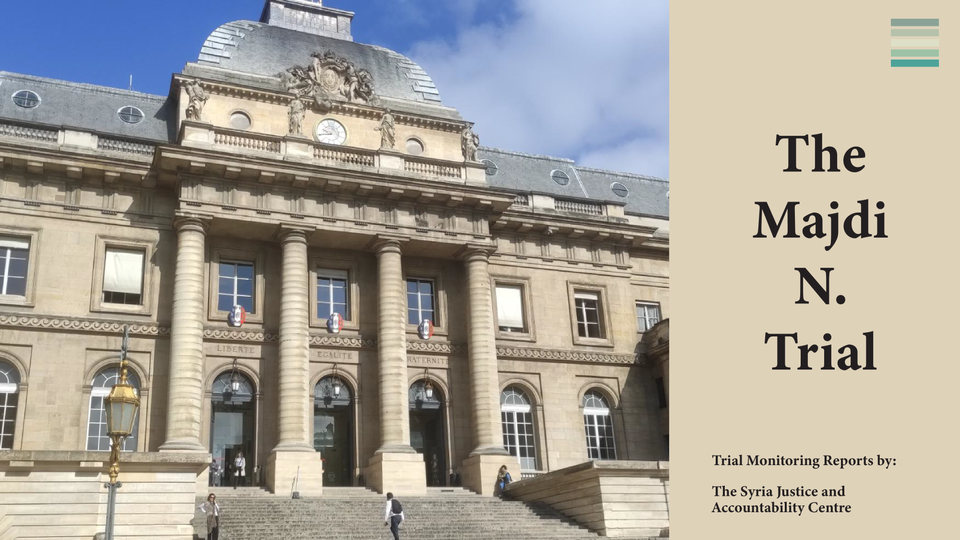
Inside the Majdi N. Trial #24: Request for Referral by the Defense and its Dismissal by the Court
TRIAL OF MAJDI N.
Court of Assize – Paris, France
Trial Monitoring Summary #24
Hearing Dates: May 19 and 20, 2025
CAUTION: Some testimony may include graphic descriptions of torture, rape or other violent acts.
Note that this summary is not a verbatim transcript of the trial; it is merely an unofficial summary of the proceedings.
Throughout this summary, [information located in brackets are notes from our trial monitor] and “information placed in quotes are statements made by the witness, judges or counsel.” The names and identifying information of witnesses have been redacted.
[Note: SJAC provides a summary of the proceedings while redacting certain details to protect witness privacy and to preserve the integrity of the trial.]
[Note: Rather than publishing the trial reports of the Majdi N. case in chronological order, SJAC has organized them thematically and coherently based on the content of the hearings, making the material more accessible by highlighting key issues and connections across the proceedings.]
SJAC’s 24th trial monitoring report details parts of day 11 and 12 of the trial of Majdi N. in Paris, France. On these trial days, the Defense presented its argument for a request for referral of the trial to a later date. The Defense Counsels argued that exculpatory witnesses were not granted access to the Court and that the improving relations between Syria and France would enable better cooperation before a new trial. Counsel Kempf also explained that the European Court of Human Rights had established a three-part test to assess if a trial should be postponed, which according to him was the case in the present trial. The Civil Parties’ Counsels and the Prosecution presented their counterarguments, stressing that the witnesses requested by the Defense were not essential to establishing the truth. The Prosecution also criticized the fact that the Defense requested the witnesses’ appearance very late in the proceedings, which rendered official judicial cooperation difficult. The Court rendered its decision the next day, dismissing the request for referral.
Day 11 and 12 – May 19 and 20, 2025
Proceedings resumed at 7:57 PM.
Defense Arguments supporting the Referral
Counsel Ruiz emphasized that from the investigation stage, the Defense had requested the hearing via Signal of 18 exculpatory witnesses located in Syria and Turkey, and noted that Prosecution witnesses had also been heard via this application. The Defense was told that it was not possible to verify identities in such a hearing, but Counsel Ruiz argued that this did not pose any difficulty for the Prosecution witnesses [who were heard via videoconferences]. Counsel Ruiz explained that, at the close of the investigation case, the Defense requested that the case be referred back to an Investigating Judge and that the Court order the hearing of these witnesses, but the request was denied.
Counsel Ruiz further noted that the Defense still had the possibility to summon witnesses up to 40 days before the start of a trial, emphasizing that the law does not state that more time is required when witnesses are located abroad. Counsel Ruiz claimed that the Defense provided all information available—phone numbers and addresses—for the Court to be able to contact the witnesses. [In case the foreign authorities did not respond or could not be contacted], Counsel Ruiz also argued that French law does not prohibit conducting a hearing outside a foreign court of law [i.e. via Signal]. Counsel Ruiz concluded that if this trial was allowed to proceed, no defense witnesses would be heard.
According to Counsel Ruiz, this trial posed an issue in terms of equality of arms. He regretted that the Defense witnesses who could obtain visas were asked to cover all sorts of costs to come to the Court, with the promise that France will reimburse them six months after the trip. In Counsel Ruiz’s view, this was not commensurate with the ambition to organize such a universal jurisdiction trial in Paris.
Counsel Ruiz pointed out the fact that Majdi N. was placed in an isolation cell, not because he was a dangerous criminal, but because there was no space anywhere else. However, he emphasized that psychologists, doctors, etc. consider isolation white [or white room] torture. If this trial went ahead, Counsel Ruiz continued, the Court would have to answer to history for having judged a man who is ill, whom a doctor has declared unfit to follow the proceedings, and who has been deprived of his witnesses for the past five years.
Counsel Kempf then declared that a decision to postpone the trial would in no way be a failure but a decision in the interest of justice, as the Court would simply be acknowledging that a man must be able to defend himself properly. Counsel Kempf quoted Article 326 of the French Code of Criminal Procedure which states that a court may postpone the trial when a witness is unable to appear.
Counsel Kempf stressed that the European Court of Human Rights had established a three-part test to assess if a trial should be postponed in case witnesses are unable to appear. First, the Court should assess if the witness failing to appear is sufficiently relevant, i.e. if his testimony can influence the outcome of the trial and is likely to strengthen the Defense's position. Second, the Court should consider the justifications for the request for referral. Third, the Court should determine if the absence of these witnesses affects the overall fairness of the proceedings for both parties.
Counsel Kempf claimed that these criteria could be applied to seven Defense witnesses and argued that a referral in a year or two would enable judicial cooperation between France and Syria. In the meantime, the French judicial authorities might consider conducting investigations on the ground, Counsel Kempf argued.
Counsel Kempf regretted that most discussions that already took place during the trial were quite distant from the matter submitted to the Court. For instance, he continued, the indictment never mentioned Adra Al-Omaliya, Abu Ali Khabiyeh, or hostages placed in cages.
The law authorizes the Defense to request and obtain the hearing of five witnesses, Counsel Kempf continued. The Prosecution chose to summon Patrick Haenni, F14, and Céline Morgan, F15, whose appearances were supported by the Defense [i.e. so that the Defense could still request the hearing of five further witnesses]. Counsel Kempf insisted that their testimony would strengthen the Defense’s position.
Regarding five other Syrian witnesses directly requested by the Defense, Counsel Kempf asserted that hearing them was crucial for the Defense of Majdi N. Usually, Counsel Kempf emphasized, no criminal trial takes place without at least one witness from the Accused’s family being heard. That is the reason why the testimony of [redacted name], F5 [Majdi N.’s nephew] was important, Counsel Kempf argued. Three other Syrian witnesses [F16, F18, and F19] were in Ghouta, Counsel Kempf continued, and [redacted name], F17 was important because he had said that he never joined Jaysh Al-Islam.
Presiding Judge Lavergne inquired about the precise declarations of F17. Counsel Kempf explained that according to F17, Jaysh Al-Islam did not force individuals of fighting age to join, taking his own case as an example. Counsel Kempf also confirmed that F17 declared to not have seen any child soldiers within Jaysh Al-Islam's ranks.
The overall fairness of the trail was at stake, Counsel Kempf continued. Since its outset five years ago, nearly every request from the Defense had been denied, while the Civil Parties and Prosecution have been granted nearly everything, he claimed. They even submitted documents without reviewing them, such as newspaper articles about parliamentary elections in Iraq and Covid-19 in Great Britain, Counsel Kempf reported.
Counsel Kempf concluded by saying that if the Court applied the criteria established by the European Court of Human Rights, the only possible outcome was to postpone this hearing.
Civil Parties’ Argument against the Referral
Counsel Bailly first stressed that Patrick Haenni and Céline Morgan refused to testify and expressed his surprise that the Defense pretended they should have been forced to come to court. Counsel Bailly further argued that their NGO [Geneva Call] was providing training on international humanitarian law to all factions, which did not mean they could plead for fighters, as they must remain neutral.
Regarding the witnesses the Defense had requested to hear at the investigation stage, Counsel Bailly emphasized that the Investigative Judge considered it disproportionate to force them to come. As for witnesses [redacted name], F72 and [redacted name], F65, Counsel Bailly pointed to F72’s statement that spokespersons had a central role in factions and F65’s declaration that Majdi N. had the same level of information as Zahran Alloush.
Counsel Bailly then mentioned the 18 other witnesses requested by the Defense and argued that they all made similar declarations regarding Majdi N.’s personality, namely that he was nice and polite. As a result, the Investigative Judge considered they were rather witnesses of personality and not essential to establishing the truth, an interpretation that was shared by the three judges of the Court of Appeal. As for [redacted name] F17 and [redacted name] F18, Counsel Bailly continued, they were linked to leaders of Jaysh Al-Islam and would likely have no additional elements to the case.
As a response to the violation of the principle of equality that the Defense had denounced, Counsel Bailly emphasized that the Defense had the possibility to travel to Syria after December 2024, whereas the Civil Parties’ Counsel could not do so because of security concerns. Regarding the Defense’s argument that the witnesses could not afford the travel costs upfront, Counsel Bailly emphasized that Majdi N.’s brothers were doctors and also mentioned a bail 200,000 Euros that was offered to the Accused. Counsel Bailly further wondered why no professor at the University in Budapest or in Istanbul were contacted by the Defense to testify in court.
Finally, Counsel Bailly suggested that the Defense filed their request for referral on the morning of May 14 in order to prevent the crucial testimonies of [redacted name], W11, and [redacted name], W12.
Prosecution’s Argument against the Referral
Prosecutor Thouault first expressed a sense of fatigue from repeating the same arguments since the beginning of the trial. With regard to the witnesses that were deemed essential to establishing the truth, she emphasized that the testimony of Patrick Haenni should have demonstrated that Majdi N. never intended to cooperate with a group formed with the project of committing war crimes. This conclusion was based on the fact that the Accused met Patrick Haenni in Turkey at the end of 2013. However, Prosecutor Thouault argued, the Prosecution never pretended that Majdi N. left Ghouta in May 2013, but believed he could have come back easily. Prosecutor Thouault also stressed that Patrick Haenni simply did not want to testify.
As for Céline Morgan, her former employer [the NGO Geneva Call] indicated a commitment to neutrality, which explained why she could not cooperate with the judicial system. Prosecutor Thouault further claimed that nothing in the content of her testimony could shed light on the facts, considering that she never traveled to Syria. Prosecutor Thouault also indicated that the Franco-Swiss judicial cooperation agreement stipulated that there could be no compulsory appearance in France of a witness located in Switzerland.
Considering the witnesses located in Syria, Prosecutor Thouault argued that they did not know Majdi N.’s background very well. As for the ones who pretended that there were no child soldiers and no compulsion to joining Jaysh Al-Islam, Prosecutor Thouault emphasized that a video showed Zahran Alloush with minors.
Prosecutor Thouault also stressed that this was the 9th universal jurisdiction trial, and the 10th trial of international crimes that has taken place in France. She noted that the same difficulties could arise with Rwanda, but they generally managed to have witnesses from Rwanda, Congo, and Liberia.
As a response to the Defense’s argument that the relation between France and Syria would improve, Prosecutor Thouault retorted that nothing was stable and there was no certainty whether the plan to open a French Embassy in Damascus will come to fruition.
Considering the witnesses located in Turkey, Prosecutor Thouault emphasized that F5 would not add any essential elements to establishing the truth, besides the fact that he saw Majdi N. in northern Syria in November 2013.
As for the argument that no exculpatory evidence had been taken into account, Prosecutor Thouault responded that the 20 volumes of proceedings were partly composed of data retrieved from the Accused’s computer itself. She also noted that the Investigative Judge granted many requests from the Defense, such as the hearing of four witnesses and the examination of the asylum files. Prosecutor Thouault also argued that [redacted name], W13 and Thomas Pierret, W3 were in fact Defense witnesses.
Considering the other 18 witnesses mentioned by the Defense, Prosecutor Thouault explained that the Investigative Judge asked for details on their testimonies. According to the Prosecution, the fact that only three of them were now requested by the Defense proved that the others were not essential to establishing the truth. Prosecutor Thouault also emphasized that conversation records of Majdi N. in detention showed that he exerted pressure to compel witnesses to testify.
Prosecutor Thouault concluded that this request was not made to obtain a postponement of the trial, but to waste time.
The proceedings were suspended at 9:48 PM. The next day, proceedings began at 9:40 AM.
Court’s Decision on the Request for Referral
Presiding Judge Lavergne noted that Patrick Haenni and Céline Morgan refused to testify, and the Court could not compel them to do so, since they resided in Switzerland. Considering the three witnesses located in Syria [F17, F18 and F19], Presiding Judge Lavergne declared that the Defense requested their appearance on the last day of the deadline, on March 31, 2025. He added that the French Ministry of Foreign Affairs indicated that since 2012, they had no means to deliver judicial documents, such as summons, in Syria. Presiding Judge Lavergne also argued that the reopening of a French Embassy seemed unrealistic and that leaders of Jaysh Al-Islam now occupied central positions in the Syrian government. He further stressed that no argument was made regarding the compelling necessity of their testimony, adding that the hearing of F17 was never requested during the investigation.
Considering the two witnesses located in Turkey, F5 and [redacted name], F16, Presiding Judge Lavergne declared that the Defense made the request for their appearance on March 18, 2025, in application of Article 281, final paragraph, of the French Code of Criminal Procedure. As a result, a request for mutual legal assistance was sent to the Turkish authorities, as well as several follow-ups. Presiding Judge Lavergne noted that the Turkish authorities never replied and that neither of those two witnesses contacted the Court.
Presiding Judge Lavergne believed that Article 6 of the European Convention on Human Rights on a fair trial had been respected and that the elements brought by the Defense were beyond the control of the French judicial authorities. Presiding Judge Lavergne further mentioned the right of the Accused to be tried within a reasonable time and the fact that the hearings of witnesses requested by the Defense did not appear essential to the establishment of the truth. Moreover, Presiding Judge Lavergne argued that the Defense and the other parties had been treated equally.
Presiding Judge Lavergne declared that telephone communications via encrypted applications such as Signal did not meet the requirements on hearings in a criminal court set forth by French law. He explained that the hearing of a witness located abroad can only take place with respect for the sovereignty of that country, and thus within the framework of a convention on international mutual legal assistance.
As a result, the Court rejected the request for referral of the case.
Proceedings continued with the hearing of [redacted name], W17 [see Trial Report #20].
___________________________
For more information or to provide feedback, please contact SJAC at [email protected] and follow us on Facebook and Twitter. Subscribe to SJAC’s newsletter for updates on our work