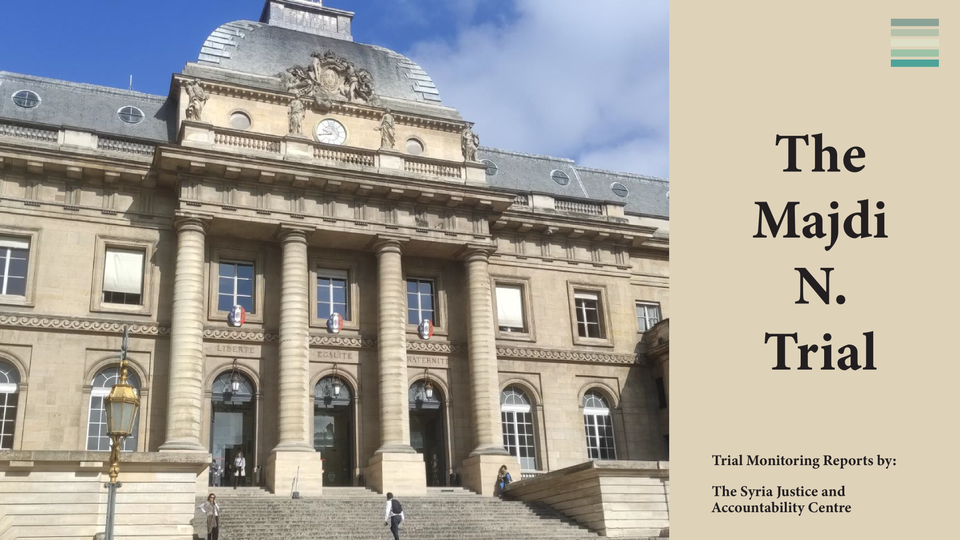
Inside the Majdi N. Trial #23: Testimony of Syrian Witness on Jaysh Al-Islam’s Detention System and Torture Methods
TRIAL OF MAJDI N.
Court of Assize – Paris, France
Trial Monitoring Summary #23
Hearing Date: May 21, 2025
CAUTION: Some testimony may include graphic descriptions of torture, rape or other violent acts.
Note that this summary is not a verbatim transcript of the trial; it is merely an unofficial summary of the proceedings.
Throughout this summary, [information located in brackets are notes from our trial monitor] and “information placed in quotes are statements made by the witness, judges or counsel.” The names and identifying information of witnesses have been redacted.
[Note: SJAC provides a summary of the proceedings while redacting certain details to protect witness privacy and to preserve the integrity of the trial.]
[Note: Rather than publishing the trial reports of the Majdi N. case in chronological order, SJAC has organized them thematically and coherently based on the content of the hearings, making the material more accessible by highlighting key issues and connections across the proceedings.]
SJAC’s 23rd trial monitoring report details parts of day 13 of the trial of Majdi N. in Paris, France. On this trial day, W18 testified that in August 2015, he published a post on Facebook criticizing Jaysh Al-Islam and was violently assaulted in the street the same day by three men who threatened to kill him. In April 2016, W18 was arrested and detained by Jaysh Al-Islam for around two weeks. W18 detailed the accusations which were brought against him and the violent interrogations sessions he was subjected to. W18 testified to having endured torture, at a time when he was 17 years old. During his detention and trial by Jaysh Al-Islam, W18 saw several leaders of Jaysh Al-Islam but denied ever having met, heard of, or been in contact with Majdi N.
Day 13 – May 21, 2025
Afternoon Session
Proceedings began at 2:15 PM.
[Redacted name] W18 was sworn in. He was born in Douma in 1999. He now lives in Belgium and testified via videoconference.
W18 testified that he did not personally know Majdi N. He said that he had awaited this moment for ten years.
On August 5, 2015, W18 published a Facebook post in which he criticized Jaysh Al-Islam. On the same day, three individuals arrested him in front of the mosque Al-Baghdadi in Douma [in Al-Quwatli القوتلي Street]. W18 knew the names of two of his apprehenders, [redacted name] and [redacted name]. They threatened to kill him if he would not stop publishing posts about Jaysh Al-Islam.
On April 26, 2016, at a time when Jaysh Al-Islam was arresting activists, one of its members called [redacted name] came to search W18’s home and to arrest him, but W18 was not there. W18 and his father then went to W18’s aunt to hide but were arrested at a checkpoint in front of the 4th school of Douma controlled by Jaysh Al-Islam, in the area of Al-Masaaken المساكن. W18 testified that he was 17 years old at the time.
The faction took W18 to a building near the Martyrs Square of Douma. There, W18 was presented to the head of Jaysh Al-Islam's public relations, [redacted name], who told him that Jaysh Al-Islam had awaited him for a long time and that he should pray if he wished to see the sunlight again. W18 stayed in this person’s office for three hours, where he was tortured. He was then transferred to the building dedicated to religious affairs [مبنى الأوقاف]. In this building, W18 was tortured by [redacted name], F83, who was tall, bearded, and weighed around 120 kilograms, whereas W18 weighed about 50 kilograms because of the siege.
W18 testified that afterwards, Jaysh Al-Islam took him in a microbus full of other detainees to his home to confiscate his phone. Once they arrived, though, W18 refused to give up his phone, so F83 grabbed him by the hair and took him back to the bus. W18 was then brought to prison 011, located between Al-Shafuniyah الشيفونية and Al-Obb العبّ, five kilometers from Douma’s city center. W18 reported that when he entered, they searched him—even his underwear—and took all his belongings. They blindfolded him, and someone led him through a corridor located on a farm to a prison that looked like an underground garage. There were five rooms, and the largest one was only four square meters with around 40 people detained with him. In the evening, they brought dinner, which consisted of four to five beans each.
W18 testified that he was then brought to an interrogation room, where he was forced to kneel with his eyes blindfolded. The man told W18 he would ask him some questions, and if W18 answered them correctly, the man would not hit him. The man started asking questions related to religion, such as about prayer, but W18 could not answer. The man hit W18 with a metal rod. Once W18 stood up, the man said, “Go on, walk,” even though W18 was still blindfolded, and another man rushed at him and kicked him, throwing him against the wall. They then put him back in a cell that was two meters wide with five other people. W18 remembered there was a hole in the ground that was used as a toilet, and because he was the smallest and there was no space, he ended up in that hole.
The next day, W18 was brought to another prison called Al-Obb, consisting of several farms named Al-Batta مزارع البطة. W18 was placed in a location called the zoo [حديقة الحيونات], and after four hours, he was brought to an interrogation room. The interrogator of Jaysh Al-Islam, [redacted name], was W18’s neighbor and later died in Al-Bab الباب in March 2020, W18 recounted. He presented to W18 the charges brought against him, among them liaising with people abroad and links with other factions, before slapping W18 in the face and telling him he would be released. W18 was then put in a cage placed on a camionette and not released but rather brought to prison Al-Batoon in Douma, near Cornice Street. W18 testified that before the war, the Syrian regime used these buildings to conduct experiments related to the agricultural sector.
When W18 arrived in that prison, he was beaten up in a “welcome party” [حفلة استقبال]. A man called [redacted name], F69 removed the blindfold from W18’s eyes. F69 was accompanied by someone called [redacted name], F68, who was a photographer for Jaysh Al-Islam born on January 1, 2000, and was 16 years old at that time. F69 asked W18’s name and if there was a family link between him and [Jaysh Al-Islam member] [redacted name] F29, who was indeed W18’s cousin. F69 slapped him even harder and told W18 that the slap was from F29. W18 was then brought to cell no. 7, which was around six meters long and held 25 to 30 people. W18 was the youngest and slept close to the door, because he was most often called in for interrogations. The cell was located underground, W18 recalled, and there was not enough light for them to see the color of the walls.
The next day, F69 came to take W18 and asked him why he dressed like a woman, slapped him, and put him back in the cell. This day, they called W18’s name in the loudspeakers placed in each cell and took him for his first interrogation [in prison Al-Batoon]. W18 did not see anything, and a man guided him in the corridor, where W18 had to stand facing the wall for four hours with his arms raised. If W18’s legs bent, the man would hit him on the lower side of his buttocks, and every time someone passed behind W18, they would kick him. W18 also received two hits with a green plastic pipe. W18 testified that, at that point, he heard the voice of a little boy, who was about two years old. Then, they took W18 into a room for interrogation, and W18 had to stay in a position with a bent back and straight legs.
Presiding Judge Lavergne asked for clarification on where W18 heard the child’s voice, and W18 explained he did not know where the boy was, but his own cell was underground, and they made him go up two steps. So, the child was either on the ground floor or on the first floor, W18 deduced.
W18 further testified that during the interrogation, the interrogator asked him the same question as usual. W18 was very frightened and told them he would do anything if they let him go. After the interrogation, he was put back in his cell, and the dinner they served was bulghur. W18 also recalled that it was really hot, that there was no air, and that the detainees were suffocating.
W18 endured a new interrogation two to three days later. Right before that, [redacted name], F28 opened the cell’s peephole, expressed his content that they finally managed to catch W18, and spat on him. F28 used very insulting words, W18 testified. W18 was then brought to an interrogation room, the investigator being [redacted name], F70, a man from Jaysh Al-Islam's security who was, according to W18, the main person responsible for crimes of kidnapping and murder in Douma. F70 took off W18’s blindfold and told him to remember his face, threatening to break W18’s hand if he wrote anything else about Jaysh Al-Islam. At one point, F70 spread W18 legs apart and bit him in his genitals. F70 then left while W18 was still on the floor, and a hooded person came in and placed his feet on W18’s head.
One or two days later, W18 was brought for a new interrogation and put on a chair. They asked him the usual questions, such as why he had written posts against Jaysh Al-Islam. The man started beating W18 with a rope and told him that he would be hanged with that rope if he did not respond. One of the accusations brought against W18 was to have had links with [redacted name], F35, the sworn enemy of F28. When questioned by Presiding Judge Lavergne, W18 specified that F35 was a religious leader and a judge.
W18 said he agreed to recognize all accusations, so they took him to a dark room similar to a studio, where there was a camera. They took off W18’s blindfold, and W18 saw three hooded men. W18 started recounting that he took money from outside [Syria] and was in contact with F35, but since he was inventing a story that was not true, it was disjointed. The photographer [redacted name] got upset and, because it was hot, took off his hood, so W18 could see his face. After W18’s statement was recorded, he had to put his fingerprints on documents he did not see. The Court’s interpreter intervened to explain that this practice amounted to signing the documents.
One day before his release, W18 was brought for a last interrogation that amounted to a trial, and recalled that [redacted name], F25 was present together with F29 and [redacted name], F56. W18 was called all sorts of names, and they told him he would risk his life if he ever published posts again. W18 was released on May 15, 2016, and they gave him back his belongings, including 1,000 or 2,000 Syrian pounds. W18 commented that Jaysh Al-Islam intended to portray themselves as individuals who safeguarded personal belongings to insist that they were not thieves. They even went so far as to offer W18 a plate of rice. In total, W18 was detained for 15 or 16 days.
W18 added that during one of the interrogations, an interrogator had asked him for his Facebook credentials and deleted the posts, but W18 managed to retrieve these posts. W18 presented to the Court via the videoconference camera three posts he had published on August 5, 2015, the same day he was beaten up in Al-Quwatli Street.
When questioned by Presiding Judge Lavergne if Razan Zeitouneh was mentioned during interrogations, W18 referenced someone who was detained with him. W18 said the jailers had not mentioned Majdi N.
W18 said he attended public executions twice. The first time, six people were executed by a bullet to the head. Another time, Jaysh Al-Islam beheaded someone with a saber, which broke while they were executing him, so they completed the execution with a gunshot. Presiding Judge Lavergne wondered how W18 knew that Jaysh Al-Islam was responsible for those public executions. W18 responded that the first one took place in front of the Hassibeh حسيبة mosque, and the executioner wore Jaysh Al-Islam’s uniform. The other execution took place in front of the great mosque and the supermarket Sheikh Arabi, where W18 was passing by coincidence. The witness recalled that the man was tied by his hands on both sides in a cross shape and the executioner was tall.
Civil Parties’ Counsels’ Questioning of W18
Counsel Pasmentier quoted a written statement of another witness from prison 011 where W18 had been detained and asked if the statement’s contents corresponded to what W18 had observed. W18 replied that he only knew the underground and never saw anything else, since he was blindfolded.
Counsel Pasmentier asked why, in W18’s opinion, Jaysh Al-Islam was targeting activists and journalists. W18 replied that those people could pass messages to many people, so Jaysh Al-Islam had an interest in silencing them. W18 added that most people [of Jaysh Al-Islam] he met in detention belonged to the media office.
Counsel Pasmentier said that W18 had mentioned [redacted name], F71 [in a previous statement], and W18 testified he was the brother of F68. W18 knew that F71 belonged to Jaysh Al-Islam’s media office, because he carried a camera, a weapon, and Jaysh Al-Islam’s emblem was printed on his belongings.
Prosecution's Questioning of W18
Prosecutor Havard recalled [redacted name], W13’s explanation that F56 was a judge in the Unified Judiciary Council and noted W18’s declaration that his trial [where F56 was present] took place inside the Jaysh Al-Islam prison. W18 commented that he was not tried by the Unified Judiciary Council, but by Jaysh Al-Islam. He added that F56 was assassinated in 2020 or 2021.
Defense Counsel’s Questioning of W18
Counsel Kempf inquired about an exam W18 passed in April 2016. W18 explained he had interrupted his education and, at the time he was detained, he had been studying in an institute to take a test and become a guard. The institute was located near the medical tower in Douma, and W18 had been studying there for three months [before his arrest]. Counsel Kempf asked if he could take the exam after his detention, and W18 showed his diploma to the Court, confirming he did pass the test in 2016. Counsel Kempf informed the witness that the Court could not see the document he was showing on the video, just like the others he had previously shown during his testimony. Counsel Kempf then asked W18 at what age he started working as a photographer, and W18 said it was in 2012 when he was 14 years old. W18 added that he worked for several organizations.
When questioned about the executions, W18 detailed that they took place in front of a supermarket that sold Eid cookies and sweets.
Counsel Kempf asked if Majdi N. had reacted to the post that W18 published on August 5, 2015 and that led to his assault on the street. W18 said that the Accused did not react and added that they were not connected on Facebook.
When questioned about Jaysh Al-Islam's jailers, W18 insisted that he had not seen 90% of them because he was blindfolded. As for the ones he saw, W18 declared that only F69 wore military clothes, whereas the others wore civilian clothes. Counsel Kempf asked if among all individuals who interrogated him, one had mentioned Majdi N., which W18 denied.
Counsel Ruiz asked W18 if he was granted access to his accusation file when he was arrested, which W18 denied. Counsel Ruiz then wondered how the witness could say that his arrest was ordered by the media office without having seen any arrest warrant. W18 responded that the man who took the initiative of his arrest used to work in the media sector and was a photographer from the media office, just like the one who assaulted him the first time. W18 repeated that the people who assaulted him in August 2015 were [redacted name] and [redacted name].
Counsel Ruiz summarized that W18 never met Majdi N., never saw his name on arrest warrants, never interacted with him on Facebook, and never heard his name being mentioned during W18’s interrogations in detention. W18 confirmed.
Presiding Judge Lavergne asked the Accused if he wished to react to W18’s testimony, and Majdi N. said that he did not. He added that he only knew the most famous individuals W18 had mentioned, like F25 and F29, but not the others.
Proceedings were suspended at 4:40 PM.
___________________________
For more information or to provide feedback, please contact SJAC at [email protected] and follow us on Facebook and Twitter. Subscribe to SJAC’s newsletter for updates on our work