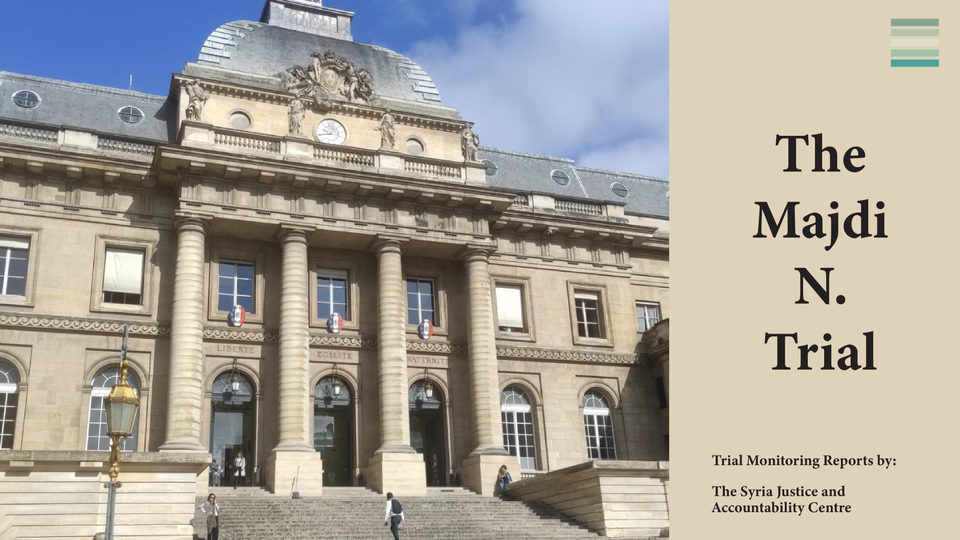
Inside the Majdi N. Trial #22: Testimony of Syrian Witness on Investigation into Jaysh Al-Islam's Prisons
TRIAL OF MAJDI N.
Court of Assize – Paris, France
Trial Monitoring Summary #22
Hearing Date: May 21, 2025
CAUTION: Some testimony may include graphic descriptions of torture, rape or other violent acts.
Note that this summary is not a verbatim transcript of the trial; it is merely an unofficial summary of the proceedings.
Throughout this summary, [information located in brackets are notes from our trial monitor] and “information placed in quotes are statements made by the witness, judges or counsel.” The names and identifying information of witnesses have been redacted.
[Note: SJAC provides a summary of the proceedings while redacting certain details to protect witness privacy and to preserve the integrity of the trial.]
[Note: Rather than publishing the trial reports of the Majdi N. case in chronological order, SJAC has organized them thematically and coherently based on the content of the hearings, making the material more accessible by highlighting key issues and connections across the proceedings.]
SJAC’s 22nd trial monitoring report details parts of day 13 of the trial of Majdi N. in Paris, France. On this trial day, W17 reported how, starting in 2013, he and Razan Zeitouneh investigated the judicial systems of different armed groups. W17 testified that, unlike other factions, Jaysh Al-Islam never granted them access to their detention facilities. W17 also deplored that the Unified Judiciary Council failed to gain a monopoly over all affairs, and each faction kept its own judicial authority and prisons. W17 mentioned having met a teenager who was 16 years old when released from Jaysh Al-Islam’s prison and whose brother had been forced to enlist because his family needed someone to work. W17 also reported to have talked with other underaged individuals who served within the group. W17 also testified to have been targeted by a campaign Jaysh Al-Islam launched to tarnish his reputation, calling him and his family infidels.
Day 13 – May 21, 2025
Morning Session
Proceedings began at 9:50 AM.
[Redacted name], W17 was heard pursuant to the discretionary authority of the Presiding Judge. [According to Article 310 of the French Code of Criminal Procedure, the Presiding Judge may, during the proceedings, call and hear any person whose testimony is deemed useful in establishing the truth. As they are not sworn in, their statements are regarded merely as informational and do not carry the same probative value as formal witness testimony.]
W17 was born in 1978 in Damascus and now lives in England. He worked as a journalist and in the human rights field for 20 years and is a volunteer at the Syrian Center for Media and Freedom of Expression (SCM). At the outbreak of the Syrian revolution, he left Darayya for Douma in Eastern Ghouta, where he stayed for five years and documented violations with Razan Zeitouneh, F21.
Starting in 2013, W17 and Razan Zeitouneh contacted factions in liberated areas to investigate prisons and tribunals. The responses varied, certain factions allowing them to enter their buildings and others not. The worst response came from Jaysh Al-Islam, W17 recounted. The witness reported that the group first made fun of them and asked if they were sent by the West. Jaysh Al-Islam then requested a written demand be sent to them, which the activists did, but the faction never replied to W17 and his colleagues.
W17 recalled that Jaysh Al-Islam used to interfere a lot in people’s lives, for instance against W17’s own wife, who worked in the field of child protection and was pressured to give different teachings to men and women. W17 also reported that women had to change the way they dressed.
Presiding Judge Lavergne inquired about the judicial system in Ghouta. W17 recounted that in 2013, each faction had its own court, judges, and even its own mufti issuing fatwas. Razan Zeitouneh had tried to conduct research on these bodies, and W17 reported that a program supported by Western countries was launched to professionalize tribunals and raise the salaries of their staff. W17 declared that the creation of the Unified Judiciary Council resulted from a coalition among factions who each appointed one or more judges to sit in this body. W17 testified that hearings were accessible to the people, and lawyers were appointed for certain hearings. However, W17 regretted that the Unified Judiciary Council failed to gain a monopoly over all affairs, and each faction kept its own judicial authority and prisons.
When asked by Presiding Judge Lavergne about the prisons, W17 reported that he met a lot of people who had been detained in the At-Tawba prison. Most of them reported torture and mistreatment. Most of the cells were underground, W17 continued, and the detention conditions were in general very difficult. W17 testified that the prisoners were soldiers and civilians, and could be men, women, or even children. Religious affiliation was also a reason for detention, W17 added, mentioning an Alawi woman who was arrested because of her clothes and her way of talking to men. When questioned about the conditions of detention, W17 mentioned the method of the “ghost,” or Shabeh, [شبح], where the prisoner is hung by his bound hands and suspended as high as possible for a long period of time. Detainees were also deprived of food, or sometimes forced to eat expired food, W17 described.
W17 further mentioned a teenager who was 16 years old when released from Jaysh Al-Islam’s prison and whom W17 and his colleagues tried to protect by taking him on as a clerk in their office. The brother of this teenager was a fighter in Jaysh Al-Islam and was killed in a battle. According to W17, the brother had been forced to enlist because his family needed someone to work.
Presiding Judge Lavergne inquired about conflicts between factions, and W17 reported that Jaysh Al-Islam conducted several battles against different groups, including ISIS. At the end of 2014, he continued, Jaysh Al-Islam tried to eradicate Jaysh Al-Umma, and managed to kill a lot of its members and arrest the others. For a long time, people thought that these prisoners had been killed but later learned that they were detained in Jaysh Al-Islam’s prisons, W17 added.
Presiding Judge Lavergne asked if Jaysh Al-Islam had a network of informants and spread propaganda. W17 reported that the group shared fake news about activists and W17 himself was targeted by a campaign that aimed at tarnishing his reputation. In this accusation campaign launched against him on social networks and in mosques, Jaysh Al-Islam depicted W17 and his family as infidels [كفار] and propagators of decadence.
Presiding Judge Lavergne inquired about the presence of child soldiers, and W17 asserted that he saw certain members of Jaysh Al-Islam who were under 18. Presiding Judge Lavergne wondered on what evidence he based this assumption, and W17 referred to their appearance but also testified that he asked several children who told him they were 16, 17, or 18 years old. The youngest he met was 16, W17 specified.
When questioned about the Accused, W17 said he only saw Majdi N. in the media, in his role as spokesperson.
Civil Parties’ Counsels’ Questioning of W17
Counsel Pasmentier wondered why, in W17’s view, Jaysh Al-Islam refused him and Razan Zeitouneh access to their prison. W17 recounted that they first met an officer overseeing a police station who treated them with respect. Then, another member of Jaysh Al-Islam entered the room, addressed the activists aggressively, and started accusing them of belonging to the West and the US. F29 said that a woman would never be allowed to visit the prison, but W17 might by authorized to do so, because he is a man. However, Jaysh Al-Islam never granted authorization to [redacted information] of them [see another description of the same encounter by Abdurrahman Al-Hamada, W10, in Trial Report #14].
Counsel Pasmentier then inquired about a documentary released by the German channel Deutsche Welle where [redacted name] [also called [redacted name]], F66 recounted having been beaten up by four teenagers of Jaysh Al-Islam under accusations of homosexuality and collaboration with the Syrian regime. Counsel Pasmentier wondered if such accusations were frequent. W17 testified that he personally knew F66 and had thought for a long time that he was dead. When he was released, W17 continued, his face was so pale that it was obvious he had not seen sunlight for a long period. W17 also heard that F66 had been severely tortured. W17 confirmed that the accusations brought against him were frequent.
Counsel Pasmentier asked if Jaysh Al-Islam intentionally targeted dissidents and [redacted information] in Ghouta. W17 mentioned [redacted name] F67 [the brother of [redacted name], W20], who was interrogated because he defended W17 against the accusations brought against him. F67 was detained and himself accused of corruption, W17 continued. W17 believed that Jaysh Al-Islam targeted activists who documented violations out of fear of being held accountable and that they did everything so Razan Zeitouneh would disappear quickly.
When questioned by Counsel Pasmentier, W17 confirmed it was important for the group to convey a certain image on the media landscape. W17 added that a commander of Jaysh Al-Islam even reckoned so in a discussion the two had in the context of the accusation campaign brought against W17. In response to it, some of W17’s colleagues started a campaign against Jaysh Al-Islam to support the activist, and Jaysh Al-Islam asked W17 to intervene to stop it.
Counsel Zarka further inquired about Jaysh Al-Islam's responsibility in the kidnapping of the “Douma four,” based on a recording of a conversation on Majdi N.’s seized computer. The conversation indicated that the Accused knew about the detention of Razan Zeitouneh. As a response, W17 said he obtained contradictory information about the kidnapping and mentioned a witness detained in Jaysh Al-Islam’s prison who claimed to have seen Razan Zeitouneh there.
Counsel Zarka alluded to the fact that Majdi N.’s popularity among ambassadors, international organizations, etc. was useful for Jaysh Al-Islam, and W17 indeed considered it was an advantage for the group.
Prosecution's Questioning of W17
Prosecutor Havard mentioned an article published in Al-Quds Al-Arabi in which Majdi N. was questioned about corruption and purification of the country. The article mentioned a reward announced by Jaysh Al-Islam to people who would give information on the location of F66. W17 confirmed he himself heard such announcements. W17 declared that such an announcement had also been made for the assassination of [redacted name] [former Head of Douma Martyrs Brigade], F36, with a reward amounting to around 10,000 US dollars. Prosecutor Havard then read a passage describing the torture inflicted on F66, and W17 confirmed he heard about intense torture F66 had suffered from.
Prosecutor Thouault referenced a document from the Violation Documentation Center (VDC) which made no mention of Jaysh Al-Islam’s prisons. Prosecutor Thouault explained this absence by the fact that Jaysh Al-Islam did not allow access to its prisons. W17 agreed on this interpretation and pointed out that the report expressly mentioned that access was not granted.
Prosecutor Thouault asked W17 to describe what the torture method of Falaqa فلقة was, and W17 explained the detainee was beaten on the soles of his feet.
Defense Counsel’s Questioning of W17
Counsel Kempf asked whether W17 personally heard the announcement of the reward for F66, and W17 denied, adding that the announcement was not made in the mosque, but through speakers installed outside the mosque. W17 could also not tell if it was Majdi N.’s voice in the announcement. Counsel Kempf added that the French transcript of F66’s video testimony did not point to Majdi N. being responsible for his detention.
Counsel Kempf noted that W17 lived in Douma from 2013 to 2018 and asked him at which date he and his spouse were targeted by the Jaysh Al-Islam's accusation campaign. W17 replied that it was in April 2017. W17 added that the magazine he worked in was located in the same building as the VDC, in the center of Douma. Counsel Kempf stressed that W17 worked there until 2017.
Counsel Kempf requested the projection of the poster in which W17 appeared alongside three other individuals [targeted by the same accusation campaign]. W17 confirmed it was the poster that was plastered all over the streets. Counsel Kempf then read the translation of a letter dated March 12, 2017 from the General Prosecutor’s Office of Douma, which demanded to identify the author of these unauthorized posters, to cease their distribution, and to take appropriate action. Counsel Kempf concluded that in March 2017, the prosecutor of Douma ordered an investigation into the incidents W17 was victim of. Counsel Kempf added that on March 8, a couple days prior, the same prosecutor had decided to close W17’s facilities.
W17 confirmed that the events unfolded as described; this started on March 7; W17’s office was closed; and the activists filed a complaint. After that, Jaysh Al-Islam launched its accusation campaign, and in response, [the activists] launched a campaign to support people who had been threatened by the faction. W17 added that between the initial complaint and the letter [from the prosecutor], several rounds of negotiations [between the activists and Jaysh Al-Islam] took place. They finally reached the agreement that normal judicial proceeding would be launched, and Jaysh Al-Islam would give its directives for the justice system to take the complaint into account. W17 declared that [the activists] obtained an order allowing them to reopen their office. The magazine and W17, as its representative, were brought before the court. After several hearings, the court ruled against the author of the article and the magazine’s editor, while the case against W17 was dismissed. Counsel Kempf noted that the judicial order to reopen W17’s office had not been added to the present case file.
W17 added that Jaysh Al-Islam denied having been the author of the posters. W17 noted that, however, the posters were colored and in A3 format and believed that Jaysh Al-Islam was the only group capable of printing such documents in the context of the siege. W17 reported that [in the negotiation phase] he and F67 met with two Jaysh Al-Islam commanders at midnight, in an atmosphere that was very tense. Despite Jaysh Al-Islam’s denial that they were behind it, they decided to take the necessary steps to limit this campaign, W17 testified. W17 left the meeting at 3 a.m. but feared for his security, so a commander of Jaysh Al-Islam made a phone call to ask for W17’s protection on his way back. W17 also noted that one of Jaysh Al-Islam’s commanders called the region’s police commander, who joined them five minutes later to take orders from Jaysh Al-Islam. W17 commented that it showed how independent the police were.
When questioned by Counsel Ruiz about the presence of Majdi N. in the media, W17 responded that when people saw him, they would always link him to Jaysh Al-Islam.
The Accused declared that he had no reaction to W17’s testimony.
Proceedings continued with the interrogation of Majdi N. on the facts of the case [see Trial Reports #29 to 31].
___________________________
For more information or to provide feedback, please contact SJAC at [email protected] and follow us on Facebook and Twitter. Subscribe to SJAC’s newsletter for updates on our work