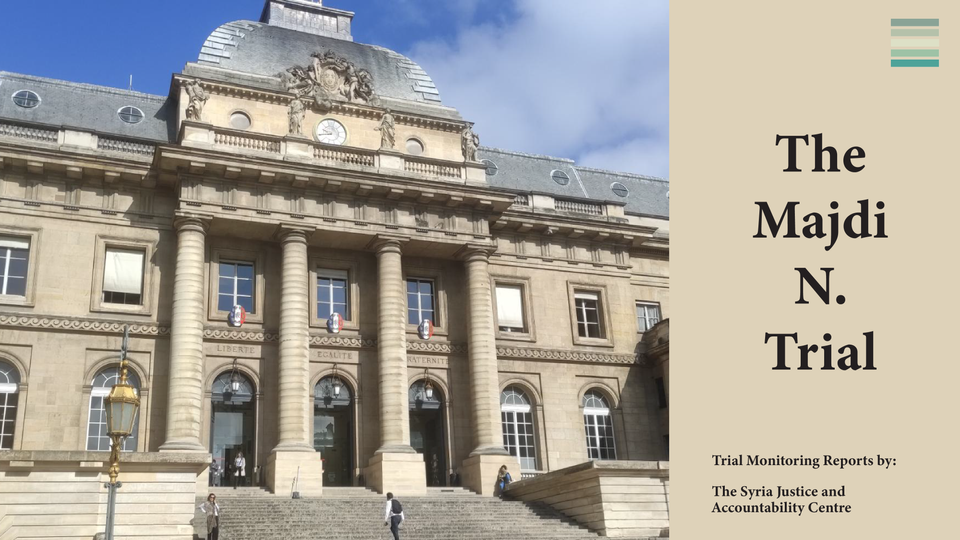
Inside the Majdi N. Trial #20: Testimony of Syrian Witness on Jaysh Al-Islam’s Prison System
TRIAL OF MAJDI N.
Court of Assize – Paris, France
Trial Monitoring Summary #20
Hearing Date: May 20, 2025
CAUTION: Some testimony may include graphic descriptions of torture, rape or other violent acts.
Note that this summary is not a verbatim transcript of the trial; it is merely an unofficial summary of the proceedings.
Throughout this summary, [information located in brackets are notes from our trial monitor] and “information placed in quotes are statements made by the witness, judges or counsel.” The names and identifying information of witnesses have been redacted.
[Note: SJAC provides a summary of the proceedings while redacting certain details to protect witness privacy and to preserve the integrity of the trial.]
[Note: Rather than publishing the trial reports of the Majdi N. case in chronological order, SJAC has organized them thematically and coherently based on the content of the hearings, making the material more accessible by highlighting key issues and connections across the proceedings.]
SJAC’s 20th trial monitoring report details parts of day 12 of the trial of Majdi N. in Paris, France. On this trial day, W16 reported to the Court how Jaysh Al-Islam arrested and detained him for 22 days in March 2015. During his imprisonment, W16 was tortured over several interrogation sessions. More generally, W16 described the poor treatment and humiliation suffered by detainees in Jaysh Al-Islam's At-Tawba prison. According to W16, several jailers he saw in detention were minors. W16 also indicated that some of his relatives joined Jaysh Al-Islam, including one of his cousins who was 16 years old at that time. Moreover, W16 claimed to have seen Majdi N. in a convoy passing through Ghouta at the end of 2013. He shared his view on Majdi N.’s responsibilities in the Media Office and Moral Guidance Office of Jaysh Al-Islam. W16 left Ghouta in October 2015. He insisted that, even during the siege, it was possible for Jaysh Al-Islam’s members, including Majdi N., to leave and come back to Ghouta using passages of the Syrian regime.
Day 12 – May 20, 2025
Morning Session
Proceedings began at 9:40 AM.
[Redacted name] W16 lives in Germany. He declared to know the Accused and the Syrian Center for Media and Freedom of Expression (SCM). The witness was sworn in.
W16 testified that he was imprisoned by Jaysh Al-Islam in March 2015 and was interrogated by someone he could not remember the identity of but added that Majdi N. surely knew him. W16 reported having been tortured in different ways and explained that they wanted him to admit to charges of treason against the country.
W16 indicated that he knew many close friends or relatives who joined Jaysh Al-Islam. Among them, he mentioned his cousin [ابن خاله] [redacted name] who was born on January 4, 1997, and who joined the group when he was 16 years old and later died.
W16 recounted that he was arrested five times by the Syrian regime because he took part in demonstrations [in Douma]. While he was working as an ambulance driver, he also witnessed many people being injured and dying because of the regime's attacks on Douma. W16 also witnessed the chemical attacks of August 21, 2013. W16 further reported that three of his cousins were killed by the Syrian regime.
W16 began working as a journalist in Douma. He reported that in early March 2013, several vehicles and armed men from Jaysh Al-Islam stopped near the building he was working in and arrested him. He remained in detention for 22 days. The investigation established that W16 had taken photos of a place they considered part of Jaysh Al-Islam’s security zone. According to W16, it was a location where they committed atrocities. In detention, Jaysh Al-Islam tried to charge him with accusations such as collaboration with the Syrian regime or with external parties, to find a pretext for his execution. W16 testified that he remained blindfolded for 22 days, and stayed in a sort of corridor alone. He had nobody he could speak with but could hear the voices of people being tortured.
During W16’s detention, Jaysh Al-Islam executed a man called [redacted name] F63, who was one of Jaysh Al-Umma’s leaders. W16 asserted that Majdi N. certainly knew about the execution. Until now, W16 continued, he did not know for what charges the man had been executed. W16 then mentioned what Jaysh Al-Islam called a judiciary authority [i.e. Unified Judiciary Council] and explained that the signatures of several judges were required in order to execute someone. Among the judges was [redacted name] F28.
Presiding Judge Lavergne inquired about Jaysh Al-Islam's arrest of W16. W16 recalled that he knew one of the people who participated in his arrest. W16 added that starting from the first day in prison, he was subjected to violence and mistreated in various ways. The three first days, W16 specified, he endured violence, physical blows, and psychological pressure. During interrogations, some people were nicer and extracted information without being violent. After three days, the interrogators started asking more personal questions and became more violent. He was hung by his arms for two to three hours as part of the “ghost” technique [شبح] and was beaten all over his body with sticks. They had special tools for flogging, W16 continued. There were always two people—one held him while the other beat him, and he would lose consciousness by the end of every torture session. When he regained consciousness, another torture session would begin.
W16 reported that afterwards, he was placed in a corridor without anyone speaking to him for 15 days. During this period, W16 heard how they beat and insulted people. During the last three to four days of his detention, interrogations resumed with the same questions and the same level of violence, W16 testified. The last two days, he added, they let him take a shower to reduce the visible traces of violence. All activists knew each other, W16 continued, and they exerted pressure from the outside to know where W16 was.
During the first four days of detention, W16 added, he was blindfolded [مطمش] and could only see the feet of people in front of him. He testified that he saw someone who wore civilian shoes, and not military shoes. While placed in the corridor, W16 understood that he was in prison Al-Batoon, also called the At-Tawba prison. W16 explained that there were maybe two adjacent buildings which belonged to the same prison.
W16 testified that he could not talk to the member of Jaysh Al-Umma F63 because the latter was executed once W16 arrived in detention, but he confirmed that F63 was detained next to him. Presiding Judge Lavergne asked how W16 could identify F63. W16 explained that he heard jailers call his name and also [redacted information]. W16 said that he also recognized [redacted name] age. Those inflicting this treatment on him were young, W16 added. Responding to Presiding Judge Lavergne, W16 declared that the people conducting the interrogations were not young.
W16 testified that he knew Majdi N. was spokesperson of Jaysh Al-Islam. He believed Majdi N. was informed about everything that was going on and participated in decisions [of the group]. Presiding Judge Lavergne asked how he could be so sure of that, and W16 replied that when a decision had to be made, they had to all agree on it, and Majdi N. was part of the command.
W16 declared that the scene of his release was filmed by [Jaysh Al-Islam member] [redacted name] F64 to make official the fact that W16 was not anymore under their responsibility. W16 remembered a Sheikh who attended this session and said W16 would return here if he continued his activity [as a journalist]. W16’s materials were seized, the witness added, and he had to insist to finally recover it after a month.
Presiding Judge Lavergne asked if W16 saw young people among Jaysh Al-Islam, and W16 responded that he could only mention the name of his cousin, but not the others he knew, since they could be subjected to pressure. W16 asserted that he saw young people as part of his documentation activities, stressing that their appearance showed that they were under 18. W16 added that people were starving, so they either had the choice to die or to join Jaysh Al-Islam. He noted that the Syrian army did not accept recruits under 18, but no law banned such recruitment. W16 added that Jaysh Al-Islam pledged to not recruit minors. W16 testified that, however, some members of the group were between 16 and 18 years old.
Shifting to Majdi N., W16 declared that he saw him once on the street. The Accused was reportedly sitting in a car with other members of Jaysh Al-Islam. W16 left Ghouta in October 2015 using tunnels, the witness concluded.
Civil Parties’ Counsels’ Questioning of W16
Responding to Counsel Bailly, W16 asserted that he did not understand why he was detained in Jaysh Al-Islam's prison. W16 confirmed that they intended to reeducate him. He added that he already knew that their behavior was dirty but had not realized that they had no limits.
Counsel Bailly mentioned a conversation between Majdi N. and [redacted name] F65, in which the Accused addressed the philosophy behind the At-Tawba prison. Counsel Bailly asked Majdi N. to comment. Majdi N. replied that, after three weeks of trial, he would follow the advice of his Defense and not reply to questions that are not directly related to the facts. Counsel Bailly then asked W16 to comment on the conversation. According to W16, this prison was created to instill remorse in all prisoners. He testified that after his release, he was scared—even of his own shadow. He did not reply to the people who inquired about what happened in detention, because W16 suspected anyone to report what he said. W16 testified that people were different after their release from the At-Tawba prison.
Counsel Bailly inquired about the conditions of detention. W16 testified that they shaved him and confirmed it was a form of humiliation. While in the prison’s corridor, W16 had to keep a blanket over his head all the time and remained blindfolded. He could only see daylight when he went to the toilet twice a day, and if he had to go a third time, he was subjected to violence.
W16 testified that he had two meals a day, but not in large quantities. However, W16 noted, people outside were starving because of the siege. Inside the prison, there was bread and food supply, which W16 found contradictory with the outside situation.
When questioned about the age of the jailers, W16 testified that he could feel that they were around 15 or 16 years old when he took something from their hands. W16 also said that Jaysh Al-Islam formatted his computer and gave it back to him after everything was deleted.
Counsel Bailly inquired about public executions. W16 confirmed he was an eyewitness to the execution of a man accused of homosexuality and affiliation with ISIS. Regarding the latter, W16 added that Jaysh Al-Islam tried to charge him with a similar allegation, but they failed because W16 was very far from this organization. W16 believed that such allegations allowed them to have a pretext to execute people in front of the public, otherwise the public would turn against Jaysh Al-Islam.
Concerning Majdi N.’s role, W16 asserted that he had heard from people belonging to Jaysh Al-Islam’s Media Office that Majdi N. was working there as spokesperson of the group. Counsel Bailly directly asked Majdi N., who confirmed that he used to sign travel authorizations [in French: ordre de mission] and was deputy head of the Moral Guidance Office مكتب التوجيه المعنوي. Majdi N. added that 90 people used to work for him.
Counsel Bailly mentioned an organizational chart of Jaysh Al-Islam in which F64, [redacted name], and [redacted name] [names unclear], who all belonged to the Media Office, were visible. W16 added that photo No. 89 [from a photo line-up presented by the Investigative Judge of Jaysh Al-Islam's members] was of [redacted name], a journalist who used to work with Jaysh Al-Islam.
Responding to Counsel Bailly, W16 confirmed that the Media Office intended to justify Jaysh Al-Islam’s actions at all costs. He added that Majdi N. tried to portray Jaysh Al-Islam in a positive light. W16 testified that Majdi N. was one of the people in charge of communication and relations. Counsel Bailly reported W16’s statement to the Investigative Judge about how Majdi N. used to move back and forth throughout Ghouta.
Counsel Bailly asked what W16 meant by the idea that famine was exploited to recruit minors. W16 mentioned a warehouse belonging to Jaysh Al-Islam where protesters found an unbelievable amount of food supplies. In W16’s view, it was proof that Jaysh Al-Islam intended to install famine in the region. At a later point, W16 indicated that Jaysh Al-Islam promised to judge and punish the soldiers and members of the group the food supplies belonged to, but they did nothing.
When questioned about Jaysh Al-Islam's training centers, W16 declared that the training sessions last 40 days and consisted of an intense physical training and a brainwashing. To W16, people who participated in these trainings had a lack of culture and were easy to influence. W16 referred to friends of his who did not talk to him anymore after they participated in such trainings. W16 declared that Majdi N. was a trainer there, even though he himself did not see Majdi N. The training center was located somewhere in Ghouta, W16 added.
Prosecution's Questioning of W16
[Trial monitor missed around ten minutes of the proceedings.]
Prosecutor Havard inquired about the political police [of Jaysh Al-Islam], and W16 replied that the so-called Hisbah حسبة arrested people on the streets, for instance if a man went out with a woman. However, these police gradually disappeared. Responding to Prosecutor Havard, W16 confirmed these police were an extension of the Moral Guidance Office.
Prosecutor Thouault questioned W16 about a journalist from Al-Jazeera called [redacted name], whom W16 was interrogated about in detention. Jaysh Al-Islam ordered him to not contact her anymore. W16 confirmed she had been threatened by Jaysh Al-Islam, and the group arrested her mother. W16 also confirmed that she left Ghouta.
When questioned about the day when he saw Majdi N. in Ghouta, W16 said that it was at the end of 2013. Prosecutor Thouault asked how he recognized Majdi N., and W16 said that when a convoy passed by, everyone knew who it was. W16 added that Jaysh Al-Islam’s members used to announce who was coming and confirmed that he saw Majdi N. in the car.
Prosecutor Thouault asked if it was easy to leave Ghouta in October 2015 during the siege, as W16 did. W16 denied, adding he was lucky because he knew someone who could help him leave. He did not pay anything, but civilians sometimes did, he added. Prosecutor Thouault quoted Majdi N.’s statement to the Investigative Judge where he had explained that it was totally impossible to leave, even through contacts or money. W16 responded that some people could leave and come back, stressing that Jaysh Al-Islam used the passage controlled by the regime and certainly paid to go through. In W16’s view, anyone who knew someone from the regime could pay and leave.
Defense Counsel’s Questioning of W16
Counsel Ruiz asked W16 if he had ever heard a speech by Majdi N. announcing the commission of war crimes or mentioning the recruitment of children, which W16 denied. Responding to Counsel Ruiz, W16 also reckoned that he knew no acts of Majdi N. that could have led to his imprisonment and never saw him in detention.
Counsel Ruiz pointed out that during W16’s detention from March 3 to March 23, 2015, Majdi N. had already left Ghouta and was in Turkey, where he worked as spokesperson of Jaysh Al-Islam. W16 reckoned that he heard of no declaration or post published by Majdi N. on his case.
Counsel Ruiz showed W16 a photo of F64, and W16 confirmed it was him. Responding to Counsel Ruiz, W16 said that F64 was not really a supporter of Jaysh Al-Islam and no official document attested to it. However, W16 asserted that he did work for them and filmed W16’s release, together with [redacted name].
Counsel Ruiz declared that there were not many operatives within Jaysh Al-Islam’s jailers who were minors and asked W16 to describe their role. W16 said that the underage jailers assisted the interrogators in torture sessions, distributed food, and humiliated prisoners. W16 added that the underage jailers also beat him when he intended to go to the toilets and it was not his turn.
Counsel Ruiz wondered on what W16 based his statement that everything in the Media Office had to be approved by Majdi N. W16 repeated that Majdi N. was the head of the office but had no more evidence than that. W16 did not know if Islam Alloush had relations with the Alloush family from Douma, which was known to be Salafist.
When questioned again about the day he saw Majdi N. in Ghouta, W16 repeated it was at the end of the summer or beginning of the winter of 2013. Counsel Ruiz said that Majdi N. had already left the region at that time, and W16 retorted that he went back and forth. W16 again confirmed that he saw Majdi N.’s face on this occasion.
Proceedings were suspended at 1:01 PM.
___________________________
For more information or to provide feedback, please contact SJAC at [email protected] and follow us on Facebook and Twitter. Subscribe to SJAC’s newsletter for updates on our work