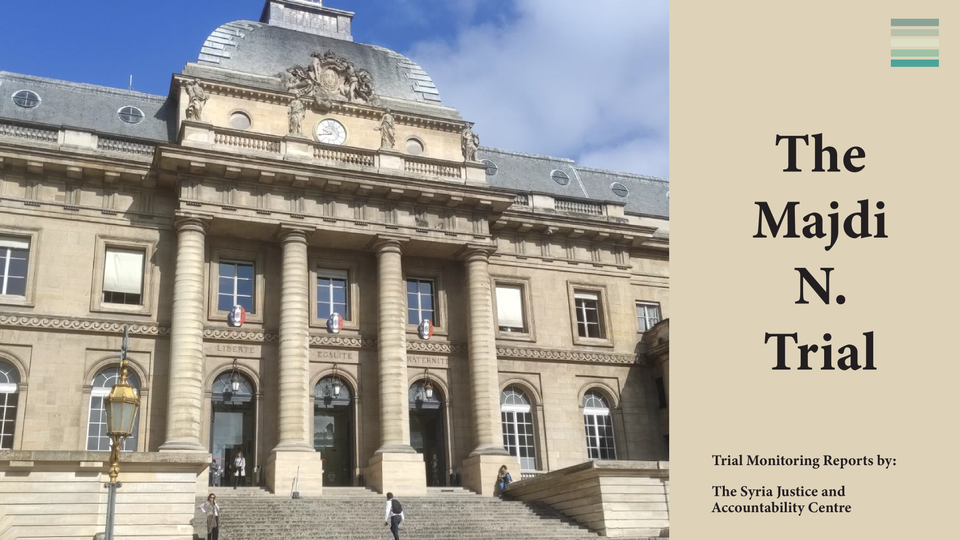
Inside the Majdi N. Trial #19: Testimony of Syrian Witness on the Detention of Civilians after the Attack on Adra Al-Omaliya
TRIAL OF MAJDI N.
Court of Assize – Paris, France
Trial Monitoring Summary #19
Hearing Date: May 19, 2025
CAUTION: Some testimony may include graphic descriptions of torture, rape or other violent acts.
Note that this summary is not a verbatim transcript of the trial; it is merely an unofficial summary of the proceedings.
Throughout this summary, [information located in brackets are notes from our trial monitor] and “information placed in quotes are statements made by the witness, judges or counsel.” The names and identifying information of witnesses have been redacted.
[Note: SJAC provides a summary of the proceedings while redacting certain details to protect witness privacy and to preserve the integrity of the trial.]
[Note: Rather than publishing the trial reports of the Majdi N. case in chronological order, SJAC has organized them thematically and coherently based on the content of the hearings, making the material more accessible by highlighting key issues and connections across the proceedings.]
SJAC’s 19th trial monitoring report details parts of day 11 of the trial of Majdi N. in Paris, France. On this trial day, Presiding Judge Lavergne read W15’s statement before the Investigative Judge. In her statement, W15 reported that she was arrested during the attack on Adra Al-Omaliya in December 2013 and detained until 2016 by several factions, including Jaysh Al-Islam. She described her detention conditions and mentioned acts of torture. She also recounted how men were used to construct tunnels, and sometimes died at work, like her brother.
Day 11 – May 19, 2025
Afternoon Session
Proceedings resumed at 6:25 PM.
Presiding Judge Lavergne read aloud the statement of [redacted name], W15, made before the Investigative Judge on March 26 and April 9, 2021. Because she did not appear in court, her testimony had less value than a formal witness testimony, meaning that the Court could not convict the Accused solely on its basis.
Reading of W15’s first statement to the Investigative Judge
Presiding Judge Lavergne read the first hearing’s report, in which W15 stated that she had lived in Adra Al-Omaliya with her parents since 1995. On December 13, 2013, she reported, factions arrived in the city and shot her brother [redacted name] dead in the street. W15 later learned that the scene had been recorded but had never managed to obtain the video. She asserted that her brother was a civilian, working as a public servant. W15 noted that the factions present were Jabhat Al-Nusra جبهة النصرة and Jaysh Al-Islam. The neighbors came to warn them and told W15’s family to hide in the basement, where they stayed for 20 days.
Presiding Judge Lavergne further read that after they got out [of the basement] and arrived at the town’s outskirts, Jaysh Al-Islam asked W15 and her family for their identity cards and noted that W15 was unveiled in the picture. They asked W15 when she began wearing the headscarf, and she responded that she started recently. W15 also reported that the men grabbed her brother by the throat, and her nephew started screaming. W15 told them they were ready to follow them but asked them to let her brother go.
In her statement, W15 then recounted that they were taken in city buses seized by the militias to another location in Adra Al-Omaliya’s 11th or 12th residential subdivision called At-Tawasso’ التوسع and imprisoned there for five months. She recalled that all detainees belonged to religious minorities, such as Alawi, Druze, Ismaili, Christian, and Shia. W15 herself was Ismaili, Presiding Judge Lavergne read. W15 also indicated that they were around 300 women and children, and they had been separated and divided into six rooms. There was only one toilet for all, and a woman aged 70 died of starvation during detention.
After five months, W15 explained that they were brought to Ghouta, and the men used to dig tunnels. Presiding Judge Lavergne then read the harsh detention conditions W15 described to the Investigative Judge. W15 further explained how her brother [redacted name], F60, died with another man called [redacted name] in August 2016 while digging a tunnel. They could never retrieve her brother’s body, since he was underground when he died.
Presiding Judge Lavergne reported the Investigative Judge’s question on the reason behind the attack on Adra Al-Omaliya. W15 responded that she did not know but pointed to the religious diversity in Adra Al-Omaliya, which she considered a peaceful town, considering there was no military presence. The Investigative Judge then inquired about the faction that detained W15, and she replied she was arrested by a group called Ittihad Al-Islami الإتحاد الإسلامي [the Islamic Union; likely referring to the Islamic Union of Ajnad Ash-Sham].
W15 recalled that the militiamen often entered their cells to film the detainees in order to prove to the regime that they held hostages. W15 stated that one day, [redacted name], F29 came and announced their transfer to the At-Tawba prison. Asked by the Investigative Judge how she could recognize him, W15 recalled his face and blue eyes and said that people knew he was even more important than Zahran Alloush. Five militia men filmed the scene, W15 continued, and the women were told which faction they would go with. The first group went with Jaysh Al-Islam, and W15 reported that her group left with Ittihad Al-Islami. A third group was assigned to Jabhat Al-Nusra and the last one to Ahrar Al-Sham. W15 pointed out that Jaysh Al-Islam had the biggest number of prisoners.
Presiding Judge Lavergne further read W15’s story of her transfer, as a detainee of Ittihad Al-Islami, through a tunnel to Ghouta. W15 recalled that on the way, she carried her five-year-old nephew with her. They were transferred to the prison of Arbin عربين, where W15 reported having heard screams of torture. She gave further details about the detention conditions there.
W15 explained to the Investigative Judge that after ten days, they were taken to Douma by bus and put in a basement, where she saw her aunt [redacted name], F59. It was the first time she saw women jailers who had warriors' names such as [redacted name] or [redacted name], W15 noted. She further described her interrogations there. She also recalled that one day, [redacted name], F35 told them that men would now guard them at night, and she described how the women detainees complained about it. W15 asserted that the families remained without news of their detained relatives for five months, and at some point, W15 could call her father with one of the women jailer’s phones.
Regarding the [aforementioned] videos of detainees filmed by factions, W15 stated that they aimed at triggering a reaction among each community to let everybody understand the lack of medication and food endured by the inhabitants of Ghouta. They were also a way to show that their detainees were in good health and ready to be exchanged. W15 reported that she stayed there [in the basement in Douma] for two months and, during that period, her aunt F59 was taken to be exhibited in cages in the streets of Douma.
Presiding Judge Lavergne reported that the Investigative Judge then inquired about W15’s aunt F59. W15 explained that F59 was detained by Jaysh Al-Islam and that this group soon attacked Ittihad Al-Islami, whose detainees, including W15, were then transferred by bus to an agricultural research center. Zahran Alloush got killed, W15 continued, and in the same period, W15 was presented to [Jaysh Al-Islam member] [redacted name], who asked her how things went with Ittihad Al-Islami. W15 also reported that both Zahran Alloush and [redacted name] took women they chose for their beauty. After two weeks, W15 continued, Jaysh Al-Islam handed them over to faction Faylaq Al-Rahman.
According to W15’s statement to the Investigative Judge, her aunt F59 had been interrogated by Zahran Alloush, who realized that she was educated and made excuses for the treatment she had endured. Regarding the exhibition of people in cages, W15 reported her aunt F59’s observation that all were prisoners from Adra Al-Omaliya. However, F59 continued, people [on the streets of Douma] thought that they were acquainted with the Syrian regime.
The Investigative Judge reportedly showed photos to W15, and she recognized Zahran Alloush and F29. When questioned about Razan Zeitouneh and Islam Alloush, she said she never heard of them.
At the end of her first hearing, W15 declared that she did not want to be an anonymous witness despite her fears, because she felt obligated to testify openly for the two brothers she lost.
Reading of W15’s second statement to the Investigative Judge
In this second hearing before the Investigative Judge, W15 shared a video she obtained from her aunt F59. It was a documentary of the At-Tawba prison from a Dutch journalist.
W15 then detailed her detention with Faylaq Al-Rahman, which brought them to the Ain Tarma عين ترما prison, where she stayed for five months. W15 recounted that they were tortured over any pretext, and that she was placed several times in an isolation cell, particularly after the detainees had intended to go on a hunger strike. She also recalled her brother F60 asking her on one occasion if she could convince women jailers to stop forced labor inflicted on men.
W15 further described how [redacted name], F61, head of faction Faylaq Al-Rahman, came to ask them why they went on a hunger strike. At this occasion, the women detainees asked him why civilians were forced to dig tunnels. Concerning W15’s brother, F61 said that he would join the military and rise against them, should he be released. W15 retorted that it would not be the case since her family was neutral. F61 said that they would be released if the regime accepted their demands. A couple of days later, three people were released, but W15 learned that her brother F60 died after the regime conducted airstrikes on the tunnel he was working in.
W15 reported that afterwards, they were brought to the third floor of the building and warned that they would die, should it be targeted by airstrikes. F61 reportedly invited them to pray and added that the regime might accept their demands tonight. The detainees were then told that general Jamil Hassan جميل حسن [former head of the Syrian Air Force Intelligence Directorate and close adviser to President Bashar Al-Assad] would come to meet them. When he arrived, Jamil Hassan told the detainees that they would be brought back to their families the next day but first questioned by the Air Force Intelligence. According to W15, the detainees reported that they could not see any faces [of factions’ members], because all were veiled, and only knew the names of F35 and of the spokesperson of Ittihad Al-Islami, whereas all others carried aliases. W15 then recounted that they received a sum of money and a pass they should keep before receiving a new ID card. W15 saw her mother again on December 11, 2016, and arrived in France on March 9, 2018. W15 added that her brother [redacted name] was released around the liberation of Ghouta.
The Investigative Judge then specifically asked how the children experienced detention. W15 replied that [her nephews] were five and eight years old and the oldest, [redacted name], F62, has suffered to this day. W15 described to the Investigative Judge shocking scenes F62 had seen in detention and recounted that one jailer once brought him to see his father. W15 recalled that, in detention, all children used to sleep at night, except for F62.
Proceedings were suspended at 7:44 PM and resumed at 7:57 PM.
Questioning of Majdi N. on W15’s statements to the Investigative Judge
Presiding Judge Lavergne turned to Majdi N. and asked him if he had any reaction to W15’s statement to the Investigative Judge. Majdi N. said he did not. Presiding Judge Lavergne then asked if Majdi N. knew about civilians arrested in Adra Al-Omaliya and detained by Jaysh Al-Islam in collaboration with other factions. Majdi N. responded that he had nothing to declare. When asked if he recalled that Jaysh Al-Islam also held detainees of Faylaq Al-Rahman, Majdi N. said he did not. Presiding Judge Lavergne asked if the Accused remembered [redacted name], and Majdi N. confirmed, adding he was spokesperson of Faylaq Al-Rahman. Presiding Judge Lavergne then read a conversation in which it was said that a man was detained by Jaysh Al-Islam but his supervisory authority was Faylaq Al-Rahman.
Prosecutor Havard mentioned a video published on Facebook on July 20, 2014, in which women and children presented as detainees of Jaysh Al-Islam discussed their conditions of detention. The women reported having been detained for seven months and coming from Adra Al-Omaliya.
Prosecutor Thouault then requested the projection of a video shared by the International, Impartial and Independent Mechanism with images of the attack on Adra Al-Omaliya and which explained the objectives of the battle. Prosecutor Thouault reported that the video was shared in 2019 for the occasion of the sixth anniversary of the battle of Adra Al-Omaliya, at a date when Majdi N. was still in office. Majdi N. retorted that he was not in office anymore at that time.
Proceedings continued with the request for referral filed by the Defense [see trial report #24].
___________________________
For more information or to provide feedback, please contact SJAC at [email protected] and follow us on Facebook and Twitter. Subscribe to SJAC’s newsletter for updates on our work