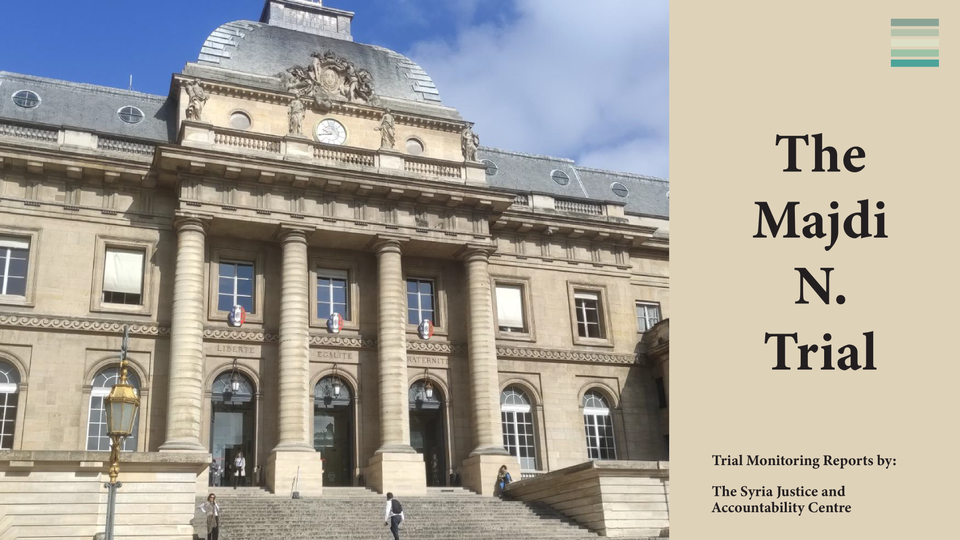
Inside the Majdi N. Trial #17: Testimony of Syrian Witness on Majdi N.'s Commitment to Apply International Humanitarian Law in Jaysh Al-Islam
TRIAL OF MAJDI N.
Court of Assize – Paris, France
Trial Monitoring Summary #17
Hearing Date: May 16, 2025
CAUTION: Some testimony may include graphic descriptions of torture, rape or other violent acts.
Note that this summary is not a verbatim transcript of the trial; it is merely an unofficial summary of the proceedings.
Throughout this summary, [information located in brackets are notes from our trial monitor] and “information placed in quotes are statements made by the witness, judges or counsel.” The names and identifying information of witnesses have been redacted.
[Note: SJAC provides a summary of the proceedings while redacting certain details to protect witness privacy and to preserve the integrity of the trial.]
[Note: Rather than publishing the trial reports of the Majdi N. case in chronological order, SJAC has organized them thematically and coherently based on the content of the hearings, making the material more accessible by highlighting key issues and connections across the proceedings.]
SJAC’s 17th trial monitoring report details day 10 of the trial of Majdi N. in Paris, France. On this trial day, W13 testified that he was detained with Majdi N. in 2010 in Palestine Branch for around 20 to 30 days. Most striking were W13’s close ties with several members of Jaysh Al-Islam, particularly Zahran Alloush and F25, whom he met in detention. W13 also reported that his cousin F47 was deputy commander of Jaysh Al-Islam. During the Syrian conflict, W13 testified, he conducted trainings in international humanitarian law for different factions. When it came to Jaysh Al-Islam, he coordinated with Majdi N. to select the attendees. Regarding the content of the training, W13 explained that he referred to principles of Sharia law to advocate for the necessity of respecting international humanitarian law. He was then extensively questioned by the parties about possible contradictions between Sharia and international law. W13 also affirmed having met Majdi N. several times in Turkey and Syria between September 2013 and December 2015. He asserted that Majdi N. did not travel to Ghouta during this period.
Day 10 – May 16, 2025
Morning and Early Afternoon Session
Proceedings began at 09:42 AM.
Witness [redacted name] W13 testified that he knew the Accused as well as members of the Syrian Center for Media and Freedom of Expression (SCM), Civil Party Mazen Darwish and his wife, in addition to [redacted name]. W13 is of Swiss nationality.
W13 was sworn in. He began his testimony saying that in Syria, relationships are very complex, and work gets mixed in with social and personal relationships. Relations are controlled by customs and not by law. For example, a murder case can be settled amicably without going through the courts. In W13’s view, understanding this deep context [لسياق العميق] took time. W13 asserted that it still did not diminish the respect he had for the present Court.
W13 testified that he was detained from September 2009 to June 2011 and during this period, he spent around 20 to 30 days with Majdi N. in Palestine Branch, or Branch No. 235, in 2010. W13 described Majdi N. as an educated, cultured, and polite person [شخص متعلم ومثقف ومؤدب] who interacted with everybody. W13 gave Arabic and poetry classes in detention, and Majdi N. was one of the few who attended.
When questioned by Presiding Judge Lavergne about the reasons behind his arrest, W13 testified that he was accused of membership in the Communist party. He then confirmed to have participated in protests against the Syrian regime as a member of this party, an engagement in the opposition he inherited from his father. W13 also recounted that he studied Islamic law and comparative law in different universities such as the Syrian branch of University Al-Azhar, in Medinah, Saudi Arabia, and in Novi Pazar, Serbia, and had completed his studies in 2005. According to him, he was arrested for security reasons.
When questioned about Douma, W13 reported he had long-standing ties to this city and pointed out its unique character. He emphasized that Douma was a conservative city that had little connection to the central state. For instance, no military officer from the Syrian Army came from there.
Regarding his detention, W13 reported to have met other individuals, including [redacted name], F25, with whom he spent two months in Branch 216. W13 added that he had known F25 since 1998 and noted that F25 was not educated [غير متعلم] but had studied in mosques with Sheikhs. W13 reported to have participated in classes that F25 gave but realized that his teaching was flawed. As a result, an intellectual conflict erupted between them in 2003, which has lasted until today. When questioned by Presiding Judge Lavergne about the part of F25’s teaching he considered wrong, W13 mentioned fundamentalism and the inability to accept someone else’s opinion, as well as disagreement on traditions in Douma.
W13 reported to also having met Zahran Alloush in Palestine Branch, adding that he had known him since 1998 because they were neighbors. W13 added that Zahran Alloush’s father had been his teacher in school for six years. Moreover, after leaving the Communist party, W13 attended religious classes by Sheikh [redacted name], Zahran Alloush’s father, in Douma’s Mosque Al-Tawhid. W13 reported that he and Zahran Alloush also studied at the same university and worked in the same shop for a small period of time. When questioned by Presiding Judge Lavergne, W13 testified that he also knew [redacted name], F7.
W13 said that he took part in the revolution after his release in June 2011 and started organizing demonstrations in coordination with activists, including Razan Zeitouneh. W13 also indicated that he created a Revolutionary Command Council مجلس قيادة الثورة in rural Damascus. After his first period of detention, W13 reported that he was imprisoned again in Branch 215 in Damascus starting in December 4, 2011 for a period of two to three months. When questioned by Presiding Judge Lavergne about the militarization of the revolt, W13 described that everything had changed when he was released in early 2012, since the revolution was now armed. W13 added that several factions emerged, pointing out that Liwa Shuhada Douma لواء شهداء دوما was headed by his brother [redacted name], aka [redacted name], who died before the creation of Jaysh Al-Islam during a fight with the Syrian regime.
W13 said that Zahran Alloush established a movement called the Islam Campaign سرية الاسلام, that first brought together 14 people. This group then became Liwa Al-Islam, and later Jaysh Al-Islam. W13 asserted that he was never a member of this group, but his cousin [redacted name], F47 was deputy commander of Jaysh Al-Islam. Responding to Presiding Judge Lavergne, W13 testified that he had had no relations with F47 since 2003, and a significant dispute erupted in 2007, so that the rupture became official. W13 recounted that since then, F47 had tried several times to kidnap W13’s children, because he believed that their education was not rigorous enough. W13 reported that he also met [redacted name], F29 in 2001, who then became head of Jaysh Al-Islam’s security apparatus, including prisons.
W13 detailed his movements between Damascus and Douma in 2012 and 2013. He specified that he was wanted [مطلوب] by the Syrian army, so he mostly stayed in Damascus, where it was easier to hide than in Ghouta. W13 emphasized that he was in Ghouta during the chemical attacks on August 24, 2013.
W13 reported that on March 11, 2012, his wife gave birth to his son [redacted name] and then died an hour and a half later. The next day, he went back to Douma, buried his wife, and directly went back to Damascus, where he lived with his children in Al-Mazzeh. However, in June or July 2012, W13 reported, he went back and settled in Ghouta. When questioned about his encounter with the Accused, W13 testified that he headed the Revolutionary Command Council at that time, and was contacted by Majdi N., who had joined Liwa Al-Baraa after having defected from the Syrian army. W13 offered to take Majdi N. with him, and Liwa Al-Baraa agreed to let Majdioand July 2012, Majdi N. was still doing his military service. W13 said he did not remember the date but asserted that he met him a little while after W13 returned to Ghouta.
W13 reported that Majdi N. then stayed at W13’s place. W13 presented him to [redacted name] and offered him to work for the revolution. Majdi N. reportedly replied that he intended to rather work in the military and join Liwa Al-Islam since he knew its leader Zahran Alloush. Presiding Judge Lavergne asked where Majdi N. precisely wanted to work, and W13 responded that he had intended to join the media sector. W13 said that he did not know what Majdi N.’s specific activities were in Liwa Al-Islam, because the things that were not shared in the media were confidential. W13 stressed that he knew about Majdi N.’s functions as spokesperson but had not heard of his responsibilities in the Moral Guidance Office مكتب التوجيه المعنوي. W13 reported that Majdi N. participated in a training camp [مخيم تدريبي] in Northern Syria, which was not a secret. W13 reported that Majdi N. regularly came to W13’s office to take advice on the Arabic language and on how to present himself in front of the camera, because of the equipment available at W13’s office. W13 also indicated that Majdi N. left Ghouta five to six months before him, in June 2013.
W13 reported that he himself left Ghouta on August 24, 2013, and arrived in Turkey on September 13, 2013. Between these dates, W13 met Majdi N. for a coffee near a military airport close to Aleppo, in the region of Shish منطقة شيش. W13 added that he met Majdi N. several times after that. Presiding Judge Lavergne asked how W13 knew that Majdi N. had left Ghouta five months earlier, and W13 simply said that Majdi N. came to say goodbye. According to W13, being outside Ghouta and closer to the Turkish border made Majdi N.'s task easier. In response to a question from Presiding Judge Lavergne, W13 said Majdi N. was called Islam Alloush to protect his family, who lived in a regime-held area.
According to W13, he and Majdi N. sometimes met for personal reasons, particularly upon W13’s arrival to Turkey when he sought advice about the life there. After that, W13 testified that his encounters with Majdi N. were mostly professional, since W13 was one of the 71 founders of the Syrian Opposition Council مجلس السوري المعارض. Moreover, W13 contributed to the National Coalition of Syrian Revolutionary and Opposition Forces الائتلاف الوطني السوري for more than ten years. For example, W13 relayed that he contacted Majdi N. to prepare meetings on political affairs, the same way as he did with spokespersons of other factions.
When questioned about the location of these encounters, W13 explained that he worked as a trainer for an organization called the ‘Afaq Academy’ which was related to ‘Geneva Call.’ Its aim was to prevent the recruitment of children. The trainings were called “Combatants and not murderers,” [مقاتل لا قاتل] W13 indicated, and were aimed at raising awareness on international law regarding the protection of children. Majdi N. was his point of contact within Jaysh Al-Islam, and an agreement was signed between W13’s organization and the group. Presiding Judge Lavergne noted that W13 had not reported the existence of such a contract during the investigation, and W13 added that this agreement solely concerned organizational issues such as schedules, training content, level, etc. Presiding Judge Lavergne inquired about the content of the trainings. W13 replied that he mixed international law and Islamic concepts, because he knew the trainees’ mindset and found that some concepts were close to Sharia rules when it, for instance, came to the protection of prisoners, etc.
W13 declared that Majdi N. participated in a training in Gaziantep in 2014 or early 2015, and that they also went to the headquarters of Jaysh Al-Islam close to Sarmada [in Syria] to conduct trainings. When questioned by Presiding Judge Lavergne, W13 asserted that he saw Majdi N. several times in Sarmada and recalled that they would visit the city together after trainings. However, he could not precisely say how many times he saw Majdi N. there, since he traveled 200 to 300 times to northern Syria in this period to also see other factions.
Presiding Judge Lavergne reported W13’s statement to the Investigative Judge about a training that he conducted in Gaziantep mid-2015. W13 reportedly indicated that he did not recall if Majdi N. was present or not. W13 confirmed it was the same training he just referred to, and that Majdi N. was present. He clarified that Majdi N. did not consider himself a trainee, so W13 could not say he really participated in the training, but he confirmed that Majdi N. came and left.
Presiding Judge Lavergne also mentioned a dozen trainings for Jaysh Al-Islam in Babesqa بابسقا in the region of Sarmada in Syria, which took place between April and September 2015. Presiding Judge Lavergne reported that the six-month program aimed at showing that international humanitarian law was not in contradiction with Sharia. W13 reportedly added that Majdi N. was present during the training in Babesqa, but not in other trainings that W13 organized. W13 also declared that Majdi N. took part in other Afaq Academy trainings in rural Idlib in 2015, in a building that Jabhat Al-Nusra جبهة النصرة later took over. Responding to Presiding Judge Lavergne, W13 testified that he also saw Majdi N. in southern Turkey where the Toran Center was located. Presiding Judge Lavergne added that W13 declared to the Investigative Judge to not having seen Majdi N. in person after 2015, since W13 then left for Switzerland, except once in Barcelona in 2018. W13 confirmed that everything was true, adding that Majdi N. also visited him in Geneva.
Responding to Presiding Judge Lavergne, W13 indicated that he was married to Céline Morgan, F15. When questioned about her links with Majdi N., W13 said that the two were in contact when F15 oversaw the Syrian file of Geneva Call. W13 explained that he left Geneva Call when F15 joined the organization, because it was not possible for a couple to work there. W13 added that “the advantage of the Swiss is that they don't talk about work at home.”
Presiding Judge Lavergne inquired about Majdi N.’s resignation from Jaysh Al-Islam. W13 responded that he was among the first Majdi N. sought advice from before leaving the group. They had a long discussion on the phone, W13 reported, and W13 first advised him to stay, but after a while, he told him that he would support him if he resigned. Presiding Judge Lavergne asked why Majdi N. wanted to resign. According to W13, the idea arose after Zahran Alloush’s death, who represented the most moderate trend within Jaysh Al-Islam. Presiding Judge Lavergne wondered what W13 meant by moderate, and W13 replied he meant [those who were] not extremist, liked people, and did not declare others as unbelievers [The witness said “لا يكفر الأخرين”–this Arabic expression meaning “to declare as unbelievers” was not translated into French by the interpreter]. Responding to Presiding Judge Lavergne, W13 asserted that this moderate trend accepted dialogue and negotiations as well as principles of international law and human rights. In W13’s opinion, those people were able to change their mind [قادر غير رائيه] through dialogue.
Presiding Judge Lavergne wondered if W13 talked with Zahran Alloush about prisons, which W13 confirmed, adding that he also discussed the ‘Douma four’ with him and managed to convince him on many subjects. W13 declared he only knew one prison managed by Jaysh Al-Islam situated in a secret location. Regarding the exhibition of people in cages, W13 knew about this event and explained that Zahran Alloush told him that he was forced to act so as to prevent the bombing of civilians [by the Syrian regime]. When questioned about Jaysh Al-Islam’s treatment of ISIS prisoners, W13 declared that he had insisted with Zahran Alloush to not treat them the same way ISIS treated prisoners. Presiding Judge Lavergne asked what Zahran Alloush did, and W13 confirmed they killed the prisoners. He declared that there was no difference between both groups on this point. “So, was he moderate?” Presiding Judge Lavergne asked. W13 replied that he had been misunderstood and insisted that it was a particular context, with very difficult siege circumstances. So, moderation did not apply in such circumstances, and W13 concluded that sometimes, people did things they did not want to do. At this point, Presiding Judge Lavergne showed irritation.
W13 argued that there was another more radical trend [than the one mentioned above] within Jaysh Al-Islam, which believed their opinion was the truth and did not accept different points of view. Presiding Judge Lavergne wondered what Majdi N. told W13 about these two trends, and W13 responded that the Accused belonged to Zahran Alloush’s wing. Presiding Judge Lavergne asked again if Zahran Alloush was moderate, and W13 retorted there were only two options within Jaysh Al-Islam, a bad and a worse one [سيئ وأسوأ]. Presiding Judge Lavergne wondered why W13 advised Majdi N. to remain in the group if it was only an option between bad and worse. W13 argued that the possibility of change was stronger from the inside.
Presiding Judge Lavergne then inquired about Majdi N.’s actions to change things and apply principles of international law within Jaysh Al-Islam. W13 asserted that Majdi N. pushed Jaysh Al-Islam to sign the Geneva Agreement consisting of four principles, one of which banned the recruitment of minors. W13 added that Jaysh Al-Islam never signed the agreement because the new head of Jaysh Al-Islam's Police Office, [redacted name], F7, did not see the benefit.
When questioned about Jaysh Al-Islam training centers located in northern Syria, W13 testified that he once drank a coffee with Majdi N. there but saw nothing and did not know that young people were there. W13 reported that he was shocked to hear about children’s recruitment, because many people wanted to join the Free Syrian Army (FSA) and armed factions. Presiding Judge Lavergne asked if, in his view, all the people fighting in Jaysh Al-Islam's ranks were volunteers, which W13 confirmed.
Civil Parties’ Counsels’ Questioning of W13
Counsel Bailly inquired about W13’s view on the legitimacy of the present trial. W13 repeated that he respected this Court and the SCM very much but considered it difficult for people living in Europe to grasp the Syrian context. He added that he found it unjust that Majdi N. had been in prison for five years. Counsel Bailly said he respected W13’s point of view but emphasized that the Syrians he represented had another view.
Counsel Bailly wondered what W13 meant when mentioning the “pressure” Majdi N. exerted on Jaysh Al-Islam to apply international law. W13 said he meant pressure in the sense of efforts. Counsel Bailly asked if, in W13’s opinion, Majdi N. was aware of certain crimes committed by the group. W13 agreed with that, stressing that Majdi N. was of course aware of crimes being committed.
Counsel Bailly inquired about the training in Babesqa, and W13 repeated that they used examples from Sharia to support the principles of international humanitarian law. Counsel Bailly asked what W13 did when a contradiction arose between both. W13 responded that the only contradiction was that in Islam, puberty determines whether a person is a minor or an adult, not the age.
When questioned about Jaysh Al-Islam’s prison system, W13 reckoned that the At-Tawba prison aimed at guiding people back to the right path and allowing them to repent. Counsel Bailly asked if the presumption of innocence existed in Jaysh Al-Islam’s prisons. W13 retorted that he did not seek to defend Jaysh Al-Islam and was against the idea of putting people in cages. W13 continued explaining to Counsel Bailly the Syrian mentality by stressing that when he was 12 years old, he was forced to carry and shoot with a Kalashnikov that was taller than him. He emphasized that [Syrians] grew up in a different environment. Counsel Bailly asked if that justified impunity, to which W13 replied that punishments were, in a way, the key to improving the situation.
Counsel Bailly quoted Majdi N.’s statement to a journalist in which he claimed that Jaysh Al-Islam fully implemented Sharia law on Earth. Counsel Bailly referenced other elements of Majdi N.’s discourse and concluded by asking if Zahran Alloush was really moderate. W13 considered it a difficult question that he could not reply to.
Considering Majdi N.’s role as spokesperson, W13 emphasized that Majdi N. could not give his own opinion. Regarding the training camp in northern Syria, W13 testified that he did not know how the camp operated, since he only stayed there fifteen minutes. Counsel Bailly then asked if Majdi N. mentioned the violations Jaysh Al-Islam committed during the trainings. W13 retorted that all factions were criminal and committed war crimes and crimes against humanity.
Counsel Zarka referenced a conversation with [redacted name] found on Majdi N.’s computer, where the Accused mentioned having left for the northern Command and a conscription office. W13 said that Majdi N. did not talk to him about the training, but only about political and military aspects.
When questioned about the date when Majdi N. officially and unofficially left Jaysh Al-Islam, W13 said it was in 2016 but could not remember the exact date.
Proceedings were suspended at 12:57 PM and resumed at 2:11 PM.
Prosecution's Questioning of W13
Prosecutor Havard referred to W13’s statement to the Investigative Judge in which he mentioned [redacted name] aka [redacted name], F56, and [redacted name], F57. W13 confirmed they were judges in the Unified Judiciary Council and affiliated with Jaysh Al-Islam. Prosecutor Havard noted that according to judge [redacted name], F35, judge F56 sought to convict Abu Ali Khabiyeh. She also mentioned a photo of Majdi N. and F57, and W13 asserted the photo was dated between November 2012 and March 2013.
Prosecutor Havard further quoted W13’s statement to the Investigative Judge about the three arguments given by Majdi N. to justify his choice to join Liwa Al-Islam rather than Liwa Al-Baraa: Liwa Al-Islam was close to the Salafist movement; it had a good reputation at that time; and Majdi N. was close to Zahran Alloush. W13 confirmed these were the arguments Majdi N. presented him.
When questioned about the fact that all factions committed crimes, W13 mentioned a battle between Faylaq Al-Rahman and the Islamic Front in 2017 or 2018 that resulted in 2,700 deaths, adding that both factions accepted the Islamic Council’s arbitration but then did not accept its decision.
Prosecutor Thouault inquired about [redacted name], F28, who, according to W13, represented the extremist wing of Jaysh Al-Islam. W13 explained that F28 presided over the theological council [Shura Council], and that after Zahran Alloush’s death, F28 effectively took command of Jaysh Al-Islam. Prosecutor Thouault then referenced a recording dated August 26, 2016 of a conversation between Majdi N. and W13, in which W13 regretted that Majdi N. had been trying to get closer to [redacted name], F29 and F28. W13 confirmed Majdi N. had tried to do so by showing them that he was devout and that their disagreement only concerned politics. Prosecutor Havard asked if Majdi N. tried to redeem himself before them, and W13 agreed with this interpretation.
Prosecutor Thouault then mentioned a conversation in which Majdi N. revealed to W13 the three options he had, i.e. either to accept the new situation with Jaysh Al-Islam, or to not accept it, or to leave. Majdi N. depicted the consequences of either option, and W13 reportedly contended that once people entered Jaysh Al-Islam, they could never really leave and were haunted by a curse. W13 confirmed he believed that, adding that he himself never joined Jaysh Al-Islam [but was considered close to the group], and so, he was still affected by this curse that followed him to this day. W13 believed it was impossible to ever get rid of it, especially for Majdi N. who was the spokesperson of the group.
Defense Counsel’s Questioning of W13
Counsel Ruiz quoted the rest of the conversation about the curse of having been a member of Jaysh Al-Islam. W13 reportedly said that people would act toward Majdi N. out of fear or out of interest, or because they sought to avoid him. Counsel Ruiz related that to the crime of criminal conspiracy [in French: association de malfaiteurs] that enable charging Majdi N. with crimes he did not commit.
Counsel Ruiz asked if all judges of the Unified Judiciary Council belonged to Jaysh Al-Islam. W13 said that some did not, like F35, but the strongest ones were affiliated with Jaysh Al-Islam. At a later point in the questioning, Counsel Kempf asked which judges signed Abu Ali Khabiyeh’s judgment. W13 replied that F35 controlled the court and had a strong personality that nobody could influence. Counsel Kempf wondered why F35 had made such a decision [to execute Abu Ali Khabiyeh], and W13 did not know, adding that Abu Ali Khabiyeh was his brother [redacted name]’s deputy.
Counsel Ruiz referred to W13’s detention in Palestine Branch, where he encountered Majdi N., and where severe human rights violations were perpetrated. W13 recounted that he stayed in Palestine Branch for two and a half years and described that in the isolation cell where he was detained, he was tied up all the time, until his shoulder got dislocated. W13 also reported not having been asked anything for seven months.
When questioned if people of Ghouta and Douma were rigorous Muslims before the siege, W13 stressed that when he was young, nobody used to pray, and everybody drank alcohol. Still, he added, mentalities were very rigid, and no women could go out without their face being covered. From the 1990s, W13 continued, people turned back to religion. But W13 believed that the preexisting social rigorism in Ghouta was not related to religion.
Shifting to a possible contradiction between international humanitarian law and Sharia law, Counsel Ruiz asked how the interdiction of recruiting children could coexist with puberty [see above]. W13 argued that Islam had to comply with international law, adding that he and Majdi N. struggled to make people understand this aspect of Islam.
Counsel Kempf wondered why W13 chose to train fighters and not document violations as Mazen Darwish and Razan Zeitouneh did. W13 responded that he was educated and had a message to share in this life. He added that documentation was already done by several people. Responding to Counsel Kempf, W13 said that he had three PhDs in religious studies and was currently working on another PhD at the University of Freiburg, Switzerland, on spiritual support in state institutions such as jails, schools, hospitals, etc.
Counsel Kempf referenced W13’s testimony that access to Ghouta was difficult at the time he was released from the Assad government-run prison in 2012. W13 explained that he needed a stamp from the Assad government security apparatus to be able to cross military checkpoints, but the ink had disappeared. Counsel Kempf then asked W13 how he managed to leave Ghouta during the siege on August 24, 2013. W13 said he wore a garbage collector’s uniform and carried nothing with him. At each point on the way out, they would meet someone who helped them pass. Counsel Kempf noted that he needed two days to go from Ad-Dhmeir الضمير to Ar-Rheybeh الرحيبة, two towns in Ghouta which are five minutes apart. W13 explained that they had to travel through the mountains.
Counsel Kempf asked how many times W13 had professional meetings with Majdi N. As a response, W13 testified that for two years, he had many meetings and never slept more than three nights in the same location. He then swore that Majdi N. never went back to Ghouta during this period.
Concerning the Afaq Academy, W13 said he started to work there in 2011. Counsel Kempf requested two documents related to the Academy’s work to be displayed in court. Responding to Counsel Kempf, W13 said that he coordinated with Majdi N. to select the Jaysh Al-Islam members who would attend the trainings. W13 added that the selected members were already acquainted with international humanitarian law, because the idea was to train trainers who would then train fighters. W13 also relayed that no attendees were from Ghouta, since it was almost impossible to leave.
Counsel Kempf inquired about the reference to Sharia law in the training, and W13 repeated that they used Sharia rules that supported international humanitarian law. Counsel Kempf then quoted a document in which Majdi N. wrote a comment stating that the approach did not match the profile of the training’s attendees and stressing that the intended audience could barely read.
Proceedings were suspended at 3:59 PM.
___________________________
For more information or to provide feedback, please contact SJAC at [email protected] and follow us on Facebook and Twitter. Subscribe to SJAC’s newsletter for updates on our work