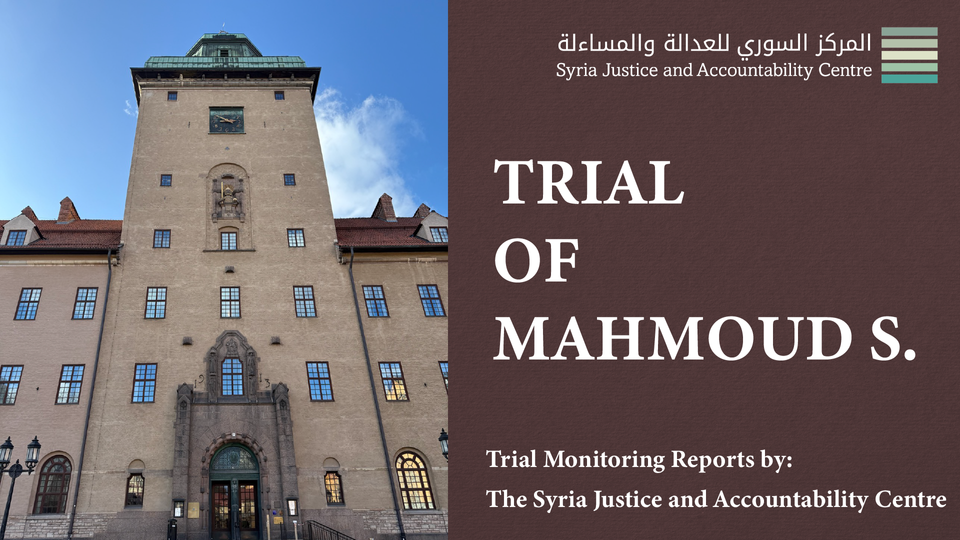
Inside the Mahmoud S. Trial #15: No Good Deed Goes Unpunished
TRIAL OF MAHMOUD S.
Solna District Court – Stockholm, Sweden
Trial Monitoring Summary #15
Hearing Date: February 16, 17, and 19, 2026
CAUTION: Some testimony may include graphic descriptions of torture, rape or other violent acts.
Note that this summary is not a verbatim transcript of the trial; it is merely an unofficial summary of the proceedings.
Throughout this summary, [information located in brackets are notes from our trial monitor] and “information placed in quotes are statements made by the witness, judges or counsel.” The names and identifying information of witnesses have been redacted.
[Note: SJAC provides a summary of the proceedings while redacting certain details to protect witness privacy and to preserve the integrity of the trial.]
Trial Monitoring reports of the Mahmoud S. trial are a result of a partnership between the Syria Justice and Accountability Centre, the University of Stockholm, Sweden, and the Center for Victims of Torture (CVT).
SJAC’s 15th trial monitoring report details days 43, 44, and 45 of the trial of Mahmoud S. in Stockholm, Sweden. On the first day this week, the Court heard two brothers as witnesses, W24 and W25. W24 testified that he worked as an ambulance driver in Yarmouk, was arrested while transporting an injured person, tortured in custody for aiding opposition‑linked individuals, released through assistance by the Red Cross and Red Crescent, and later identified his disappeared brother in the Caesar photographs after years without information. He further described widespread arrests, killings at roadblocks, and the collection of unidentifiable bodies after regime withdrawals. W25 corroborated these events, detailing how their brother was singled out at a roadblock near Al‑Bashir Mosque, taken by masked men to makeshift detention sites, never heard from again, and how roadblocks, armed groups, and targeted arrests intensified prior to the siege of Yarmouk.
On the second day this week, witness W26 testified that after unrest made his barber work impossible, he volunteered at the Palestinian Hospital transporting and assisting the wounded, until he was critically injured in an air strike in 2013 that killed several colleagues and nearly severed his leg. He described severe medical shortages, being discharged as unlikely to survive, questioned at a roadblock, and later witnessing roadblocks, demonstrations, and the shooting of civilians, which he understood to have been carried out by state security forces.
Day 43 – February 16, 2026
Today, the Court heard the witness, [redacted name], W24. W24 was born in [redacted time] in Yarmouk and lived there until [redacted time], near the Palestine mosque. The witness grew up with four brothers and five sisters. One of the brothers, [redacted name], F38, was killed and another brother, [redacted name], F39, disappeared.
W24 started working as an ambulance driver for the Palestine and Al-Basel hospital when the unrest began around 2011-2012. W24 helped with the injured during the Abdel Kadir bombing. Around a week later, the witness was arrested at the At-Tadamon roundabout and remained in custody for four days. He travelled to the At-Tadamon roundabout to transport an injured person who was in need of surgery to the hospital. At the time of his arrest, a background check was conducted, and it was registered that W24 had helped an individual belonging to the opposition, and was punished for helping. The Red Crescent and the Red Cross assisted in the release of W24. In custody, he was tortured with electric chocks and batons that left marks on his body still visible today. W24 described his time in custody as something that still affected him today due to the widespread use of torture. At the time of his release, the witness was still wanted, accused of helping wanted individuals. W24 left Yarmouk two days after his release. He recalled that, at that time, there were no roadblocks.
When his brother, F39, was arrested, W24 was in [redacted location]. F39 was an employee at the state power company and therefore had no problems entering or exiting Yarmouk. There were masked individuals present at the roadblocks by the entrance who singled out people. F39 was singled out and arrested. The witness explained that the family did not get any further information until the Caesar Files were published. The Prosecutor then showed the respective Caesar photograph to the witness behind closed doors who confirmed his brother’s identity.
The Prosecutor further showed a group picture, where W24 identified [redacted name], F8, as number 10; number 3 as someone from the D. family; [redacted name], F40, as number 4; number 7 as someone from the N. family. W24 described F8 as a well-known figure.
As a volunteer, W24 saw a lot of dead bodies at the Palestine hospital. The regime put up a roadblock at 30th Street, where they stopped buses, arrested whoever they wanted, and killed them. After they withdrew from the roadblock, they contacted them [the ambulance] to pick up the bodies. W24 recalled picking up 10 bodies which were unidentifiable. The regime had piled up the bodies at the roadblocks and withdrew suddenly.
The witness also remembered that, before the air strikes, there were people's committees consisting of individuals from the neighbourhood to protect the area.
***
[15-minutes-break]
***
After dismissing W24, the Court heard [redacted name], W25, the brother of W24. W25 was born in Yarmouk in [redacted time] and worked at the emergency department at the state waterworks. His brother, F39, used to work for the state power plant. Before the air strikes, the employees used to exist and enter Yarmouk with ease, up until the roadblocks. W25 recalled that it became difficult after the bombings. The day after the bombing, a lot of people fled and masked men appeared by the roadblocks and passing them became dangerous.
W25 noted that most individuals who stood by the roadblock were from Yarmouk as W25 recognized them by their appearance. They stood armed by the roadblock at the Bashir Mosque, together with divisions belonging to the regime.
When the Prosecutor showed a map of the Bashir Mosque area, W25 identified where the roadblocks were established, as well as where his brother, F39, was taken. W25 also recalled having seen a car with a masked individual sitting in it. F39 was arrested in [redacted time].
After his brother’s arrest, W25 remained inside for 15 days and stopped going to work. The possibility of passing through the roadblocks remained open for a while, but later the roads were completely blocked. W25 left Yarmouk in [redacted time], 2-3 weeks before the total siege of Yarmouk.
W25 remembered that he used to pass the roadblock every day before F39’s arrest, but with fear as people could simply single you out. W25 said that he witnessed masked individuals pointing people out and how snipers had shot people. Arrested individuals were taken to the buildings on the opposite of the mosque which had been turned into Branches. They were first taken to the side and then taken there by car. W25 recalled seeing this in the mornings on his way to work.
The roadblocks were manned by the Security Services and the General Command (GC). The Security Service members wore camouflaged clothes with a red armband while the GC had uniforms but mixed with civilian and sporty clothes. Everyone from the GC was from Yarmouk Camp, according to W25.
On his way to work in the mornings, W25 saw three masked individuals on each side, totaling six masked individuals by the roadblock. Probably there to point out individuals, W25 added. However, there were not always six masked individuals present, sometimes they were two, three, six and sometimes there was no masked person at all. People from the camp used to say that these masked individuals were from Yarmouk.
Upon questioning, W25 identified the place where F39 was taken on a map showing the Bashir Mosque area. He was standing by the queue during the incident. W25 identified the place of a wine-red car. Two people grabbed F39 and took him to the car and covered his head.
***
[15-minutes-break]
***
Following a break, the questioning of W25 resumed. He recalled that the ones who arrested F39 belonged to the area and the Palestine Branch. The brother was covered with his shirt and put in the tailgate of the wine-red car. The car remained there for 20 minutes before driving towards the houses that had been turned into Branches where people were taken before being moved to other places. However, many individuals have already passed away there due to the atrocities committed, W25 added. W25 remembered how he stood there for an hour, too scared to pass the roadblock.
The family made an attempt to find any information and sold land cheaply but never got any proper information. They only learned what happened through the Ceasar photos. There was no known reason for F39’s arrest, W25 explained
W25 had previously heard of the Accused and that he belonged to the regime and the Shabiha, but he did not know him nor had seen him.
The Defense Counsel then referred to the name of a masked individual that W25 mentioned during the police interview. The name was [redacted name], F41, who was a young individual around the age of 11-13. W25 had heard that F41 was the one who singled out his brother, F39.
The Prosecutor then asked about the masked man in the car during the incident. W25 believed that this was F41. W25 had previously seen him without unmasked and F41 had been in a fight recently before that which resulted in an injury in the leg, making him identifiable according to W25.
The witness was then dismissed, and the proceedings were adjourned.
The next trial day will be on February 17, 2026, at 09:00 AM.
Day 44 – February 17, 2026
The proceedings began at 9:04 AM with the Prosecutor’s questioning of a new witness. [redacted name], W26, was born in Yarmouk Camp in [redacted time], where he lived in [redacted location] and worked as a barber while he was living in [redacted location].
The Prosecutor began by questioning W26 about his job. W26 testified that he worked as a barber until the onset of the unrest in Yarmouk Camp. W26 explained that chaos prevailed on the street where his workplace was located due to the presence of the Free Syrian Army (FSA). W26 testified that he stopped working at the barbershop after a mosque was bombed on December 16 or 17 [year unknown]. Following this incident, W26 and his family fled to his sister’s home in [redacted location], where they stayed for two to three days. He then returned to Yarmouk Camp and continued to move in and out of the area.
When questioned by the Prosecutor about his activities in the camp, W26 testified that he attempted to resume his work as a barber but found it difficult due to the circumstances. As a result, he began working at the Palestinian Hospital. He testified that his duties included assisting the injured, supporting affected families, and transporting wounded individuals to the hospital. W26 continued this work until he was injured on March 31, 2013. W26 testified that he sustained his injuries during an air strike. He explained that he was traveling with eight colleagues to a family home after receiving information that a gas tank had exploded and that the family inside required assistance. Upon entering the house, W26 and his colleagues were targeted in an air strike carried out by a regime-affiliated group. W26 testified that he regained consciousness and realized he was bleeding heavily, particularly from his leg, which was nearly severed. He further testified that he had sustained injuries to multiple parts of his body, including his arms and stomach. Some of his colleagues were killed in the attack, while others survived.
W26 testified that he was transported to a hospital and regained consciousness two days later at the Palestinian Hospital. W26 recalled that there was a severe shortage of blood supplies, which led to negotiations between the Palestinian Hospital and the Syrian regime. It was decided that only those with a chance of survival would receive blood transfusions, while those expected to die would not. W26 testified that he was among the first patients discharged because doctors believed he would not survive his injuries. W26 remembered that he was left at a roadblock, where he was questioned by Syrian security personnel. However, upon observing his physical condition, they left him alone. His relatives later collected him and transported him to another hospital for further treatment. Afterward, W26 moved to his grandfather’s family apartment to continue his recovery. W26 testified that the apartment was located near the [redacted information].
The Prosecutor then asked W26 about armed groups active in Yarmouk during 2011–2012. W26 testified that a pro-regime group known as the General Command (GC) was present and that it was led by Ahmed Jibril. He testified that he had never personally seen Ahmed Jibril.
The Prosecutor also asked whether W26 had seen the brother of the Accused, [redacted name], F6, at any roadblock. W26 said that he believes to have seen F6 once, but was not certain.
***
[20-minutes-break]
***
Upon return from the break, the Prosecutor asked W26 whether he had ever seen Mahmoud S. W26 testified that he had for sure seen him during more peaceful times. He further testified that after the events in Yarmouk, he believed he saw Mahmoud S. at a roadblock near a mosque. When questioned by the Judge about the timing, W26 testified that this occurred sometime between 2012 and 2013, prior to his injury. He explained that he had no personal relationship with the Accused and that he did not observe him carrying a weapon at the roadblock.
The Prosecutor then questioned W26 about the demonstration that took place on July 13, 2013, on Palestine Street. W26 testified that he was present at the Palestine roundabout near the Al-Bashir Mosque. When the Prosecutor asked whether anyone had been killed, W26 recalled that eleven people died. The Prosecutor noted that W26 had given a different account during a [redacted location] police questioning in [redacted time]. W26 clarified that he participated in several demonstrations during that period (2013). He explained that there was a demonstration near a mosque that he did not attend, as it was close to his workplace, he only observed it from a distance. W26 testified that shooting began during this demonstration in which a 14-year-old boy was shot in the stomach. W26 testified that he attempted to assist the boy by transporting him to the nearest hospital. W26 further explained that he did not see who fired the shots and that he did not know the boy personally.
When asked by the Prosecutor what type of weapon was used, W26 did not answer directly but instead testified about what he had heard regarding who was responsible for the shooting. W26 recalled speaking with a police station chief, who told him that the state security service in Syria had deployed a group to fire on the demonstrators. The Prosecutor then concluded her questioning. The Defense Counsel did not ask any questions to W26.
The proceedings were adjourned at 11:54 AM.
The next hearing will take place on February 19, at 9:00 AM.
Day 45 – February 19, 2026
[SJAC was unable to monitor today’s hearing.]
The next trial day will be on March 2, 2026, at 9:00 AM.
___________________________
For more information or to provide feedback, please contact SJAC at [email protected] and follow us on Facebook and Twitter. Subscribe to SJAC’s newsletter for updates on our work