Inside the Mahmoud S. Trial #13: The Cave And The Sun
TRIAL OF Mahmoud S.
Solna District Court – Stockholm, Sweden
Trial Monitoring Summary #13
Hearing Date: February 2, 3, and 5, 2026
CAUTION: Some testimony may include graphic descriptions of torture, rape or other violent acts.
Note that this summary is not a verbatim transcript of the trial; it is merely an unofficial summary of the proceedings.
Throughout this summary, [information located in brackets are notes from our trial monitor] and “information placed in quotes are statements made by the witness, judges or counsel.” The names and identifying information of witnesses have been redacted.
[Note: SJAC provides a summary of the proceedings while redacting certain details to protect witness privacy and to preserve the integrity of the trial.]
Trial Monitoring reports of the Mahmoud S. trial are a result of a partnership between the Syria Justice and Accountability Centre, the University of Stockholm, Sweden, and the Center for Victims of Torture (CVT).
SJAC’s 13th trial monitoring report details days 37, 38, and 39 of the trial of Mahmoud S. in Stockholm, Sweden. On the first day this week, W17 appeared via video and described witnessing a large 2012 demonstration where security forces and GC‑affiliated committees opened fire from the biscuit factory, causing multiple deaths and injuries. He also recounted meeting Mahmoud S. once at a checkpoint, where S. offered help, and testified about the harsh checkpoint controls and disappearances during the siege. Throughout the hearing, W17 clarified discrepancies between earlier statements, emphasizing memory issues and maintaining that he had only limited contact with the Accused and never saw him performing duties or carrying weapons.
On the second day, W18 testified that he once saw the Accused and F6 armed, but his fear of S. was mainly based on personal conflict, rumors, and threats relayed by neighbors rather than direct actions. W18 never saw Mahmoud S. at the checkpoint nor saw him threaten anyone directly. Moreover, W19 confirmed the presence of pro‑regime groups in Yarmouk, knew Mahmoud S. and F6, and witnessed the July 2012 shooting near the biscuit factory, but had never seen S. armed and only heard rumors about him being the masked man involved in arrests.
On day three of the trial week, the Court heard testimony from W20 and W21 concerning events in Yarmouk Camp in 2012–2013, with a focus on the checkpoints around Yarmouk, specifically near Bashir Mosque following the bombing of the Abdul Qadir Mosque. Both witnesses testified to the presence of armed and masked individuals at checkpoints operated by Qiyad al-Ama (the General Command) and Falastin Hurra. W20 testified about the abduction of her 14-year-old son at the Bashir checkpoint, her subsequent arrest when inquiring about him, detention at Adra Prison, and the deaths of her son and husband. W21 testified about the establishment of multiple checkpoints in Yarmouk, his arrest and beating at the Bashir checkpoint, and a second arrest involving forced labor. Both witnesses identified locations using maps and were shown photographs previously presented during police interviews.
Day 37 – February 2, 2026
[Redacted name], W17, appeared before the Court via video call. He was questioned about what he witnessed during the day of the demonstration, what he had seen at the checkpoint and when he had met Mahmoud S.
W17 was born in [redacted location] in [redacted time] and lived in Yarmouk from [redacted time] to [redacted time]. He left Yarmouk after the airstrikes in 2012, and returned 2-3 times per week up until the summer 2013 to pick up belongings and check on his house. During this time, the siege of Yarmouk intensified and by May/June, Yarmouk was under total siege.
The Prosecution asked whether W17 knew or had met Mahmoud S. W17 recalled that he had seen Mahmoud S. only once in Yarmouk, at the checkpoint. W17 had known Mahmoud S.'s oldest brother [redacted name], F7, because he used to go to his jewelry store. W17 described the situation when he had met Mahmoud S., when he and his wife had tried to take their belongings out of Yarmouk through the northern checkpoint by the mosque. Mahmoud S. had offered to help them get their stuff out of Yarmouk. W17 explained that the state's security forces sometimes closed off the passage because they did not want to let the inhabitants take their belongings with them. W17 said that he believed that when Mahmoud S. offered help, he meant that he had contacts through which he could help. W17 declined the offer and said he would let him know if he needed help. W17 explained that later when he had moved to [redacted location], he met Mahmoud S. again at the “[redacted information]” in [redacted location], and that Mahmoud S. then reminded him of this occasion.
The Prosecution questioned W17 about what he saw during the day of the demonstrations at Palestine street on July 13, 2012. W17 remembered that he did not participate in the demonstration but that he had seen it from a distance and that it was the first time that there were shooting at a demonstration, and seven people died and about 15 got injured. W17 further testified that it was a very large demonstration, with thousands of people, and when they were passing the biscuit factory, the shooting began through the windows of the factory. W17 also recalled that he stood about 150 meters away and had heard the shootings and seen people falling to the ground. Others had later confirmed to him that the shootings came from the state-owned biscuit factory.
***
[15-minute break]
***
The Prosecution continued asking about the demonstration, and W17 said that he had heard that [redacted name], F2, died as a martyr. People W17 knew had later confirmed to him that it was the Syrian security forces and other groups that did the shooting. W17 explained that the groups that had weapons were the security forces and other committees [Swedish: “Folkkommittéer”] that belonged to the GC. He had seen no oppositional groups with weapons in Yarmouk.
The Prosecution questioned the witness about the checkpoints, and W17 explained that after the demonstration, the committees set up checkpoints and that voluntary persons joined the committees to control these checkpoints that belonged to the GC. Many people fled Yarmouk at this point. W17 created a national help committee that collaborated with UNRWA to provide help to persons living in Yarmouk, where many suffered from starvation during the siege. From January 2013, it became more difficult to pass through the checkpoint by the al-Bashir Mosque, and only a small amount of food was allowed to be brought in, otherwise it was taken and registered. W17 testified that when entering Yarmouk, they were controlled by members from the Intelligence Services, belonging to the Palestine Branch and the area department that were in control of the checkpoint, and that they registered the name and time of entrance and exit. Sometimes members from the GC helped.
W17 then informed the Court that he had been in intensive care for 35 days following a Covid-19 disease, and that this affected his memory about specific dates.
***
[15-minute break]
***
The Prosecution asked if W17 recognized anyone from the GC at the checkpoint, and W17 listed some names including persons from the [redacted name]-family (Moafak D.) but emphasized that he held distance from all groups working at the checkpoint to avoid being associated to any of them. W17 also testified that the GC helped strengthen the military organization because sometimes attacks from the Free Syrian Army occurred. He explained that a van (gray or black) stood there sometimes, belonging to the security forces. W17 recalled that it was frightening to look at it because they took many men to the van that never returned, which W17 had seen himself. W17 explained that it was forbidden to register these men as disappeared. W17 further remembered that the men were brought into the van with their heads covered with their shirts and with their hands tied behind their back. The Prosecutor showed a picture of a van, but W17 said he did not recognize the one in the photo.
The Prosecutor questioned W17 about [redacted name], F8. W17 explained that he founded Falastin Hurra [Free Palestine] together with one other person, to support the Intelligence Services. W17 had heard about Falastin Hurra in relation to two incidents, one murder and one occasion when F8´s car was blown up. W17 had seen F8 in his car on random occasions but did not know him.
***
[60-minute break]
***
The Court proceedings continued with W17 pointing at a map where he had met Mahmoud S., and explained that S. was wearing training clothes and offered him help. The Prosecution asked several times if Mahmoud S. had had any duties at the checkpoint, but W17 testified that he had not seen him doing anything else nor talking to anybody else there. W17 told the Court that he had heard about one other person who had got help from Mahmoud S. as well. On the question of whether W17 knew if Mahmoud S. was part of a group in Yarmouk, W17 answered that he had only met him once at the checkpoint and had not heard anything else about Mahmoud S.
The Prosecution read out a couple of excerpts from an earlier questioning of W17, where he had given information about Mahmoud S. that, according to the Prosecution, did not correspond with the information W17 testified in Court. During the earlier questionings, W17 had said that Mahmoud S. was part of Falastin Hurra in Yarmouk under F8's responsibility and had worked at the checkpoint. However, during the Court proceedings W17 said that he only had heard this later in [redacted location]. W17 emphasized that he had only seen Mahmoud S. this one time and never with Falastin Hurra, and added that it must have been an interpretation error.
***
[15-minute break]
***
The Prosecution continued by showing additional excerpts from the earlier interview and asked W17 to verify the information given there. W17 explained that he had seen masked persons (one or more) at the checkpoint but that he had avoided them and cannot know who they were. W17 testified that while in [redacted location], he and Mahmoud S. had not talked about what Mahmoud S. had done in Yarmouk. However, according to the excerpts shown by the Prosecution, he had said so in an earlier questioning. W17 then explained that his brother and another person he knew had disappeared in 2013, taken by the area department from the checkpoint. Finally, the Prosecution asked W17 if he was afraid to testify in Court. W17 replied that he talked freely but that the Prosecution had made him feel like a suspect, not a witness. The Prosecution then asked why his responses differed in two questionings. W17 explained that he had given the same information but had clarified things the second time.
The Defense then asked a couple questions. W17 testified that he had never seen Mahmoud S. carrying weapons and never in anything other than civilian clothes except in photos shown by the investigator. W17 witnessed that he had never seen Mahmoud S. together with F8 and had only seen Mahmoud S. once. Later he had heard that Mahmoud S. and F8 were family. The Defense asked W17 to clarify things about the differing information that the Prosecution had read out and asked if he found out in Yarmouk or [redacted location] that Mahmoud S. knew F8. W17 said that it was in [redacted location]. The Defense asked if W17 found out in Yarmouk or [redacted location] that Mahmoud S. had spent time with F8, which also was in [redacted location]. W17 finally emphasized once more that he had never seen Mahmoud S. with F8 at the checkpoint. W17 also added that, later in [redacted location], he had heard people talking bad about and accusing Mahmoud S. on Facebook.
The proceedings were adjourned at 3:15 PM.
The next hearing will take place on February 3, 2026, at 9:00 AM.
Day 38 – February 3, 2026
Today’s witness, [redacted name], W18, was born in [redacted time] and lived in Yarmouk from around the [redacted time]’s until around [redacted time]. He was neighbors with the Accused and has known him for a long time.
W18 testified that he had seen Mahmoud S. and his brother [redacted name], F6, armed at Lubia Street once. They were armed with hunting rifles and wore civilian clothing. W18 did not know if the Accused was part of an armed group inside the camp; he did, however, testify that he was part of the group Falastin Hurra, [redacted name]’s , F8’s group, outside of the camp. W18 has never seen the Accused together with F8. According to his testimony, W18 was afraid to leave the camp because he believed that the Accused had put down his name on a list, which would result in his capture by the checkpoint. The Prosecution asked what the Accused has done to W18 to make him believe this, to which W18 testified that the Accused hated him due to a financial conflict between them. W18 further testified that he was afraid of the Accused; he was not able to speak up against him, and the Accused used to taunt him inside the camp and had also sent him threats. W18 testified that his neighbors had seen the Accused at the checkpoint and, upon instruction from the Accused, brought threats to W18 and his other neighbor.
***
[15-minutes-break]
***
W18 told the Prosecution that the reason he was afraid of the Accused was that he had connections to the Intelligence Services. The Prosecution asked why W18’s name would be on a list by the checkpoint, to which W18 replied that the Accused was at the checkpoint, and he had previously threatened him. He had also heard rumors that he was the masked man, who had young men arrested.
W18 was then questioned by the Defense. W18 testified that he never passed by the checkpoint, nor has he ever seen the Accused there. The Accused has never threatened W18 in person, only taunted him. W18 has not seen that the Accused put him on the list; this was only something he believed. W18 was more afraid of F6. Upon further questioning by the Defense, W18 said that he cannot remember one concrete person who has seen and said that Mahmoud S. was the masked man.
The witness was then dismissed, and the Court issued a lunch break.
***
[105-minutes-break]
***
Following the break, a new witness appeared before the Court. [Redacted name], W19, had previously been the plaintiff in the [redacted name] case in Germany. W19 was born in [redacted time] in the Yarmouk-camp and lived there until [redacted time]. He volunteered as a [redacted information] at various hospitals.
W19 confirmed that pro regime groups existed in Yarmouk. W19 personally knew of persons who were members of the General Command in 2012. Among the ones he remembered were the Accused and his brother [redacted name], F6. W19 did, however, also testify that he was not able to differentiate the different groups, and therefore does not know which group the Accused was part of. W19 confirmed that he knew Moafak D. in the camp. W19 also knew F6, as they were classmates growing up. He also knew the Accused through being friends with his brother but added that he does no longer know him. W19 did not personally know F8, but had seen him in the camp. He had not seen the Accused together with him. Upon question from the Prosecutor, W19 testified that he could not remember seeing the Accused or F6 together with [redacted name], F28. W19 had never seen the Accused bearing arms.
W19 was asked about the demonstration on July 13, 2012. According to his testimony, he passed by the demonstration, but did not take part in it, on Palestine street, and fled when he heard gunshots by the biscuit factory, where the Intelligence Services were. W19 was located across the street from the demonstrators and saw people falling to the ground.
***
[15-minutes-break]
***
W19 then testified that there were no armed oppositional groups inside the camp in the middle of 2012. He also recalled seeing [redacted name], F10, carrying guns inside the camp. W19 was asked about the checkpoint and testified that he had never passed through it. Upon reminder by the Prosecution, he did, however, recall that he had passed through once, together with his [redacted information], who was shot at. W19 did not recognize anyone at the checkpoint. Further, W19 had not seen any masked man there. He had heard from others in the camp that the masked man was the Accused and had heard from [redacted name], W7, that the Accused had been bragging about getting people arrested. W19 also testified that his sister was captured during the war and had lost all her teeth.
The Defense then posed a few questions. W19 confirmed that he knew W7 through social media, where W7 was infamous. W19 also knew who W7 was in the camp. The Defense asks if W19 was allowed to call W7 during a police interview, which was noted in the transcript, but W19 was not able to remember this due to an injury causing memory loss.
The proceedings were adjourned at 3:15 PM
The next trial day will be on February 5, 2026, at 9:00 AM.
Day 39 – February 5, 2026
Today, the Court heard witness [redacted name], W20, testifying about her experiences in Yarmouk Camp during 2012–2013. She was born in [redacted time] in [redacted location] and lived in Yarmouk with her husband and children until the escalation of hostilities.
The Prosecution asked about the bombing of the Abdul Qadir Mosque in 2012 and its impact on Yarmouk Camp. Following the bombing, the situation in the camp changed significantly. W20 temporarily left Yarmouk for [redacted location]. She had returned to Yarmouk with her son to collect clothing. W20 and her son, who was [redacted information] years old at the time, passed the checkpoint near Bashir Mosque to enter the camp. While waiting in line at the checkpoint, her son was taken away.
When asked who had taken her son, W20 identified [redacted name], F29, [redacted name], F30, [redacted name], F31, and a person from the [redacted name] family, explaining that she primarily recognized them by appearance. The group present at the checkpoint belonged to Qiayd al-Ama (the General Command). The group also consisted of Palestinians based on their dialect. There were also masked individuals present at the checkpoint.
Her son was taken by members of the Intelligence Services when it was his turn at the checkpoint. She later heard that he had been taken to a location on Farah Street, behind Bashir Mosque, but she did not receive further information about him. Her son was placed into a car together with two other individuals, including a 16-year-old and his mother. She later learned that her son had died.
The Prosecution asked whether W20 had any contact with F30 after her son’s abduction. She remained in contact with him for approximately one week to ten days, hoping he could assist her. She had met him near the Bashir Mosque.
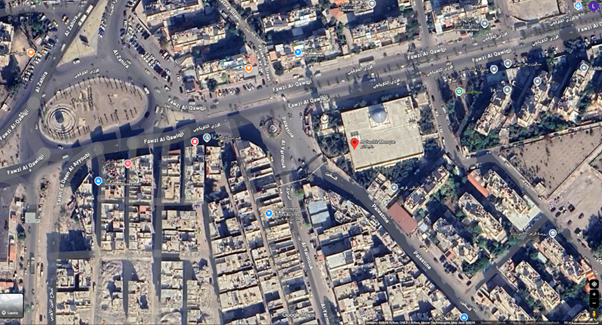
The Prosecution presented Map 1 depicting the area around Bashir Mosque. W20 indicated that the checkpoint entrance was located to the west of the mosque towards Palestine street.
***
[15-minute-break]
***
After a break, the Prosecution again referred to Map 1 and asked W20 to confirm the location of the checkpoint. W20 pointed out the checkpoint beneath the mosque’s dome, facing north towards Fawzi Al Qawiqji [street], and testified that she was certain of the location. W20 also pointed out the location of a car which often was present by the checkpoint.
On the same day her son was taken, she contacted [redacted name], F8, whom she knew through family connections, and who belonged to the same group. When asked about her knowledge of this group prior to the bombing, she explained that she had heard the group carried out arrests of individuals from their homes. This group was connected to F8 and that it was the only group with access to the camp.
The Prosecution presented photographs previously shown to W20 during her police interview. W20 identified one individual as [redacted name], F6 [brother of the Accused] and the second individual, wearing a military uniform, as F31. She had often seen F6 armed at the checkpoint and said that she had seen F31 armed on a limited number of occasions. When shown Photograph 2, W20 again identified F6.
She was later arrested when she went to the Terrorism Court to inquire about her son. She was detained at Adra Prison, however, with no clear basis for her arrest and that it occurred after a report was written about her in connection with her inquiries. She suggested that the same person who recorded her son’s name also reported her.
She had been subjected to violence once during the interrogations but did not wish to discuss details. Others detained there had also been subjected to violence. While she was detained, her husband was also arrested. She later learned that he had been arrested approximately two to three months after her detention and that he had died.
During cross-examination, the Defense Counsel asked whether F31 had been armed. W20 had seen F31 armed at the Bashir checkpoint and al-Batika on several occasions.
The Defense Counsel asked whether W20 had seen the individuals on TikTok. W20 testified that she had seen them on TikTok and learned the name of F6 through social media.
The examination of W20 concluded.
***
[145-minutes-break]
***
The Court then heard [redacted name], W21, who testified about his experiences in Yarmouk Camp during 2012–2013. W21 was born in [redacted time] in Yarmouk and lived there until 2012, leaving the camp the day after the Abdel Kadir bombing. He later left [redacted location] in [redacted time].
Prior to the bombing, Qiyad al-Ama (the General Command) cooperated with Falastin Hurra. He recognized several surnames associated with the group but had difficulty recalling names. When the Prosecution mentioned Ahmad Jibil and [redacted name], F8, W21 recognized them.
Checkpoints were established near his neighborhood, including near the Palestinian Hospital and School Street. When shown Map 2 of Yarmouk Camp, W21 identified checkpoints [redacted information] The checkpoints were set up during the [redacted information] months of 2012 and armed individuals staffed them. Furthermore, the cooperation between the Intelligence Services and Falastin Hurra was widely known, particularly at the Bashir checkpoint.
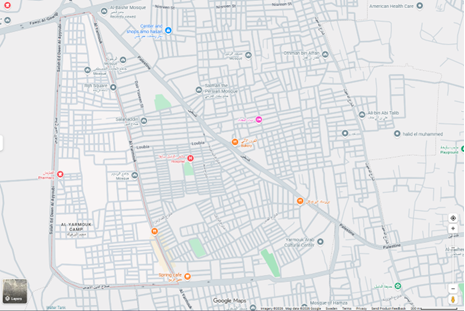
Referring to Map 2, W21 explained that the al-Khalsa building was considered an Intelligence Services building and new members were often taken there.
W21 passed the checkpoints on several occasions but it was difficult to distinguish group affiliations. The individuals staffing checkpoints were armed and masked individuals were present.
When shown Map 1 of Bashir Mosque [see above], W21 identified the checkpoint location as being [redacted information].
***
[15-minutes-break]
***
W21 was arrested at the Bashir checkpoint and taken to a street behind the mosque. Several individuals grabbed him and beat him with hands and feet on his body and back. He told the Court that he did not wish to provide further details.
On a second occasion, he was arrested at the Bashir checkpoint and taken to perform work. He believed he was taken to buildings southeast of the mosque, where he was ordered to dig a hole with a shovel until 4:00 PM, after which he was released. At the time, he did not know whether he would live or die.
The Prosecution presented Photograph 1 [previously shown to W20]. W21 did not personally know the individuals in the photograph but noted that they were well known and that one resembled the Accused. When shown Photograph 3, in which one individual had been identified as F8 during the police interview, W21 testified that the other unidentified individual also resembled the Accused.
During cross-examination by the Defense, W21 explained that he did not use TikTok and primarily used Facebook, where he followed pages related to the events. He had learned the names through social media. The Defense Counsel referred to the investigation file, [redacted information], noting that according to the transcript, the investigator mentioned F8’s name, not W21.
The proceedings were adjourned at 3:50 PM
The next trial day will be on February 9, 2026, at 9:00 AM.
___________________________
For more information or to provide feedback, please contact SJAC at [email protected] and follow us on Facebook and Twitter. Subscribe to SJAC’s newsletter for updates on our work