Inside the Mahmoud S. Trial #09: Power Concedes Nothing
TRIAL OF MAHMOUD S.
Solna District Court – Stockholm, Sweden
Trial Monitoring Summary #09
Hearing Date: January 7, 8, and 9, 2026
CAUTION: Some testimony may include graphic descriptions of torture, rape or other violent acts.
Note that this summary is not a verbatim transcript of the trial; it is merely an unofficial summary of the proceedings.
Throughout this summary, [information located in brackets are notes from our trial monitor] and “information placed in quotes are statements made by the witness, judges or counsel.” The names and identifying information of witnesses have been redacted.
[Note: SJAC provides a summary of the proceedings while redacting certain details to protect witness privacy and to preserve the integrity of the trial.]
Trial Monitoring reports of the Mahmoud S. trial are a result of a partnership between the Syria Justice and Accountability Centre, the University of Stockholm, Sweden, and the Center for Victims of Torture (CVT).
SJAC’s 9th trial monitoring report details days 26, 27, 28 of the trial of Mahmoud S. in Stockholm, Sweden. The first day this week, W8 described conditions in Yarmouk following the December 2012 Al Bashir Mosque bombing, including the establishment of the “Death Road” checkpoint by the Shabiha and an alleged campaign to empty the camp. He claimed to have seen Mahmoud S. at the checkpoint and implicated him in arrests, though the Defense challenged his credibility due to temporal uncertainty and inconsistencies.
On day three this week, W9 testified about violence and shifting power structures in Yarmouk, including armed groups, abuses by the FSA, and the suppression of a July 13, 2012 demonstration. He alleged that after the December 2012 bombing, Shabiha members, including Mahmoud S., abused civilians at checkpoints, a claim the Defense contested by highlighting inconsistencies and questioning his identification.
Day 26 – January 7, 2026
Proceedings began at 9:00 AM. [Redacted name], W8 was examined via videoconference. The examination began with the Prosecutor asking the witness questions.
W8 provided an overarching description of the situation in Yarmouk and placed significant emphasis on the bombing of the Al Bashir Mosque on December 16, 2012, as well as the bombing of a nearby café that occurred around the same time. According to W8, the checkpoint [at the northern entrance, known as the “Death Road” checkpoint] was established by the committees [Shabiha] approximately ten days after the mosque bombing. In connection with this, unrest in the camp increased and control over the population was tightened. W8 testified that the regime’s objective was to empty the camp, which, according to him, succeeded for a short period. He and his family left Yarmouk for approximately one week before returning. After their return, until June 13, 2013, W8 passed the checkpoint roughly twice a week in order to purchase food and other necessities that were not delivered to the camp. He thereafter left Yarmouk for [redacted location] and later [redacted location].
W8 was further questioning regarding Mahmoud S.’s role in the checkpoint and the camp. He testified that anyone who associated with [redacted name], F8, the leader of the Shabiha, was automatically a criminal, and that the entire camp shared this view. He recalled that Mahmoud S. has been seen in numerous photographs with him. The Prosecution and Defense pointed out the risk of the witness’s generalizations. The witness had considerable difficulty placing various events in time and specifying exact dates.
With regard to the Accused Mahmoud S., W8 testified that he had personally seen him manning the checkpoint on three to five occasions during the relevant period. However, he could not say with certainty whether he had seen Mahmoud S. manning the checkpoint while masked on additional occasions and said that he believed he had only seen him unmasked.
W8 further claimed that Mahmoud S. was responsible for two to three arrests. The only concrete case described in court concerned [redacted name], F18. W8 testified that he had seen F18 being pointed out by Mahmoud S. at the checkpoint. The Defense challenged this claim, referring to a previous statement [from 2024] in which W8 had stated that he arrived at the scene later and thereafter concluded that F18 must have been pointed out and arrested by Mahmoud S.
W8 further asserted that Mahmoud S. acted beyond his role and abused his position for private purposes. According to the witness, F18 was pointed out due to his surname and family affiliation rather than on orders from the regime.
W8 also claimed that on one occasion he saw Mahmoud S. at the Al Bashir Mosque when women were being pushed into the mosque to be sexually exploited. Behind the mosque, according to the witness, there is a preschool that was used by the Shabiha to detain individuals who had been singled out. W8 said that he had only witnessed this on one occasion, while simultaneously claiming that similar incidents occurred repeatedly.
The Defense concluded by questioning W8 about his relatives and acquaintances, including [redacted name], W7. W7 is a “friend” of W8, and has been heard in previous hearings [for W7’s testimony, see Trial Report #08]. W7 is alleged to have organized witnesses into WhatsApp groups. The Defense cited these groups as evidence suggesting potential bias and coordination among the witnesses.
Following further questioning, it emerged that W8 does not have extensive personal activity on social media platforms such as Facebook or TikTok, but that he is exposed via his feed to content relating to Syrian legal proceedings and judgments in Europe. W8 testified that he believed this content and said that “everything that has been said on there has turned out to be true.”
Finally, W8 was able to identify Mahmoud S. in photographs in this hearing, despite having been unable to do so in earlier questionings. The Defense argued that this is due to W8 having seen images of Mahmoud S. on social media after the fact, and that he therefore cannot reliably identify Mahmoud S. as having been present at the checkpoint during the period 2011-2013.
The proceedings were adjourned at 2:10 PM.
The next hearing will take place on January 8, 2026, at 9:00 AM.
Day 27 – January 8, 2026
[SJAC was unable to monitor today’s trial day.]
The next hearing will take place on January 9, 2026, at 9:00 AM.
Day 28 – January 9, 2026
[redacted name], W9, a Palestinian raised in the Yarmouk refugee camp, testified as a witness with close personal ties to victims of the events under examination. He left Yarmouk in 2013. At the relevant time, he worked at the [redacted name] Hospital and was also active in an organization that sought to reduce violence in the camp by mediating between Palestinian factions and encouraging armed groups to leave the area.
His engagement in this organization continued until early January 2013, when its work collapsed due to escalating violence. Two members were kidnapped by the FSA and subjected to torture. W9 stated that ransoms had to be paid to secure their release, including a sum of approximately 38,000–43,000 USD to free his cousin, [redacted name], F19.
W9 testified that, initially, Yarmouk was controlled by the General Command (GC). According to him, the GC armed various local groups, referred to as “committees” to fight regime opponents. One such group was led by [redacted name], F8. W9 recalled that this group received compensation in the form of money, food, and narcotics.
He further testified that F8’s headquarters were located near Al-Quds Mosque and that the group was formed toward the end of 2011. W9 remembered that he had personally visited F8’s home on several occasions in connection with a dispute involving his cousin, in which W9 acted as a mediator.
[15-minute break]
The Demonstration
W9 participated in the demonstration on July 13, 2012, joining after Friday prayers. He testified that the demonstrators were unarmed. While moving from Palestine Roundabout on Palestine Street toward the biscuit factory, he heard gunfire and screams and realized people had been injured. He went to Al-Basel Hospital, where he learned that his brother, [redacted name], P2, had been shot. W9 did not witness his brother being wounded but saw people fall to the ground. His brother sustained severe abdominal and back injuries, required partial removal of his intestines, and continues to suffer permanent harm.
W9 described the attack as planned, noting that the location limited escape routes. He testified that the perpetrators wore military-style clothing and carried shields and batons, which led him to identify them as Shabiha rather than GC members. He was approximately 200 meters from the gunfire and could not identify individual shooters. After the shooting, Yarmouk was sealed off, which he believed was intended to prevent medical assistance. He saw a lot of people injured at the [redacted name] Hospital, he did not specify how many. He met one of the dead persons, [redacted name] ´s, F2’s father at the hospital. He later heard that F8’s group had been present at the site of the shooting.
W9 did not see Mahmoud S. at the demonstration. He testified that he knew Mahmoud S. from seeing him at checkpoints and from knowing his brothers when growing up, and he was able to identify the Accused from a photograph as well as pointing to him in court.
[15-minute break]
Checkpoint
Following the Syrian army’s bombing of Yarmouk on December 16, 2012, including Al-Quds Mosque, checkpoints were established. W9 testified that the northern checkpoint was manned by Security Services and Shabiha, and that it was commonly known that those arrested there did not return.
Initially, movement in and out of Yarmouk remained relatively unrestricted, many residents fled. W9 himself remained in the camp after the bombing to assist at [redacted name] Hospital, which had also been damaged. During this period, he moved in and out of the camp frequently, maintaining both a residence inside Yarmouk and accommodation outside. This continued until March, when his cousin was kidnapped and threats against W9 increased, prompting him to flee the camp and later Syria.
Between mid-December 2012 and January 2013, W9 passed through the checkpoint many times. Identification documents were required, and he testified that a masked man pointed out individuals, though he did not personally witness arrests and relied partly on reports from others. No metal barriers were present at the checkpoint during his time in the camp, although he later saw such barriers in photographs. In February 2013, the checkpoint was moved closer to the camp entrance and was then manned by committee members [Shabiha], including Falastin Hurra [short for “Haraket Falastin Hurra”, i.e. Free Palstine Movement (FPM)]. W9 testified that he frequently saw a masked man, such as Mahmoud S., Moafak D. and others, there, armed with Kalashnikovs, pointing out individuals and stealing food. He also reported hearing of torture and rapes in the nearby mosque. He recalled that he did not dare approaching closer than approximately 30 meters since he was a wanted man.
He then described the locations on satellite imagery:
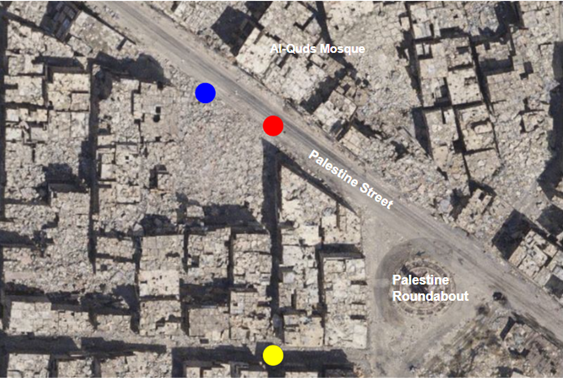
Yellow dot: Where the checkpoint was located before the demonstration (pre-7/1-2013)Red dot: Where the checkpoint was later moved to after the demonstration (post-7/1-2013)Blue dot: Where the masked man aka Mahmoud S. often stood.
F8’s men lived and operated in the buildings located between the Palestine roundabout, the red dot and the yellow dot.
W9 expressed fear about testifying, highlighting that circumstances could change and that the regime might return. He emphasized that power dynamics in Yarmouk were deeply connected to family ties, rivalries, and enmities. He explained that he had spoken to others in [redacted location] about his experiences in Yarmouk and expressed the belief that perpetrators must be held accountable.
The Defense’s Questioning
During cross-examination, the Defense Counsels highlighted inconsistencies between W9’s testimony and earlier statements. They argued that he had previously stated he did not see Shabiha at the demonstration and that his account was based on what others told him. The Defense also pointed out that W9 had earlier said he had not seen the masked man at the checkpoint with his own eyes.
The Defense further challenged his identification of Mahmoud S., arguing that W9 had confused him with his brother Ahmed, F6. They noted that W9 had previously described Mahmoud S. as [redacted information]. Features more closely matching F6. He also claimed Mahmoud S. to be a [redacted information], which was F6’s profession. The Defense claimed that W9 had incorrectly identified F6 as Mahmoud S. on three occasions and that he failed to identify the Accused when shown photographs on two prior occasions. They argued that his in-court identification constituted a reconstruction influenced by seeing Mahmoud S. present in the courtroom and on social media.
The Defense further referred to WhatsApp groups discussed in earlier hearings and to [redacted name], W7. W9 explained that he believed association with F8 was sufficient to establish guilt. He testified that he had heard from W7 that Mahmoud S. had boasted about raping women. W9 described W7 as a friend, noting that their friendship developed after W7 contacted him with the intention of holding F8’s associates accountable.
Finally, W9 explained that he had undergone knee surgery around the time of earlier questionings, which he suggested might account for discrepancies in his previous statements.
The next trial day will be on January 13, 2026, at 9:00 AM.
___________________________
For more information or to provide feedback, please contact SJAC at [email protected] and follow us on Facebook and Twitter. Subscribe to SJAC’s newsletter for updates on our work