Inside the Mahmoud S. Trial #08: Pictures Don’t Lie?
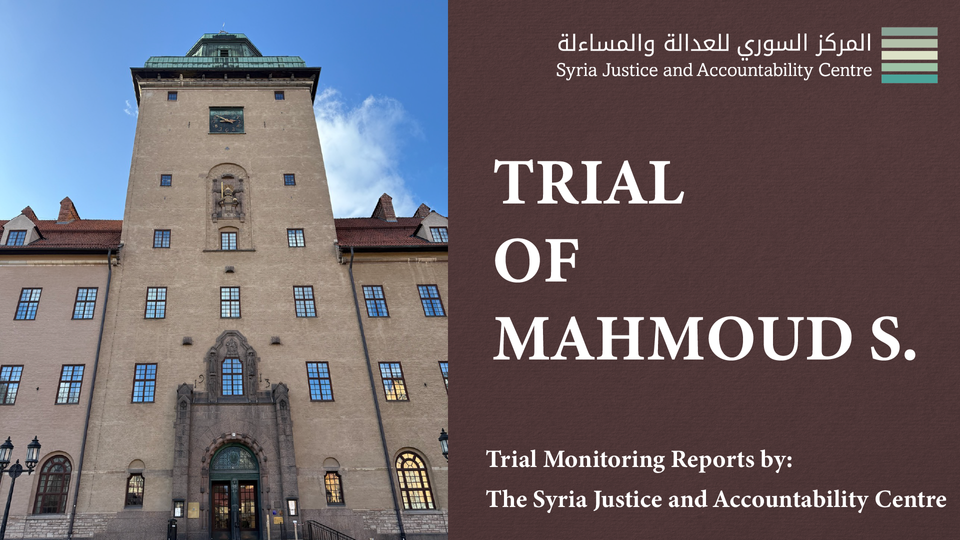
TRIAL OF Mahmoud S.
Solna District Court – Stockholm, Sweden
Trial Monitoring Summary #08
Hearing Date: December 16, 17, and 18, 2025
CAUTION: Some testimony may include graphic descriptions of torture, rape or other violent acts.
Note that this summary is not a verbatim transcript of the trial; it is merely an unofficial summary of the proceedings.
Throughout this summary, [information located in brackets are notes from our trial monitor] and “information placed in quotes are statements made by the witness, judges or counsel.” The names and identifying information of witnesses have been redacted.
[Note: SJAC provides a summary of the proceedings while redacting certain details to protect witness privacy and to preserve the integrity of the trial.]
Trial Monitoring reports of the Mahmoud S. trial are a result of a partnership between the Syria Justice and Accountability Centre, the University of Stockholm, Sweden, and the Center for Victims of Torture (CVT).
SJAC’s 8th trial monitoring report details days 23, 24, and 25 of the trial of Mahmoud S. in Stockholm, Sweden. This week, witness W5 testified regarding his observations following the demonstration on July 13, 2012, in order to establish that individuals were injured during the event. He further testified that he received a phone call from F12 concerning a close relative who had been shot during the demonstration. According to the witness, he treated the person for an injury and provided medical care at home, as there was a risk that the person would have been arrested by the Syrian authorities if he had been taken to a hospital.
On the second day this week, witness W6 testified regarding his presence at a demonstration that took place in Yarmouk in 2012. W6 testified that he participated in the demonstration and described his experiences, among others, of having been arrested and mistreated by the regime-affiliated groups in Yarmouk.
On day three of the trial week, a new witness, W7, appeared and identified several individuals in photographs, including the Accused, Mahmoud S. and one of the five accused in the sister trial in Koblenz, Germany: Sameer S. The Accused was not present in the courtroom during the hearing.
Day 23 – December 16, 2025
The Prosecutor’s Examination of the Witness
Following the administration of the witness oath, the Prosecutor began questioning the witness, [redacted name], W5. W5 testified that he was born on [redacted time] and grew up in the Yarmouk camp, but that in 2008, when he got married, he moved to [redacted location]. He is a doctor, specialized in [redacted information], and worked in several places during his time in Syria. W5 further described that during 2012 and 2013 he worked in Yarmouk, but that his residence was in [redacted location], and that he ended his service at the time of the bombings.
The Prosecutor then examined him regarding his knowledge of the demonstration on July 13, 2012. W5 said that he had no information of his own, but that he had heard about the incident from others. He could not remember if he had treated patients that day, except for one patient who had an injury in his leg, which he remembered because he went to the patient’s home. According to W5, this patient was the nephew of a colleague of his who was related to the [redacted name] family, and when the Prosecutor asked if it was [redacted name], F12, W5 confirmed. The witness then explained that F12 had contacted him and said that his nephew had been injured during the demonstration, whereupon the witness went to the patient’s home to treat the wound. Here, the Prosecutor was interested in why he and others treated patients in their homes, and W5 replied that people were afraid of being arrested if taken to the hospital and thus risking being tortured or disappearing in some other way. According to the witness, this was "common knowledge." The Prosecutor also wondered if W5 had heard which armed group was there, and W5 replied that he had heard that the Security Service had stopped the shelling. But he heard nothing about any other opposition groups and didn’t see the Free Syria Army (FSA) present at the time. When the Prosecutor asked if W5 knew [redacted name], F14, W5 replied that he knew him and that he was an ambulance driver. The witness explained that they worked together at [redacted name] Hospital and that he was related to a general who belonged to the Palestine Liberation Army.
The Prosecutor then went on to ask about the checkpoints, whereupon W5 explained that the checkpoints appeared later after people had left, but that he couldn’t remember when exactly. What he remembered was that the checkpoints were there when he returned to [redacted location] to collect his belongings, which, according to him, was the only time he returned after the bombings and the end of his service. The Prosecutor wanted to know more about the circumstances of his leaving, and the witness said that he left in connection with the bombing of the Abdul Qadir Mosque. He described that he worked at the hospital and was in an operation when he received a call from his wife that a bombing was going on and that everyone was leaving. When he called his wife afterwards, she asked him not to return. A few days after the call, he returned to pick up his belongings, and it was at that point that he went in and out of the checkpoint, but not on other occasions. The Prosecutor then pointed out that he had stated at a previous interrogation that he had returned 2-3 times, whereupon W5 said that this was not true.
***
[15-minute break]
***
The Prosecutor then asked the witness about his observations of the checkpoints. W5 said that they were typical control points. As he could remember, the Syrian Security Service staffed the checkpoints, as he had seen the Syrian flag and Syrian military uniforms in a green camouflage pattern. W5 subsequently testified that the checkpoint itself was not difficult for him because he was a doctor in a state hospital, but the situation was still tense due to fear of his name being confused with persons affiliated with the FSA or with wanted individuals. He also said that a person who worked with him in Al-Kiswah was arrested at the Al-Kiswah checkpoint and died due to torture.
The Prosecutor then brought up W5’s mention in a previous examination of an explosion in 2012. The witness testified that there was an explosion that occurred on Yarmouk Street and that he had gone to [redacted name] Hospital after hearing that there were injured people. He further described that "they," whom he thought was an armed group, initially prevented him from driving in, but that he was then allowed to enter after [redacted name], F14, who was there, had asked them to let him pass. He then passed Loubia Street. W5 explained that the reason he didn’t believe that those armed individuals were the Syrian Security Services was because the people were in civilian clothes. The Prosecutor then brought up an earlier examination with the witness in which the interrogator had asked him about the armed people’s clothes, whereupon W5 had answered that they were not wearing a full uniform. The witness then replied to the Prosecutor that he generally used to see people in only camouflaged trousers, but that the rest of the people in that specific incident were in civilian clothes. He further described that during that time, there were some people in the camp who dressed in half-uniforms but that they were only there to keep an eye on things. From what he had heard, they [the half-uniformed people] were called the People's Committee and belonged to the General Command. He then said that he had heard that the People's Committees were part of the Free Palestine Movement (FPM) and that [redacted name], F5 was the founder and that [redacted name], F8, who was also a Palestinian, was the son of a high-ranking person in the Ba´ath Party.
The Defense’s Examination of the Witness
The Defense Counsel began by asking questions about the northern checkpoint and whether the witness could remember if they were looking for anything in particular. W5 said that he understood that they might have been looking for wanted persons, whereupon the Defense Counsel then pointed out that he had said in a previous interrogation that they had been looking for weapons. W5 said that it could probably be so when they searched the car but that no one said it explicitly. The witness then answered that he had not seen any masked person, nor someone being arrested or someone sexually assaulting or violating women at the checkpoint.
The Prosecutor's Supplementary Questions
The Prosecutor proceeded to pose her concluding questions, in which she first wanted to know who the owner of [redacted name] Hospital was. W5 replied that it was the Palestinian Liberation Army. The Prosecutor also wanted to know why W5 left Syria, and the witness explained that it was because of what happened at the other checkpoint in Al-Kiswah, where he was informed that the aforementioned person was stopped and died due to torture. This ultimately made him leave, so as not to risk the same thing happening to him.
The proceedings were adjourned at 11:00 AM.
The next hearing will take place on December 17, 2025 at 9:00 AM.
Day 24 – December 17, 2025
Examination of Witness by the Defense Counsel
Proceedings began at 09:00 in the morning with the Prosecution asking a new witness, [redacted name], W6 introductory questions, including where he was from, where he was born, and where he lived in Yarmouk.
W6 testified regarding his presence at a demonstration that took place in Yarmouk in 2012. W6 testified that he participated in the demonstration and described his experiences. He explained that there were groups in Yarmouk that were both in favor of and opposed to the regime. According to W6, those opposed to the regime did not form an organized group but consisted of individual persons. He testified that, in contrast, there were two large groups supporting the regime: the Free Palestine Movement (FPM) and the General Command (GC). W6 explained that he did not personally know members of these groups but recognized them by their appearance and their military-style clothing.
W6 recalled that toward the end of 2011, demonstrations began taking place every Friday. He recounted that groups supporting the regime began suppressing the demonstrations and concealing those who initiated them. W6 testified that he became aware of this through information conveyed to his [redacted information].
Regarding the demonstration in Yarmouk in 2012, W6 recalled that information about demonstrations was circulated on Facebook. On one occasion, following Friday prayers at a mosque in Yarmouk, he decided to participate in a demonstration. Upon arriving at the location, W6 described that gunfire erupted, and demonstrators were shot at. At the time, he did not know who had initiated the shooting. W6 further testified that information later circulated on Facebook indicating that Syrian forces, supported by the GC, were responsible for the shooting. He testified that he fled the area and attempted to hide. He further said that the demonstrators were not armed at that time.
W6 also testified regarding his arrest by a regime-affiliated group. The arrest occurred in connection with his work for [redacted information]. He explained that [redacted information] was not permitted to operate in Syria at that time and had therefore relocated to [redacted location], Lebanon. W6 testified that he later also moved to [redacted location]. He recalled that he was arrested after the regime group learned of his connections with [redacted information]. During his arrest, he lost weight, experienced severe physical distress, and was subjected to mistreatment. He testified that those who arrested him burned his hair and [redacted information] because he was studying to become a [redacted information].
W6 also testified that he saw Mahmoud S. standing at a roadblock in Yarmouk during the 2012 demonstration. He said that Mahmoud S. was masked and armed. W6 testified that he recognized Mahmoud S. because he had a [redacted information] than his brother and a [redacted information].
Cross-examination by the Defense Counsel
During the cross-examination, the Defense Counsel asked W6 whether he recognized certain individuals. The Defense Counsel asked relatively few questions and referred to the preliminary examination report. The Defense Counsel attempted to challenge W6’s credibility by pointing to alleged inconsistencies between his testimony during the main hearing and statements he had given during interviews conducted in 2024 by the preliminary investigation authority. W6 argued that his testimony during the main hearing was not contradictory, despite what was reflected in the preliminary examination report. Finally, W6 explained that he did not personally know Mahmoud S. The examination was then concluded.
The proceedings were adjourned at 2:45 PM.
The next hearing will take place on December 18, 2025, at 09:00 AM.
Day 25 – December 18, 2025
The proceedings began at 9:00 AM.
The Accused was not present in the courtroom during today’s hearing.
Questioning by the Prosecution
[Redacted name], W7, was born in [redacted time] in [redacted location] and grew up in the [redacted location], where he lived until leaving Syria in [redacted time]. In [redacted time], W7 lived across from the [redacted location], and his office was also located close by.
The Prosecution asked him about Imad Sari. W7 recounted that he was a Security Service member who lived in the camp and was murdered in June 2012. He was part of an armed group that struck down peaceful demonstrations. The group did not have a particular name. The Prosecution specifically asked W7 about [redacted name]’s, F8’s group. W7 recounted that he knew about [redacted name], F8, from the area and had seen him. W7 had seen [redacted name]’s, F8’s, group taking part in striking down demonstrations and recounted that they patrolled the area at night, up until the murder of Imad Sari, sometime in the first half of 2012. W7 was afraid of [redacted name]’s, F8’s group, and he recounted seeing them when he was walking in the street. The Prosecution then asked about Ahmad Jibril. W7 recounted that he was the leader and founder of the General Command [Jibril died in 2021]: a Palestinian organization that left the liberation army and worked for the regime. He had seen the group armed in Yarmouk.
The Prosecution showed photos which W7 himself had submitted to the police. Photo 1 showed a group of men, some holding guns, numbered 1-12. The Prosecutor asked if W7 knew each person, one by one, and if so, what he knew about them.
W7 recognized person 1 as Sameer S. [accused in the Yarmouk trial in Koblenz, Germany] a person who joined [redacted name]’s, F8’s group. He is the nephew of [redacted name], F10. W7 knew about him because the area was small.
W7 recognized person 2 as the Accused. He did not know him personally, he only recognized him. W7 knew who he was before the conflict started. He had known that there had been rumors about him being a troublemaker. W7 had seen him in the streets during the conflict. He had seen the Accused with Imad Sari, but did not know anything about what they were doing. He had never seen the Accused armed. W7 had seen the Accused walking with a group, among whom was the Accused’s brother, who was armed at the time. W7 did not know anything more about the Accused. W7 also knew who the persons numbered 3-9 were, and recognized person number 10 as F8. W7 did not know persons 11 and 12.
The Prosecution asked if W7 knew the people in photo number 2. W7 pointed them out as the Accused and a person named [redacted name], F15, who he recounted putting up a checkpoint in early 2012. The Prosecution asked who the people in photo number 3 were, and W7 identified them as [redacted name], F6, the Accused, and [redacted name], F8. The Prosecution asked W7 who was in photo number 4, to which W7 responded F10. The Prosecution asked who was in photo 5, to which W7 responded [redacted name], F16, and [redacted name], F17. Answering a question by the Prosecution, W7 recounted that some of his family members were members of an armed group opposing the regime and were killed by ISIS.
***
[15-minutes-break]
***
The Prosecution asked about the demonstration on July 13, 2012. W7 recounted that he was at his office close to the Palestine mosque and saw people gathering outside. W7 recounted seeing regime forces, some from [redacted name]’s, F8’s group, passing by him. He recounted seeing [redacted name], F6, and the Accused, among some others. The Accused was not armed, but the others were. W7 recounted walking after them at a distance. He heard and saw shots fired by the armed group. The Prosecution asked who was there. W7 recounted seeing the Accused while the group was shooting; however, he was not carrying a gun.
***
[15-minutes-break]
***
After the bombing on December 16, 2012, W7 took his wife and children out of Yarmouk and later returned by himself. He left and returned once more after leaving for good. W7 recounted that there was a siege of the camp. Anyone could still get in and out of the camp, but arrests did occur. The Prosecution asked about the checkpoint. W7 recounted that if he would see the Accused standing at the checkpoint, he would not dare to pass, as the rumour was that he was among those who arrested people. When W7 was leaving the final time, he hid among furniture in a car of a person moving out of Yarmouk. He felt the need to hide because he had been threatened by a leader at the checkpoint. W7 recounted seeing the Accused at the checkpoint that time. He did not wear a mask.
[Note: The hearing continued, however, the author of this report was unable to monitor the second part of the hearing. The report thus covers the trial day from 9:00 AM to 12:30 PM.]
The next trial day will be on January 7, 2026, at 9:00 AM.
___________________________
For more information or to provide feedback, please contact SJAC at [email protected] and follow us on Facebook and Twitter. Subscribe to SJAC’s newsletter for updates on our work