Inside the Mahmoud S. Trial #07: Echoes From the Streets of Yarmouk
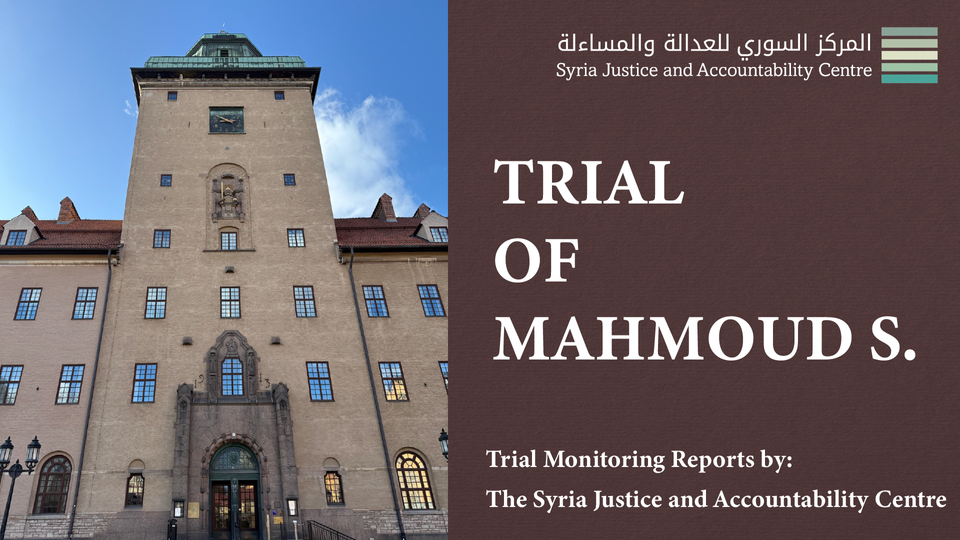
TRIAL OF Mahmoud S.
Solna District Court – Stockholm, Sweden
Trial Monitoring Summary #07
Hearing Date: December 8, 9, and 11, 2025
CAUTION: Some testimony may include graphic descriptions of torture, rape or other violent acts.
Note that this summary is not a verbatim transcript of the trial; it is merely an unofficial summary of the proceedings.
Throughout this summary, [information located in brackets are notes from our trial monitor] and “information placed in quotes are statements made by the witness, judges or counsel.” The names and identifying information of witnesses have been redacted.
[Note: SJAC provides a summary of the proceedings while redacting certain details to protect witness privacy and to preserve the integrity of the trial.]
Trial Monitoring reports of the Mahmoud S. trial are a result of a partnership between the Syria Justice and Accountability Centre, the University of Stockholm, Sweden, and the Center for Victims of Torture (CVT).
SJAC’s 7th trial monitoring report details days 20, 21, and 22 of the trial of Mahmoud S. in Stockholm, Sweden. This week, W3 testified regarding the demonstrations in Yarmouk and his knowledge of the Plaintiffs and the Accused. The Prosecutor then briefly presented some supplementary statements of facts in regards to a previous claim that relief shipment was able to enter Yarmouk from December 2012, as well as to prove that P1 was an ambulance driver at the hospital.
On the third day of the week, the Defense argued that key evidence, including ambulance photos and images of alleged perpetrators, came from overlapping social‑media networks where material is repeatedly circulated and may lack reliable verification. After the break, witness W4 testified about a 2012 demonstration in Tadamon during which her cousin’s son was fatally shot, her subsequent participation in a video about his death.
Day 20 – December 8, 2025
At the beginning of the proceedings, a power outage that lasted for approximately one hour impeded the start of the hearing. Subsequently, the Court summarized and reviewed the information covered in previous trial days.
A lunch break ensures, but the trial monitor was unable to attend the proceedings after the lunch break due to illness.
The next trial day will be on December 9, 2025, at 9:00 AM.
Day 21 – December 9, 2025
Questioning by the Prosecution
The witness, [redacted name], W3 was born in [redacted time] in the Yarmouk camp. He is a [redacted information] who had worked at the Basel hospital and, during the conflict, he volunteered as part of their medical team. He had previously also completed military service at an army medical reception. W3 testified that about a month after the war started in March 2011, the Basel hospital began to receive wounded people from the rural area of Damascus. Later on, the hospital began to receive wounded from Yarmouk.
W3 testified that he took part in demonstrations in Yarmouk. The Prosecution asked W3 about the demonstration on July 13, 2012. W3 confirmed that he took part in this demonstration. He explained it happened on a Friday. People started demonstrating after the prayer, and the demonstrations started outside different mosques. They all came together in Yarmouk Street, where W3 joined in. The demonstrators were heading towards the cracker factory when W3 told them to stop, since he knew that was a dangerous area. W3 and some others left the demonstration and walked back. W3 did not see or hear the shooting but was later told that there had been a shooting by the Cracker factory. W3 later went to the Basel hospital where the wounded started arriving. W3 testified that when he arrived, he saw 2-3 dead bodies lying by the entrance as well as some wounded. He began to help out and recounted all rooms in the hospital were full. W3 recounted that everyone wounded had been shot. He had seen a man named [redacted name], F13, dead from 2-3 shots in the chest. There were two rounds of wounded coming to the hospital; W3 had heard that the first one was a consequence of the demonstration, and the second round was a consequence of the military’s engagement. The Prosecution specifically asked about [redacted name], P3. W3 and P3 are [redacted information] through W3’s [redacted information] and P3’s [redacted information], who were brothers. W3 recounted that he had seen P3 in the hospital on the day of the demonstration. P3 had been shot in the head and was undergoing a medical operation. W3 recalled this detail because P3’s family had asked him to check if P3 was still alive, which he was. However, P3 was in need of more resources than what was available at the Basel hospital. If he were to stay there, he would die. The director of the hospital decided to move P3 to a national hospital. P3 survived and was not arrested by the regime, which had been a concern when moving him.
The Prosecutor asked specifically about what W3 knew about [redacted name], P2. W3 testified that P2 had come into the hospital during the first round, and that he had been taking part in the demonstration. He was injured in the stomach and was undergoing a medical operation when W3 arrived at the hospital. He was later informed that P2 was there. W3 knew P2 as he was the brother of one of W3’s co-workers at the hospital.
***
[15-minutes-break]
***
The Prosecutor asked in which way the wounded came to the hospital. W3 said that they were usually carried by other people. The Prosecutor then asked if there were no ambulances in Yarmouk. W3 first testified that there was nothing organized, but that the Palestine hospital had 2-3 ambulances and that the [redacted name] hospital, which belonged to the army, had one. W3 testified that [redacted name], P1 was an ambulance driver, and that his brother knew him.
W3 testified that Yarmouk was bombed on December 16, 2012, and that people started to leave in the aftermath, while opposition forces came. W3 left one day after and returned after about five or six days. After that, he left and returned to Yarmouk only once, before leaving for good in May or June 2013. W3 testified that there was a checkpoint by the army and security service. The last time W3 returned to Yarmouk, he recounted snipers shooting at the line of people getting into the camp after passing the checkpoint. He recalled that four women were killed. W3 did not know the people controlling the checkpoint, only that they were part of the regime. When W3 left the final time, he did not see anything unusual. The Prosecution asked if he saw anyone at the checkpoint wearing a mask, to which he replied that he did not. He had heard the rumors about the masked man and had seen him once when he was walking in the camp.
***
[15-minutes-break]
***
Lastly, the Prosecution asked if W3 knew the Accused during his time in Yarmouk, to which W3 replied that he did not, he had only seen him on Facebook.
The Prosecutor presented some supplementary statements of facts, among which was a photo of P1’s driver’s license, which the Prosecution intended to show what he looked like in 2005 until 2013. Another photo was of a white van with a Red Crescent symbol. The Prosecution showed photos supposedly taken outside the [redacted name] hospital. The photos showed a gathering of people and a van arriving with the Red Crescent symbol, the driver’s face visible in the window. The Prosecution explained that these similarities indicate that it is P1 driving. Lastly, the Prosecution showed a list of an order of command with the Accused’s name. There was also a new name: [redacted name], F6, the brother of the Accused, named as a group leader.
The proceedings were adjourned at 12:15 PM.
The next trial day will be on December 11, 2025, at 9:00 AM.
Day 22 – December 11, 2025
Completory Facts by the Defense
Proceedings began at 9:11 AM. The hearing began with the Defense presenting supplementary facts addressing previous testimony concerning specific allegations, witnesses, and social media.
First, the Defense addressed the testimony about an ambulance that was allegedly shot at in Yarmouk. The Defense said that they had investigated this claim using social media and online sources covering the incident, including Facebook posts and websites such as Orientnews.net, Athrpress, and Islamicsham. The testimony had also claimed that the ambulance had been placed outside the Palestine Hospital, and the Defense presented photos of a damaged ambulance. The Defense argued that the photos did not appear to have been taken outside the Palestine Hospital, as the surrounding environment did not match the hospital area.
The Defense then discussed the risk of collusion among witnesses. They explained that they had examined where the photos used in the case originated, how they became part of the investigation, and how they are shared through social media activism. According to the Defense, a large number of photos have been circulated on Facebook. One witness, who testified to German police, stated that it was difficult to find all images of the alleged perpetrators and that a group effort on social media was used to collect them. This witness submitted a total of 75 photos to investigators in 2020. During the same year, two other witnesses submitted some of the same photos to German police.
The Defense also highlighted that the witnesses are connected to one another and that information is repeatedly shared among them. As a result, much of the evidence in the case is circulated within the same network of individuals.
Finally, the Defense emphasized the role of social media activism. For example, on Telegram, there is a group called “Assad's Shahiba Hunters,” where members share photos of people they believe to be Shabihas. On platforms such as Instagram and TikTok, livestreams are frequently held in which moderators discuss ongoing trials against alleged Shabihas in Europe and Syria. One such livestream took place outside the Stockholm District Court during a trial day. These livestreams are public and often tag other accounts, allowing them to reach a wide audience. The Defense presented examples of recordings from livestreams held between October and November 2025, in which several individuals were named as alleged Shabihas or associates. Overall, the Defense emphasized that widespread speculation on social media leads to people being labelled, identified, and linked to actions or individuals without reliable verification.
***
[15-minute break]
***
Testimony of W5
Following a break, the witness, [redacted name], W4 took an oath before giving testimony, and the Prosecutor proceeded to question W4. The Prosecutor asked W4 to give a brief background about herself and her life in Syria before moving to [redacted location] in 2014. She told the Court that she was born in [redacted time] in Syria and had lived her entire life in Tadamon, a district adjacent to Yarmouk. She identified herself as Syrian. W4 testified that she is a trained nurse and continued working as a nurse between 2012 and 2013 after the outbreak of the revolution. During this period, she often provided medical assistance outside hospitals and formal medical facilities, treating people injured in the fighting. When asked about her involvement in political activity, W4 testified that she opposed the Assad regime and had participated in several demonstrations, mainly in Tadamon but also in Yarmouk.
The Prosecutor then asked W4 to describe the day of the demonstration. She testified that it was a very large demonstration, which she planned to attend together with her cousin’s son, whom she described as being like a brother to her, as well as with other individuals. She could not recall who informed her about the demonstration. She met her cousin’s son at the Palestine roundabout. Shortly afterward, she heard gunfire coming from Palestine Street. She and her cousin’s son began to run to escape.
When the Prosecutor asked for more details, W4 testified that she heard gunfire, including shots fired from vehicles, but did not see the shooters, as she fled immediately. While attempting to cross the street, her cousin’s son was shot in the head and collapsed in the middle of the road. W4 and others attempted to save him by transporting him in a tuk-tuk to a medical facility. During the journey, she tried to stop the bleeding and provide first aid, but he died in the vehicle. He was later taken to a mosque and buried.
A few hours later, during the funeral, W4 participated in a video recording in which she said that her cousin’s son had been killed, that the Assad regime would fall, and that the people wanted freedom. The Prosecutor played the video in court, and W4 confirmed that she appeared in it. Her face was partially covered because she feared being identified by the regime, although she said that the authorities later identified her despite this. When the Prosecutor asked whether she was surprised that demonstrators were shot at, W4 replied that this was not unusual and had happened before during demonstrations.
The Prosecutor then asked about the siege of Yarmouk. W4 testified that she believed the siege began around 2012. During this period, she remained in Tadamon and was unable to leave the district. Unlike Yarmouk, no one was allowed to enter or leave Tadamon unless they were cooperating with the Syrian regime. She was also unable to enter Yarmouk and kept a low profile because she was wanted by the Syrian authorities.
Finally, the Prosecutor asked when W4 left Syria. She testified that she escaped Tadamon by hiding in a box on a truck and exiting via Yarmouk Street. In 2014, after the death of her son, she left Syria.
Neither the Defense nor the Plaintiff’s Counsel had any questions for W4.
Proceedings were adjourned at 12:42 PM.
The next hearing day will be on December 16, at 9:00 AM.
___________________________
For more information or to provide feedback, please contact SJAC at [email protected] and follow us on Facebook and Twitter. Subscribe to SJAC’s newsletter for updates on our work