Inside the Mahmoud S. Trial #06: Unmasking the Truth
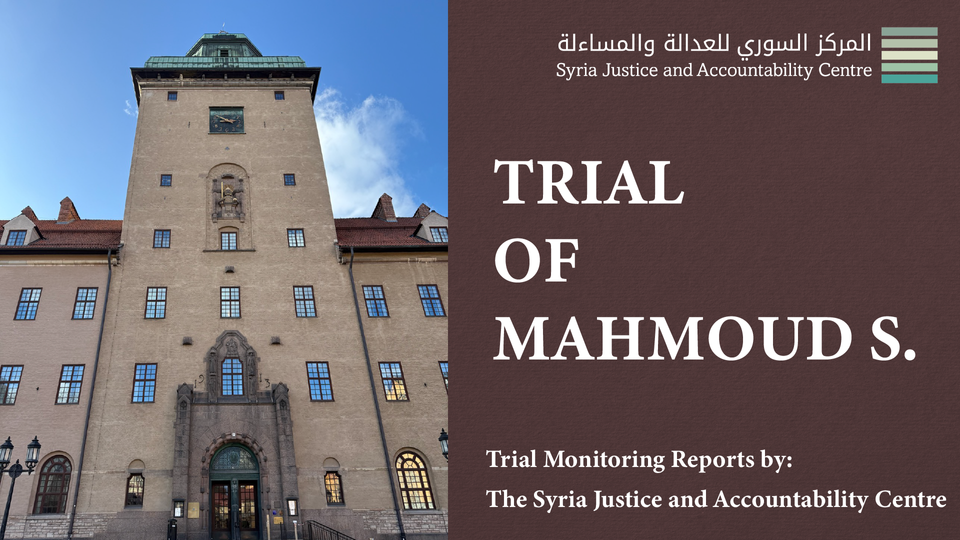
TRIAL OF Mahmoud S.
Solna District Court – Stockholm, Sweden
Trial Monitoring Summary #06
Hearing Date: December 3, 4, and 5, 2025
CAUTION: Some testimony may include graphic descriptions of torture, rape or other violent acts.
Note that this summary is not a verbatim transcript of the trial; it is merely an unofficial summary of the proceedings.
Throughout this summary, [information located in brackets are notes from our trial monitor] and “information placed in quotes are statements made by the witness, judges or counsel.” The names and identifying information of witnesses have been redacted.
[Note: SJAC provides a summary of the proceedings while redacting certain details to protect witness privacy and to preserve the integrity of the trial.]
Trial Monitoring reports of the Mahmoud S. trial are a result of a partnership between the Syria Justice and Accountability Centre, the University of Stockholm, Sweden, and the Center for Victims of Torture (CVT).
SJAC’s 6th trial monitoring report details days 17, 18, and 19 of the trial of Mahmoud S. in Stockholm, Sweden. On the first day of the week, witness W1 described the early unrest in Yarmouk, the later kidnapping of his brother, and his work with a peace‑focused group. He said he knew Mahmoud S. only as an acquaintance and could not identify him among armed groups. Rumors linked Mahmoud S. to a masked man, but W1 never saw this person himself and denied being influenced in his testimony.
On the second day of the week, the trial of Mahmoud S. continued with the examination of witness W2 by both the Prosecutor and the Defense. W2 testified about the security situation in Yarmouk, his observations of Mahmoud S. at regime-controlled checkpoints, and his own detention and mistreatment after being wrongfully arrested. The Defense focused on challenging the reliability of W2’s identification of Mahmoud S., highlighting inconsistencies with earlier statements during the interview with the police.
On the third day this week, only the Judges were present, reviewing recordings of testimonies presented on previous court days and advised the trial monitor to leave.
Day 17 – December 3, 2025
Questioning of W1
Witness, [redacted name], W1, was sworn in, and the questioning by the Prosecutor began. W1 briefly described his personal background. He was born and raised in Damascus, in the Yarmouk Camp. In [redacted time], he moved to [redacted location], located west of Damascus. Despite relocating, he continued to visit Yarmouk regularly due to his work.
W1 recalled that the first significant change in the Yarmouk Camp occurred on July 13, 2012, following the Friday prayer, when a demonstration broke out. As he travelled to Yarmouk to stay with a friend for a celebration, he encountered difficulty entering the camp, as many of the streets had been closed off. Upon his arrival, he heard gunfire. Although he did not see any of the shooters, the gunfire continued throughout the night. According to him, the shots originated from Palestine Street.
***
[20-minute break]
***
Questioning by the Prosecutor continued. W1 emphasized that the events occurred 13 years ago, which made it difficult for him to recall all details clearly. He noted that the day after arriving at his friend’s home, he discovered that one of the tires on his car had been struck by a bullet. He also described the circumstances surrounding the loss of his brother in July 2013. His brother had been kidnapped and, despite efforts to secure his release—including an offer of money by W1's family—he was never returned. The family never learned the reason for his abduction or what ultimately happened to him.
W1 explained that he had been part of a group he referred to as “the Educated People of Yarmouk,” whose aim was to promote peace and security within the camp and to prevent individuals from taking actions that could provoke problems. The group attempted to cooperate with individuals in leading positions but ultimately did not succeed.
He described the Shabiha as civilians who were armed, supported, and coordinated by the security services, and whose purpose was to target those opposing the regime. W1 testified that he had witnessed Shabiha attacks on people during Friday prayers in Damascus, although he had not seen such incidents in Yarmouk. Demonstrations took place every Friday in Damascus, and the Shabiha appeared at each of them.
***
[60-minute break]
***
Questioning by the Prosecutor continued. W1 was asked to clarify several details he had previously mentioned. He confirmed that he knew Mahmoud S., describing him as an acquaintance and noting that people of the same age in Yarmouk generally knew one another. He explained that he often saw Mahmoud S. on a street where W1’s cousin owned a shop—a central commercial street in Yarmouk frequented by many residents.
W1 also recalled having seen an armed group positioned at the entrance to the Yarmouk Camp, though he emphasized that he could not identify Mahmoud S. among them. He noted that his eyesight is poor and that he generally avoided the military areas near the camp, particularly Palestine Street, the Palestinian Roundabout, and the beginning of Yarmouk Street.
When asked by the Prosecutor about a masked individual mentioned in an earlier testimony by W1, W1 testified that he had never seen this person himself but had heard about him repeatedly. Various names had been associated with the masked man, including Mahmoud S.’s. W1 recounted that a friend, shortly before his death, said that he believed the masked man was Mahmoud S., claiming he recognized him by his eyes. Seeking clarity, W1 contacted two friends who were lawyers—one of whom worked on war crimes investigations in Syria—but neither was able to confirm any connection between Mahmoud S. and the masked individual.
The Defense Counsel proceeded to question W1, clarifying his connections and acquaintances within Yarmouk. He was also asked about his previous conversations with a lawyer during the German investigation and whether anyone had instructed him on what to say during that process or before the Court. W1 denied this and testified that he had not been influenced by others, although he acknowledged that many names were circulating rapidly in the media at the time, including Mahmoud S.’s.
The proceedings were adjourned at 4:30 PM.
The next trial day will be on December 4, 2025, at 9:00 AM.
Day 18 – December 4, 2025
The Prosecutor’s Questioning of W2
The proceedings began at 09:00 AM. Upon request by the Prosecutor, [redacted name], W2 began by giving a brief background of himself. He testified that he was born in Yarmouk and lived there with his family until around 2013. After the bombings of Yarmouk, he resided in another city outside of Syria, [redacted location]. In March 2014, he fled to [redacted location], where he continues to reside. He explained that the conflict in Yarmouk was very apparent, particularly after the bombings in December 2012. Even before that, shootings and demonstrations were common in the district.
Regarding the demonstration on July 13, 2013, W2 testified that he did not attend. He was in the Yarmouk camp at the time, but does not recall his exact location. When the Prosecutor asked about his understanding of what occurred that day, he said that opposition-affiliated civilians held a demonstration, which was later attacked by regime-loyal forces. He added that he remembered a 14-year-old boy being killed during the protest. However, given the frequency of demonstrations in Yarmouk during that period, he clarified that he was not entirely certain that the boy’s death occurred at this specific demonstration.
The Prosecutor then asked about the conditions in Yarmouk following the installation of the checkpoints. After the bombings in December 2012, W2 never returned to the camp itself. He did, however, occasionally go to what he called “the bridge” area, referring to the vicinity of the Al-Bashir Mosque where the checkpoints had been set up. He explained that he could not enter Yarmouk due to the risk of being detained or killed by regime-allied forces. For example, his brother and two of his nieces disappeared during this period, and after the fall of the Assad regime in 2024, he learned that all three had died. W2 also explained that he had obtained a fake ID to move around in the bridge area, as he feared being arrested by those guarding the checkpoints because he was not aligned with the Syrian regime. He emphasized that if he had not obtained the fake ID, he would be at risk of getting arrested.
***
[15-minute break]
***
The Prosecutor proceeded with several questions concerning W2’s knowledge of Mahmoud S.'s involvement in guarding the checkpoints and the role he believed Mahmoud S. held there. W2 testified that the roadblocks were manned by various regime-allied groups, including members of the General Command, the Syrian Security Service, and the Free Palestine Movement (FPM). He testified that he had recognized Mahmoud S. and had seen him at the checkpoints on multiple occasions. According to W2, he only observed Mahmoud S. actively reporting individuals while wearing a mask. On one occasion, W2 saw Mahmoud S. identify a person who was then detained by forces at the checkpoint. W2 was not entirely certain which group carried out the detention but believed it to be regime-loyal forces such as the FPM or the Syrian Security Service. He said that after the person was taken away, Mahmoud S. remained at the roadblock.
When asked how he identified Mahmoud S. despite the mask, W2 explained that he recognized Mahmoud S.'s body shape and slim build. He added that although he never saw Mahmoud S. shoot anyone, he did see him armed on several occasions. W2 confirmed that he had known of Mahmoud S. prior to the conflict, recognizing him by appearance, but emphasized that they had never been friends. The Prosecutor also asked why individuals were being reported at the checkpoints. W2 said that the roadblock personnel were targeting opposition-affiliated individuals. W2 said that Mahmoud S. sometimes wore camouflage trousers and at other times civilian clothes. W2 further asserted that it was widely known in the Yarmouk area that Mahmoud S. supported the regime and was considered a Shabiha. In response, the Prosecutor asked him to clarify what he meant by Shabiha. W2 explained Shabiha were those who allied with the Syrian regime, and looked down on those who did not. He also said that it was common knowledge in the district that Mahmoud S. had reported his own niece to the authorities.
The Prosecutor lastly questioned W2 about his time in detention. Approximately one month after the bombings in Yarmouk, W2 was arrested in the town he resided in on allegations that he had participated in the fighting in Yarmouk. It was later established that his name had been confused with someone else’s, and he was released once this was clarified by the Court. W2 testified that during his imprisonment he suffered significantly, explaining that he had been placed in an isolation cell and subjected to abuse at the time of his arrest.
***
[15-minute break]
***
The Defense’s Questioning of W2
The Defense began its questioning by addressing the discrepancy between W2’s inability to identify Mahmoud S. in photographs during the 2020 interrogation and his claimed ability to recognize him while masked at the roadblocks in 2013. The Defense presented three photographs of Mahmoud S.: two depicting him with a friend while wearing a cap, and a third showing him among a larger group of individuals. In the first two photographs, W2 was unable to identify Mahmoud S., although he did recognize Mahmoud S.’s friend. In the group photograph, W2 was able to name five individuals, but none of those identified was Mahmoud S. On this basis, the Defense challenged the reliability of W2’s claimed identification of Mahmoud S. as the masked individual pointing out people at the roadblocks.
W2 responded that the German authorities, conducting the questioning in 2020, had not specifically asked whether he could identify Mahmoud S., and therefore, he did not mention Mahmoud S. during that interview. He also noted that the group photograph had been shown to him only in physical form, without the possibility of zooming in. The Defense further questioned W2 regarding his claim that Mahmoud S. had reported W2’s niece to the Syrian authorities, asking when this had occurred. W2 said that he was uncertain but believed it may have been sometime around 2013.
The proceedings were adjourned at 12:42 PM.
The next trial day will be on December 5, 2025 at 9:00 AM.
Day 19 – December 5, 2025
On this trial day, the courtroom opened a few minutes late. The trial monitor was the only member from the public present. Neither the Defense nor the Accused attended the hearing. Only the Judges and the Prosecutor were present. The Judge explained to the trial monitor that the purpose of the session was to review recordings of testimonies presented on previous court days, already monitored by the trial monitoring team, and advised the trial monitor to leave.
The next trial day will be on December 8, 2025 at 9:00 AM.
___________________________
For more information or to provide feedback, please contact SJAC at [email protected] and follow us on Facebook and Twitter. Subscribe to SJAC’s newsletter for updates on our work