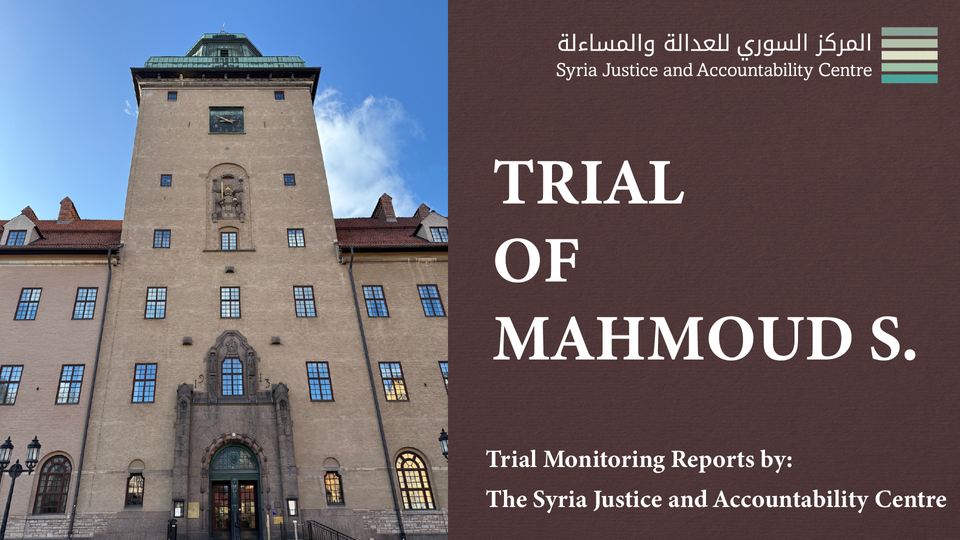
Inside the Mahmoud S. Trial #03: Testimonies of Plaintiff
TRIAL OF Mahmoud S.
Solna District Court – Stockholm, Sweden
Trial Monitoring Summary #03
Hearing Date: November 10, 12, and 13, 2025
CAUTION: Some testimony may include graphic descriptions of torture, rape or other violent acts.
Note that this summary is not a verbatim transcript of the trial; it is merely an unofficial summary of the proceedings.
Throughout this summary, [information located in brackets are notes from our trial monitor] and “information placed in quotes are statements made by the witness, judges or counsel.” The names and identifying information of witnesses have been redacted.
[Note: SJAC provides a summary of the proceedings while redacting certain details to protect witness privacy and to preserve the integrity of the trial.]
Trial Monitoring reports of the Mahmoud S. trial are a result of a partnership between the Syria Justice and Accountability Centre, the University of Stockholm, Sweden, and the Center for Victims of Torture (CVT).
SJAC’s third trial monitoring report details days 8, 9, and 10 of the trial of Mahmoud S. in Stockholm, Sweden. On the first day of this week, the Plaintiff, P2, provided his account of what occurred during the demonstration in Yarmouk on July 13, 2012. He explained that he was shot by the security services, requiring surgery and causing intense physical and mental pain. He also recalled that after December 17, 2012, the camp's population declined significantly. The regime and forces loyal to the regime set up checkpoints and checked ID documents, controlling who went in and out.
Trial days 8 and 9 were heard behind closed doors.
Day 8 – November 10, 2025
Testimony of Plaintiff P2
Today, [redacted name] P2 was heard in court regarding his observations and experiences from Yarmouk on July 13, 2012. P2 was heard to confirm the shooting that occurred in connection with the demonstration next to the biscuit factory, and to confirm that he was shot in the stomach on Sarafand Street. The Plaintiff was also heard to talk about the risks of being shot and about a roadblock (the northern checkpoint) next to the Bashir Mosque.
The Prosecutor’s Questioning of the Plaintiff
The Prosecutor began by asking questions about where P2 was and how he remembered the demonstration. The Plaintiff described that he stood and watched people throw stones. Following this, he was shot in the stomach, but he could not give a direct estimate of how long he was there. The Prosecutor then asked questions more specifically about the shooting. P2 testified that it was the security services that shot him and that they were standing on Palestine Street. The Prosecutor then displayed a satellite image of the area for P2 to point out the location of the sequence of events. P2 first pointed to Palestine Street, then he described that it was next to the biscuit factory where he was standing when two young people came and talked to him about being shot at. P2 further said that the shooting took place at Palestine Street, but that he did not see the shooter; he heard shots from a narrow side alley next to the street. The Prosecutor then showed the Plaintiff's sketch that he had drawn during a previous questioning and asked if he remembered anything about the location, but P2 could not locate exactly where the shooter(s) were standing. The Prosecutor then asked whether P2 had an opinion on how the security services could have known about the demonstration and whether it was planned by them. P2 replied that he did not know how they knew, but that it did not matter whether it was planned, because the climate was such that the military and security officers did not allow demonstrations against the regime at the time.
***
[15-minute break]
***
The Prosecutor was interested in knowing what happened to the Plaintiff’s brothers. P2 said that he and his brothers walked away from their mother’s home to the demonstration. At the biscuit factory, they backed up, and he could no longer see the brothers, but was left alone. P2 estimated the walk to be about 30 minutes at a slow pace, but emphasized that it was difficult to estimate the time exactly. He was then asked if he could see any injured or deceased person at the scene or at the hospital after he was taken there. He said that in retrospect, he had only seen on YouTube that [redacted name] F3 had been shot in the head.
The Prosecutor then proceeded to ask about the risks at his workplace. P2 recalled that he was at home for two months after the injury and that he told his employer that it was because of a bowel obstruction that he underwent surgery. When the Prosecutor asked why, P2 replied that it would have been risky if they had found out that he had been injured at a demonstration, then they would have handed the case over to the security apparatus that is located at the workplace. P2 also described that if you had been arrested for participating in a demonstration against the regime, you probably wouldn’t get out without being killed.
The Prosecutor then proceeded to ask about the northern checkpoint. P2 testified that traffic on Palestine Street was stopped and that FPM controlled the area. He further described that there were rarely tensions in the Yarmouk camp, but that in the last few months bombs and shells could fall everywhere in the camp. P2 then explained that after December 17, 2012, there was a change, and most of the residents left the camp. The regime and forces loyal to the regime set up checkpoints and checked ID documents, and controlled who went in and out. P2 could not accurately describe the division among them, but said that all of them ultimately belonged to the regime that served as the “umbrella” for the groups. He also talked about the People’s Committees where the basic idea was that they would neither belong to the regime nor the opposition, but that this was changed, and most belonged to the General Command, which was under the Syrian security apparatus. P2 described that it became clear that they also became part of the checkpoints as they grew bigger. The Prosecutor also asked questions about P2’s own experience of having gone through the checkpoint, to which P2 replied that during the first week of Ramadan, he went in on one occasion just before the camp closed on July 20, 2013, to see his brother and that the checkpoint was north of the Bashir Mosque.
The Plaintiff’s Counsel’s Questioning of the Plaintiff
It was then the Plaintiff’s Counsel’s turn to ask P2 questions about his injuries and their effects. P2 said that he had surgery for the shot in the stomach and had to have approximately 30 cm of the intestine removed. He remained in the hospital for about one week and was on sick leave for two months. Then he described that he experienced intense physical pain and that the mental suffering could be divided into two stages. The first stage was himself, that he was not contactable after the injury and could not recognize himself. The second stage was the suffering that had caused his family and his daughter, who was 6 years old at the time. P2 said that there was a false report stating that he was dead, which had an effect on the whole family.
The Defence’s Questioning of the Plaintiff
The Defense thought that the Plaintiff deviated from what he had stated in a previous interview about the incident with the two children who had thrown firecrackers. They wanted to know if the children had first thrown stones and then been shot at or vice versa. P2 could not answer in what order, but said that the sequence of events was correct. The Defense then asked supplementary questions about, among other things, [redacted name] F3, but nothing new emerged from the Plaintiff.
The trial of Mahmoud S. will resume on Wednesday, November 12, 2025.
Day 9 – November 12, 2025
[Note: Today’s hearing was held behind closed doors. The rules on hearings behind closed doors in Sweden are based on the Code of Judicial Procedure and the Public Access to Information and Secrecy Act. The Court decides whether to hold a hearing behind closed doors in sensitive cases, according to Chapter 5, Section 1 of the Swedish Code of Judicial Procedure. The Court’s decision to hold the hearing in closed session is supported by grounds for secrecy (for example, to protect the investigation). Relevant provisions may include Chapter 35, Sections 12, 12a, 13, and 17, or Chapter 36, Sections 1 and 2 of the Swedish Public Access to Information and Secrecy Act.
Most often, a decision to hold a hearing behind closed doors applies only to a limited part of the proceedings. The hearing is reopened to the public once the protected information or examinations have been concluded. It remained unknown to the monitor on which grounds the public was excluded on this trial day.]
The trial of Mahmoud S. will resume on November 13, 2025.
Day 10 – November 13, 2025
[Note: Today’s hearing was held behind closed doors. It remained unknown to the monitor on which grounds the public was excluded on this trial day.]
The trial of Mahmoud S. will resume on November 17, 2025.
___________________________
For more information or to provide feedback, please contact SJAC at [email protected] and follow us on Facebook and Twitter. Subscribe to SJAC’s newsletter for updates on our work