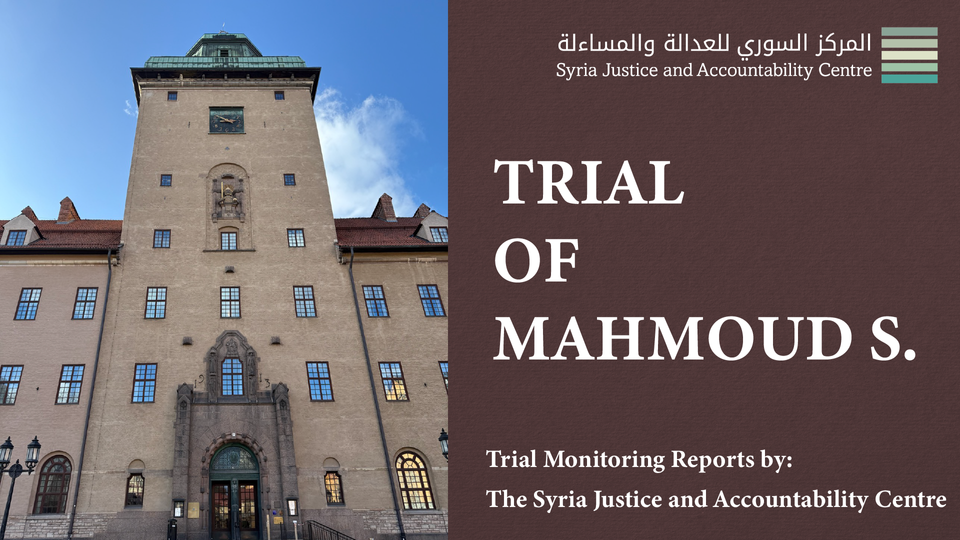
Inside the Mahmoud S. Trial #02: Plaintiffs’ Testimonies
TRIAL OF Mahmoud S.
Solna District Court – Solna, Sweden
Trial Monitoring Summary #02
Hearing Date: November 5, 6, and 7, 2025
CAUTION: Some testimony may include graphic descriptions of torture, rape or other violent acts.
Note that this summary is not a verbatim transcript of the trial; it is merely an unofficial summary of the proceedings.
Throughout this summary, [information located in brackets are notes from our trial monitor] and “information placed in quotes are statements made by the witness, judges or counsel.” The names and identifying information of witnesses have been redacted.
[Note: SJAC provides a summary of the proceedings while redacting certain details to protect witness privacy and to preserve the integrity of the trial.]
Trial Monitoring reports of the Mahmoud S. trial are a result of a partnership between the Syria Justice and Accountability Centre, the University of Stockholm, Sweden, and the Center for Victims of Torture (CVT).
SJAC’s second trial monitoring report details days 5, 6, and 7 of the trial of Mahmoud S. in Solna, Sweden. On the fifth day of the trial, the Prosecutor presented her supplementary statement of facts in response to the Defense’s statement submitted on the fourth day. During this trial day, hearings were also held with P8, whose son F3 got killed in the demonstration.
During the sixth day of the trial, two Plaintiffs were heard. Both Plaintiffs were questioned by the Prosecutor, their Counsel, and the Defense. Furthermore, the Prosecutor added to her supplementary statement of facts.
The seventh day of the trial was dedicated the testimony of Plaintiff P11, the father of killed F2. He clearly identified the Accused of having been present at several scenes and testified that he was particularly feared among the residents of the neighborhood.
Day 5 – November 5, 2025
Completory facts by the Prosecutor
The Prosecutor initially clarified that it was not disputed that crimes had been committed by both opposition and regime-affiliated forces. Moreover, the Prosecutor stated that she is not denying that some of the sources and reports originate from oppositional actors. The Prosecutor, however, argued that this does not mean all of its information is untrustworthy.
The Prosecutor highlighted several examples indicating the reports used in the investigations are trustworthy. For example, she mentioned that [the NGO] SCM had been awarded this year’s Civil Rights Defenders Award in recognition of its work to ensure accountability for war crimes and uncover the truth. Concerning AGPS, she explained that the organization maintains neutrality, reporting on human rights abuses committed by both opposition and regime-loyal forces. As the Defense noted that neither UN reports nor those from Human Rights Watch or Amnesty International mentioned Mahmoud S., thereby suggesting no indication of his involvement, the Prosecutor emphasized that such organizations rarely disclose individual names in their reports.
***
[15-minute break]
***
Regarding the trustworthiness of the witnesses, the Prosecutor stated that the Defense had taken conversations out of context. The Prosecutor emphasized that there is nothing to indicate that [redacted name], P1, has attempted to alter their statements in order to allow another person to marry a relative. Regarding P1, the Prosecutor explained that the witnesses in the case were identified through various sources, primarily via searches conducted through the Swedish Migration Agency. Some witnesses were referred by the particular witness in question, but by no means all. Thus, the investigation is not based solely on a single witness, as claimed by the Defense.
Concerning the video footage from the demonstration, which the Defense suggested could indicate clashes between opposition and regime-loyal forces, the Prosecutor acknowledged that the translation of the spoken content in the videos shows that some of the slogans were oppositional. Some of the slogans were directed against Assad, while others were shouted in support of the Free Syrian Army (FSA). However, there are no indications that the Free Syrian Army was present at the demonstration.
Testimony of the Plaintiff
[redacted name] P8 was then questioned by the Prosecutor, his Counsel, and the Defense. The testimony began by P8 providing a brief background of his personal life, explaining that he had lived in Yarmouk since he was one year old and remained there until late [redacted time]. He worked as a [redacted information] in [redacted location], and his wife ran a [redacted information] close to their home in Yarmouk. They had two sons. He expressed that he was never politically active, although he privately held some critical opinions about Assad’s regime. He chose not to express his opinions openly due to the risks involved, especially as a state employee.
P8 then testified regarding the demonstration that took place on 13 July 2012. He stated that after the outbreak of the civil war, demonstrations occurred almost daily in Yarmouk. Although his son, [redacted name] F3, was eager to participate, P8 had initially prevented him from doing so out of concern for his safety and the risk of arrest. Yet, on Friday, 13 July, P8 participated in a demonstration along with his two sons. He explained that he was mainly concerned for his younger son and therefore held his hand throughout the event, while F3, who was very enthusiastic, moved ahead of them. When the march reached the Palestine Roundabout, P8 and his other son suddenly heard intense gunfire. He and his younger son fled into a nearby side street. Upon returning home, P8 and his family waited outside for approximately one to two hours for his F3 to arrive. When he did not return, P8 and several close relatives began searching for him. Later that evening, P8 received a phone call from a mosque informing him that his son had been injured. When P8 and his brother arrived at the mosque, they were informed that his F3 had passed away and had already been buried in a cemetery.
***
[60-minute break]
***
One or two days after the demonstration, P8 visited a neighbor who had also lost his son at the scene. The neighbor mentioned several names of individuals he had seen open fire on the protesters, among them was Mahmoud S. There is, however, some uncertainty regarding this testimony, as P8 did not state this during the first hearings. He explained that this was because the events occurred roughly thirteen years ago and his memory is somewhat unclear. Nevertheless, P8 insisted that he provided this information in earlier interviews with the Swedish police. According to P8, he had never heard about Mahmoud S. before visiting the neighbor. After that, he had done some research of Mahmoud S. and he also expressed that he recognized him in the court.
The Prosecutor posed several questions concerning the roadblocks, the impact of the war in Yarmouk on P8’s daily life and how the death of his son had affected him. P8 explained that when the bombings in Yarmouk began, he and his family relocated to another area but regularly returned to check on their home. However, the roadblocks that were established after 2012 made returning to their home in Yarmouk increasingly difficult. P8 testified that his son’s death had turned his entire world upside down and caused him immense grief. As a result of his loss, he has suffered both physical and psychological harm, including symptoms of PTSD and hearing issues.
The proceedings were then adjourned, and the trial of Mahmoud S. will resume on Thursday, November 6, 2025.
Day 6 – November 6, 2025
Hearing of P9
The questioning by the Prosecutor began with [redacted name] P9 briefly describing her personal background. P9 had lived in the Yarmouk Camp between [redacted time], where she worked as a [redacted time]. She explained that life in Yarmouk before 2011 had been peaceful, with no significant problems beyond ordinary everyday challenges. However, following the outbreak of the Syrian conflict in 2011, the situation worsened rapidly. P9 described how indiscriminate bombings and shelling against civilians made life unbearable in the camp. She eventually left Yarmouk permanently in December [redacted time].
P9 was heard about the demonstration that took place on 13 July 2012, in which her 14-year-old son (F3) lost his life. She testified that she heard the marchers outside her apartment and saw the streets filled with people taking part in the peaceful demonstration. At first, she heard scattered gunshots, which soon escalated into heavy gunfire. Her husband, P8, and two sons had joined the demonstration, and both her husband and youngest son returned home as soon as the shooting started. When F3 hadn’t returned an hour and a half after the shooting began, the family went out to look for him. They visited several hospitals within the Yarmouk Camp and attempted to leave the camp to check hospitals outside, but were stopped at a checkpoint where they came under fire. A photo of F3 was posted on Facebook in hopes that relatives would recognize him and be able to say farewell before burial. However, by the time the family found out about F3´s passing, he had already been buried.
***
[15-minute break]
***
P9 considered the shooting deliberate, as many protesters were shot multiple times, including F3. Although she did not see who fired the shots, she assumed it was the Syrian Security Services, who were known to make arrests in the camp. She explained that this was the first demonstration of such magnitude in Yarmouk and that she had not anticipated the use of lethal force. Had she known, she would never have allowed her sons to participate. She recalled that thirteen people died that day.
P9 further explained that during the autumn of 2012, the checkpoints around Yarmouk became increasingly strict and dangerous. People’s IDs and vehicles were checked thoroughly, and the guards’ behavior became more threatening. Due to the danger the roadblocks posed, and her emotional distress of being in the environment F3 once lived and was killed, she never went back to the Yarmouk camp after December [redacted time]. When asked by P9’s Counsel how F3’s death had affected her, P9 explained that she has been, and still is, devastated both mentally and physically. She noted that she experiences nightly hallucinations and was unable to work for a long time following the passing of F3. She has developed health problems such as high blood pressure and diabetes, and she now lives in constant fear for her remaining son.
***
[60-minute break]
***
Testimony of Plaintiff P10
[Redacted name] P10, initially provided background on his personal situation, explaining that he had lived in Tadamon from the [redacted time]. He described life in Tadamon as calm and peaceful before the revolution, but after the conflict began, societal divisions emerged, turning friends into enemies and creating a clear divide between supporters and opponents of the regime.
P10 fled from Tadamon to Yarmouk and participated in peaceful demonstrations against the regime. P10 stated that he and his 17-year-old son, [redacted name] F1, participated in a demonstration in Tadamon on 13 July 2012. Based on his observations, the demonstration was peaceful, with no armed opposition and approximately 40 to 50 participants. After the main demonstration dispersed, F1 continued with a group of local youths walking between Tadamon and Yarmouk. Gunfire erupted, and F1´s friend was shot. When F1 attempted to assist his friend, he too was fired upon, and killed. In total, three young men were killed.
Upon hearing the gunfire, P10 ran toward the scene and encountered a group of youths carrying F1´s body. P10 then, along with a friend, pursued to wash the bodies of the killed boys and then, by car, tried to locate a place for burial. While in the car, they came under gunfire near the Palestinian Roundabout, which P10 suspected came from the General Command (GC) due to its proximity to the roundabout. P10 did not personally see the shooters but heard continuous gunfire throughout the car ride. His son was buried alongside his friend.
P10 was further asked about the roadblocks in Tadamon which he said he avoided due to fear of the regime and the Shabiha, and the potential consequences if he were arrested. He had not personally witnessed incidents at the roadblocks but had received information from media reports and knew several relatives who had been killed by the regime, causing his fear of meeting them.
Complementary facts by the Prosecutor
The Prosecutor emphasized that several of the individuals who are heard in this trial also took part in the German investigation [note: in Koblenz, Germany, the trial against five Accused started on November 19, 2025. For the details, see the trial monitoring reports by SJAC], during which they were previously interviewed. In that earlier inquiry, the witnesses were immediately informed of the identities of the Accused. The Prosecutor pointed out that these prior interviews may have some influence on what the witnesses now recall, potentially shaping their memories and serving as a reference framework for the accounts they provide in the present proceedings.
The trial of Mahmoud S. will resume on Friday, November 7, 2025.
Day 7 – November 7, 2025
Testimony of P11
[Redacted name] P11, was living in Yarmouk at the time of the demonstration on the 13 of July 2012. The protest, held in memory of the fifteen young conscripts killed near the Golan border earlier that year, began peacefully but was violently suppressed by armed Shabiha. Live fire was opened without warning into the crowd of thousands of civilians, resulting in multiple casualties, including P11’s son, [redacted name] F2, who was shot while documenting the demonstration with his camera. P11 appeared in court to give his testimony about the demonstration and his observations at the Northern Checkpoint.
P11 had not planned to participate in the demonstration but people gathered in his neighborhood, and he decided to accompany his son to document the event. During the incident, he witnessed targeted gunfire and identified several perpetrators who were Shabiha members – Mahmoud S. being one of them.
Demonstration
The demonstration remained peaceful until it turned onto Palestine Street, a street on the outskirts of the Yarmouk camp. At Abu Hassan station, demonstrators encountered armed Shabiha positioned with motorcycles and Kalashnikov rifles. Gunfire began without any warning shots, causing panic as the crowd fled. P11’s son raised his camera to capture the incident and was shot in the eye by one of the Shabiha members. A young man who rushed to assist him was shot in the abdomen and bled to death.
***
[20-minute break]
Following the incident, Shabiha members came to P11’s home and threatened him – demanding that he claim his son had died of natural causes.
P11 named several Shabiha members present at the time of the shooting. He claimed to have seen the Accused, Mahmoud S., at the scene before his son was killed. Mahmoud S. was described as thin, tattooed, wearing a white t-shirt and summer trousers, and armed with a Kalashnikov. According to P11, Mahmoud S. was the first to open fire at close range. Although P11 could not confirm whether Mahmoud S. hit anyone, he testified that Mahmoud S. appeared determined to kill. P11 did not say who killed his son during the trial in Stockholm. However, in the 2023 trial in Germany, Moafak D. was named as the perpetrator by him. P11 also claimed that he did not know Mahmoud S. personally but knew about him as he was a well-known figure in the camp, closely associated with the upper ranks of Shabiha leadership.
***
[65-minute break]
***
The Checkpoint
P11 testified about various checkpoints in and around the Yarmouk camp, these are run by Shabiha members working in cooperation with the Syrian Security Services. Where civilians are reported to have been abducted, extorted, and falsely accused. P11 testified that those who came into contact with the Security Services returned as different people. He frequently went by the checkpoint on the north side of the camp, though he only went through it once. He recalled seeing a masked man at the checkpoint who pointed out individuals who subsequently disappeared. P11 testified that the masked man was not always the same person and that he was certain that it was sometimes Mahmoud S. wearing the mask. Residents avoided going outside when he was seen, as he was particularly feared.
When the Prosecutor later pointed at Mahmoud S. in court, P11 broke down in tears, and a short break was issued immediately after.
***
[15-minute break]
***
Defense Questioning
The Defense questioned P11’s relationship with Anwar al-Bunni and Firas Salim (Damounia) [name unclear], who, upon P11’s arrival in Germany after leaving Syria, introduced him to the German legal process and informed him about the possibility of prosecuting Shabiha members in Europe.
The Defense argued that P11 may have been motivated by a personal interest in pursuing members of the Shabiha after losing his son, suggesting that his testimony could be influenced by his desire for revenge and justice rather than being solely based on his observations at the time and place. They also claimed that he had not mentioned Mahmoud S. in the first five of his six statements and had initially identified only four individuals present at the demonstration. Compared to today’s testimony, where he did mention 20 individuals.
P11 explained that he did not mention certain names or details in earlier statements due to concerns for his family in Syria, specifically his sister and nephew, who were reportedly under the control of Mahmoud S.’s brother. In the first two statements he gave in the German case, he was instructed to focus only on Moafak D. and not on other members of the Shabiha FPM.
Although the Defense argued that Mahmoud S’s name was added later on, the Prosecutors presented records showing that Mahmoud S.’s name had in fact been mentioned in the second statement in Germany. In the same statement, P11 had identified 17 individuals connected to the events.
Proceedings were adjourned at 3:25 PM, following 15 minutes held behind closed doors.
The trial of Mahmoud S. will resume on Monday November 10, 2025.
___________________________
For more information or to provide feedback, please contact SJAC at [email protected] and follow us on Facebook and Twitter. Subscribe to SJAC’s newsletter for updates on our work