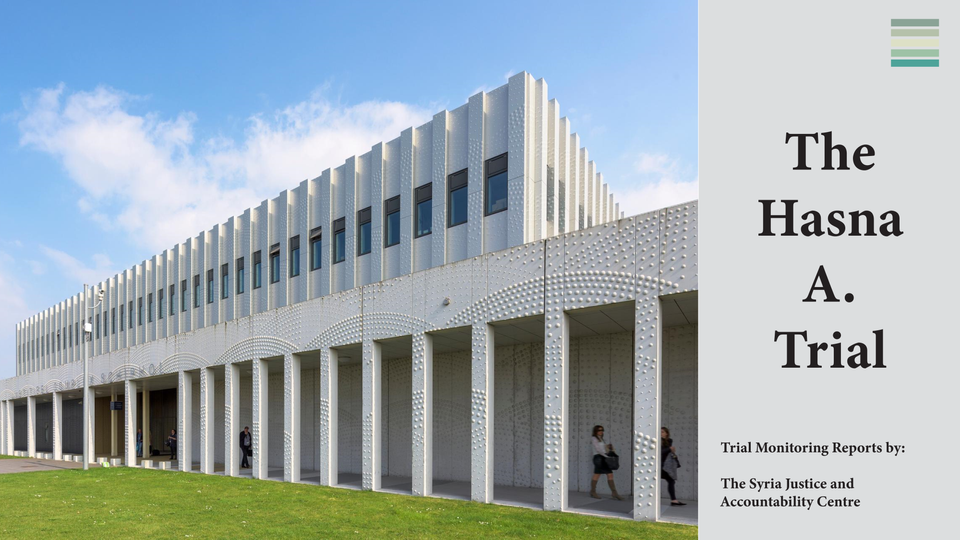
Inside the Hasna A. Appeal Trial #2: A Wound That Will Not Heal
APPEAL TRIAL OF HASNA A.
The District Court of the Hague – Badhoevedorp, the Netherlands
Trial Monitoring Summary #2
Hearing Date: February 10, 2026
CAUTION: Some testimony may include graphic descriptions of torture, rape or other violent acts.
Note that this summary is not a verbatim transcript of the trial; it is merely an unofficial summary of the proceedings.
Throughout this summary, [information located in brackets are notes from our trial monitor] and “information placed in quotes are statements made by the witness, judges or counsel.” The names and identifying information of witnesses have been redacted.
[Note: SJAC provides a summary of the proceedings while redacting certain details to protect witness privacy and to preserve the integrity of the trial.]
For the trial monitoring reports of the first instance proceedings, please see the Hasna A. case on SJAC’s website. Trial Monitoring reports of the Hasna A. appeal trial are a result of a partnership between the Syria Justice and Accountability Centre and the Criminal Justice Clinic at the University of Amsterdam, the Netherlands.
SJAC’s 2nd trial monitoring report details day 2 of the appeal trial of Hansa A. in Badhoevedorp, the Netherlands. The second day of appeal proceedings focused on the Plaintiff Z’s statement, presented through the Plaintiff’s Counsel and a pre-recorded video, situating the charges against Hasna A. within the broader context of the ISIS crimes against the Yazidi population. The Public Prosecution Service then addressed jurisdiction, evidentiary assessment, and applicable international and domestic law, arguing that the Accused knowingly contributed to ISIS practices, including the enslavement of Z, and bore criminal responsibility for crimes against humanity, terrorism-related offenses, and endangering her child. The Prosecution requested a sentence of ten years’ imprisonment and compensation for damages, emphasizing the significance of the case for accountability and recognition of Yazidi victims.
Day 2 – February 10, 2026
The second day of proceedings were held in Schiphol Judicial Complex, Badhoevedorp, the Netherlands before the International Crimes Chamber of the District Court of the Hague. The proceedings started at 10:30 AM.
The Presiding Judge apologized for the delay and gave an overview of the schedule for the day. The first issue to be addressed would be the Plaintiff’s (Z) right to speak, which would be delivered by their Counsel, Dr. Brechtje Vossenberg. Z would also speak to the Court through a pre-recorded video. Following this, the claim of the Plaintiff would be addressed by the prosecution. There would be two interpreters.
The Court heard Vossenberg speak on behalf of the Plaintiff Z. The Plaintiff’s Counsel highlighted that the charge against the Accused, Hasna A., could not be separated from the context of the Yazidi genocide in Syria. She warned of the dangers of world leaders dismissing international criminal law, and the importance of remembering what was done to the Yazidi population in Syria. Vossenberg detailed the work organizations like UNITAD and Yazda had done to gather and preserve evidence which could then be presented at trial. She stressed the significance of this case to both the Yazidi community and the international legal order, as it shows what is possible when the system works.
Though Z herself could not attend the proceedings due to personal circumstances, she had prepared a statement for Vossenberg to read in court. In relation to the proceedings, Z described a dual feeling of joy and sorrow. Whilst she expressed that it is good that the suspect was brought to trial, seeing her again in court for the first time in October 2024 brought up a lot of emotions. Vossenberg then recapped the personal history of Z. After the start of the IS attack, Z fled to the Sinjar area. The following day, she was kidnapped along with her children and brought to Raqqa, where she was separated from her children. She was allocated to [redacted name], F3, and forced to convert. The Accused was married to [redacted name], F4, and willingly went to join ISIS, whereas Z had no choice. Hasna A. knew that Z was not paid and could not leave as long as her children were being held captive.
Z found it upsetting that yesterday in court, the Accused kept denying what she did to Z. In response to this, Z reported seeing the Accused “dancing when she saw ISIS fighters, that’s how happy she was.” Z described her experience as a wound that will not heal, a wrong that can never be put right. She was disappointed that the Accused received a punishment of eight years in the first instance. Though she feels ten years imprisonment is an improvement, she does not feel that there is a prison term long enough to match the crimes of the Accused. As Z could not be present in Court, she had arranged a pre-recorded video in which she could address the Court.
The Court proceeded to play the pre-recorded video on screens at the front of the court. In the video, the voice of Z could be heard and the image of Lalish, a holy temple for the Yazidi community, was shown. There were Dutch subtitles, and an interpreter read the subtitles aloud in Dutch so that those furthest away from the screen could still follow. However, the interpreter was not able to keep up with the speed of the video, and the Presiding Judge determined that the video would be played again and that the Dutch-speaking members of the public could read along with the subtitles. Following the video, the Presiding Judge asked Vossenberg if her client Z would be calling in. The court took a 10-minute break to give Vossenberg an opportunity to contact her client.
***
[10-minute-break]
After the break, Vossenberg confirmed that her client would not be calling in. The Presiding Judge asked the Public Prosecution Service to give an estimate of the amount of time they would need. The Prosecution said they would need a maximum of three hours to get through 56 pages, considering the time it would take to interpret everything.
One of the Prosecutors began by checking if he could be understood in the public gallery. As the interpreter had not pressed the correct button, the public could not follow what he had said. He began his pleadings again, by setting out that the aim of the Public Prosecution Service was to contribute to justice for the Yazidi community. To protect victims, names would be referred to by an abbreviation. The Prosecutor then laid out the relevant background information. As of 2026, more than 2,000 Yazidi are still missing. He spoke about how girls aged nine and older were separated from their mothers. Yazidis were referred to as ghanima (spoils of war) and sabaya (slaves) by members of ISIS.
The Prosecutor then went on to the applicable law and jurisdictional grounds for the trial. For the first three facts (the charge of slavery as a crime against humanity, participation in a terrorist organization and participatory actions) the jurisdiction of the court was not contentious. As such, the Prosecutor asked to address only fact four (the charge of bringing and leaving a dependent in a helpless state). The Presiding Judge responded that he would like all facts to be discussed but that the Prosecutor could refer to his written submissions for supporting arguments.
The Prosecutor proceeded with the grounds for jurisdiction for fact four. Based on article 255 of the Dutch Criminal Code, extraterritorial jurisdiction for the crime of bringing and leaving a dependent in a helpless state could be established if the unlawful act concerned the same set of underlying facts. The Presiding Judge interrupted to ask the Prosecutor to take more pauses so that the interpreter could keep up. The Prosecutor argued that the “bringing” of a dependent in a helpless situation was inextricably linked to “leaving” the dependent in that situation. As Hasna A. had her child in the Netherlands, and travelled from the Netherlands to join the caliphate, the unlawful act started in the Netherlands. The Prosecutor made the case that Hasna A. violated her parental duties under Dutch law by bringing her child to the caliphate. By not putting an end to the helpless situation, she could be held liable for “leaving” him there, which is classified as a continuing offence. The Prosecutor also referred to article 483 of the Syrian Criminal Code which contained a similar provision regarding parental authority.
The Prosecutor then asked the Presiding Judge if he could skip a part of his pleadings and address this part at a later point. The Presiding Judge permitted this, provided he orally stated the relevant arguments and conclusions.
For the next section, the Prosecutor described the assessment of witness evidence in criminal cases involving international crimes. In the case of the witness statement by Z, she declared multiple times, the first of which was at UNITAD. Her statements were determined to be sufficiently consistent. The Judge had previously determined that the Accused’s statements differed regarding how often Z was at her home, however Z’s statements were seen as reliable. In the case of the second Plaintiff in the trial at first instance, S, the Court acquitted the Accused of the alleged crimes against her due to the varying statements she gave concerning the Accused’s actions. The discrepancies in her statements related to a part of the unlawful actions of the Accused that would be decisive in terms of determining a sentence, namely the exercise of ownership rights over S. However, the Prosecutor stressed that these discrepancies did not mean that the statements made by S were unusable, as they supported the statements made by Z on key points.
The Prosecutor then turned to the statements made by the Accused. In her fourth interrogation, the Accused stated that she studied ISIS but was not aware of everything they did and provided inconsistent statements about the level of her knowledge. On the first day of this trial, the Accused stated that she had been aware of ISIS action due to the news coverage at the time. The Prosecutor emphasized that the Accused left to join the caliphate around the time of the high-profile beheading of US journalist James Foley by ISIS fighters, and that it would have been difficult not to be aware of such brutalities. The Prosecutor also referred to statements by witnesses [redacted names], W2 and W3, who knew the Accused and testified that she would encourage other students at school to study ISIS ideology and said that koevar (unbelievers) had to be destroyed. The Prosecutor emphasized that there was no reason to doubt the statements given by S and Z, as they supported each other on key facts. Whilst the Accused stated that she was unable to leave the caliphate (on the first day she said it was not a “holiday”), the Prosecutor argued that her responses to questioning in court revealed that her presence in the caliphate did not qualify as a force majeure situation.
Additionally, the Prosecutor pointed to the communication between the Accused and her father once she was living in the caliphate to argue that she aligned herself with the ideology of ISIS. For instance, she sent a photo of her son in ISIS clothing. On the previous trial day, the Accused said that this was the only photo she had of her son. She also sent messages to her father encouraging him to bring her aunt, writing that her aunt would have a better life in the caliphate than in the Netherlands. Moreover, the Accused referred to kuffar (unbelievers) in text messages with her father. According to the Prosecutor, she told her father: “Bismillah we will all become shaheed (martyrs)”.
The Prosecutor proceeded to respond to the rest of the testimony of the Accused. The Accused had been acquitted for aspects E and F. Here, the Presiding Judge interrupted to ask the Prosecutor to mention what these aspects related to. Aspect E concerned taking part in the armed struggle of ISIS and aspect F concerned using the internet and social media to propagate armed jihadist content. However, aspect G related to the carrying of a weapon and would be discussed in more detail. Whilst the Accused declared that her husband said she had to carry arms for her own protection, the Prosecutor raised the question of what the Accused had to protect herself against.
Further, the Prosecutor made the point that the Accused travelled with the view to strengthen the fight of ISIS, and as such there was at least a case for conscious decision making. As ISIS itself has said that every contribution of women within and outside the caliphate was essential, the Accused knowingly perpetuated the existence of the caliphate. The Prosecutor argued that, in line with the case of Amber K., there was co-perpetration the moment the Accused married her husband, as they were jointly responsible for their household. The legal evaluation of this related to the close cooperation between F3 and the Accused which in its core constituted a joint action.
The first Prosecutor ended his part of the pleadings by referring to the expiration of the charge of rendering and leaving her child in a helpless state under Dutch law. The Prosecutor asked the Presiding Judge if he may skip a section of the pleadings because he wished to address it in the reply because it required further explanation. Though the Presiding Judge agreed to this, he asked the Prosecutor to take a position so that the Defense could sufficiently prepare. The Prosecutor asked whether he could do so at the end of the indictment so that he could discuss it during the break. The Court agreed to this. The Presiding Judge then proposed a 40-minute lunch break and checked if this was enough time for the Prosecution and the Defense.
***
[40-minute-break]
***
After the break, the second Prosecutor continued the pleadings by addressing the legal basis for the crime of slavery. The Prosecutor opened by stressing that in the Netherlands, the House of Representatives only recognized the genocide and crimes against humanity committed against the Yazidi population in 2021. The Prosecutor then laid out the contextual background of this crime. In the Nuremberg accords, it was established that torture is not a prerequisite for proving slavery. Slavery is also mentioned in the Geneva Conventions, and the Nuremburg and Tokyo Statutes include it as a crime against humanity. In the Dutch Law of international crimes (WIM), slavery is defined as the exercise of property rights over another person, with a special focus on women and children. Crimes against humanity, as included in the Rome Statute, typically differentiate themselves due to the contextual “chapeau” elements, namely that the unlawful act must take place within the context of a “widespread” and “systematic” attack against the civilian population.
International case law has shown that a transaction is not a requirement to prove slavery. Instead, in the Ongwen case, the ICC [International Criminal Court] held that a “similar deprivation of liberty” was enough. Likewise, the Prosecutor argued that violence or abuse against enslaved people was not decisive. The essence of the crime was the removal of the victim’s autonomy.
Turning to the testimony of the Accused, the Prosecutor reiterated that she denied giving Z orders to do the household work and care for F2 [Hasna A.’s son]. Nevertheless, supporting statements by S strengthen the allegation that the Accused made use of Z when she knew the latter had been enslaved. The Prosecutor added a “personal professional addition” namely that Z gave a nuanced testimony, and if she had wanted to lie, she could have elaborated on her story. Z was working more than twelve hours a day in a state of fear and testified that she and other enslaved people did not know “if they would beat us, buy us, sell us or kill us.” At this point, the Prosecutor checked if the interpreter could still follow. Continuing with his pleadings, Z had previously testified that she was forced to pray five times a day. She recalled the husband of the Accused referring to her as her sabaya. Z also testified that as a wife of an ISIS fighter, the Accused was free to move. The Accused had also told her that she knew Yazidis and had been in school with them.
The Prosecutor proceeded to test the conduct of the Accused according to the “chapeau” elements of the crime against humanity of slavery, as established in art 7(1)(c) of the Rome Statute. First, the attack against the Yazidi community qualified as a widespread and systematic attack. Slavery was described by ISIS as the reintroduction of early Islamic practice. Given the scale and scope of the attack, it could be classified as an attack on the civilian population. The systematic nature of the attack could be derived from official ISIS publications and regulations. Moreover, the ISIS administrative apparatus was involved in all aspects of the attack on the Yazidis. The crime against humanity of slavery also requires a nexus (link) between the actions of the perpetrator and the widespread and systematic attack. To that end, the characteristics, purpose, nature and consequences of the actions had to be considered. The Prosecutor made the argument that the actions committed by the Accused toward Z were closely related to the pattern of actions perpetrated by ISIS. The Prosecutor argued this based on two points. First, the Accused knew that Z had been enslaved. Second, the Accused knew that there was an attack against the Yazidi. The Presiding Judge interrupted to ask the Prosecutor to slow down and give the interpreter time to catch up.
The timeline of events was outlined by the Prosecutor. Between May 2015 and October 2015, the Prosecutor alleged, Z had been kept as a slave and given orders by the Accused. The Prosecutor turned to the NTA (Nuance through Training and Advice) report, which established that the Accused was lightly mentally handicapped, and that her departure to join the caliphate had a strong escapist character. The report established that long-term intensive care was needed. The Public Prosecutor’s Office agreed that this slightly reduced the culpability of the Accused. The Prosecutor further highlighted that the time spent by the Accused in the Al-Hol camp should be taken into consideration. However, the Prosecutor also emphasized that this case involved one of the core crimes against the international community, slavery as a crime against humanity.
The Prosecutor finished his pleadings by saying that everyone in attendance had come to court on their own free will. In response to this, one of the Judges gestured to the Accused. The Prosecutor emphasized the necessity of ensuring “that the voice of the Yazidi community is also heard here in the Netherlands.” The Prosecutor also pointed to the two faces of the Accused. When asked questions that suit her, such as about her experiences in the camps, the Accused answers enthusiastically. However, when asked questions that hinder her case, the Accused claims not to know what was happening and presents herself as a victim of ISIS. The Prosecutor said that he found this painful on behalf of Z, as it does her no justice. The Prosecutor requested a 10-year sentence, 30,000 Euros in damages plus statutory interest.
The next trial day will take place on February 11, 2026.
[Note: Following the trial, the Prosecutors came to take questions from the public gallery. There were many members of the Yazidi community present. Whilst they expressed that the second day of the trial had been less upsetting than the first, they found that a sentence of 10 years was “too light” given the severity of the crimes. The Prosecutors explained that the average sentence in the Netherlands for people who travel to join ISIS was 4 years. Given the severity of the charges, the Public Prosecutor’s Office demanded a sentence of 10 years. By comparison, genocide carries a sentence of 15 years in the Netherlands. There were also people present who had themselves been enslaved by ISIS, and they doubted the Accused’s account of events because, under Islamic law, she could have initiated a process of manumission [the act of freeing slaves by their owner].]
___________________________
For more information or to provide feedback, please contact SJAC at [email protected] and follow us on Facebook and Twitter. Subscribe to SJAC’s newsletter for updates on our work