Inside the Hasna A. Appeal Trial #1: Revisiting the Past
APPEAL TRIAL OF HASNA A.
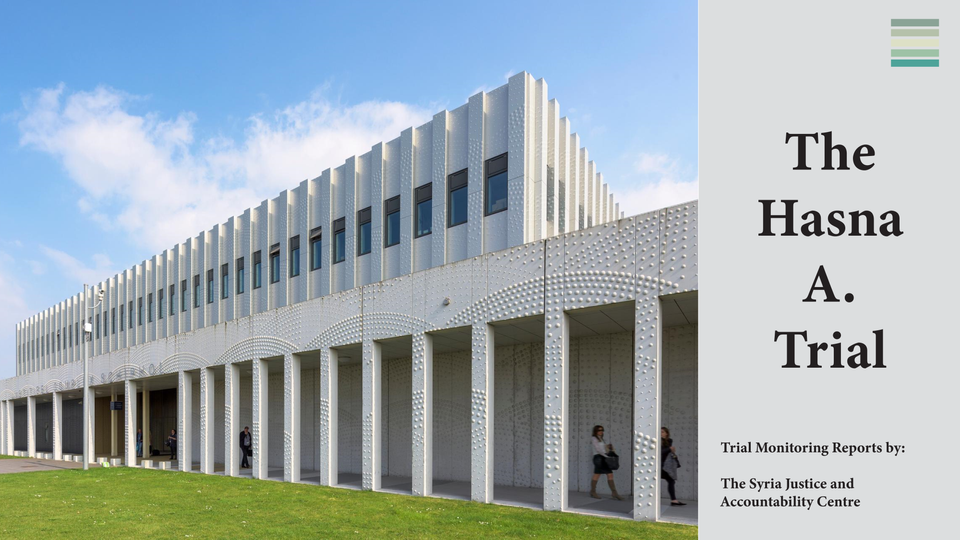
The District Court of the Hague – Badhoevedorp, the Netherlands
Trial Monitoring Summary #1
Hearing Date: February 9, 2026
CAUTION: Some testimony may include graphic descriptions of torture, rape or other violent acts.
Note that this summary is not a verbatim transcript of the trial; it is merely an unofficial summary of the proceedings.
Throughout this summary, [information located in brackets are notes from our trial monitor] and “information placed in quotes are statements made by the witness, judges or counsel.” The names and identifying information of witnesses have been redacted.
[Note: SJAC provides a summary of the proceedings while redacting certain details to protect witness privacy and to preserve the integrity of the trial.]
For the trial monitoring reports of the first instance proceedings, please see the Hasna A. case on SJAC’s website. Trial Monitoring reports of the Hasna A. appeal trial are a result of a partnership between the Syria Justice and Accountability Centre and the Criminal Justice Clinic at the University of Amsterdam, the Netherlands.
SJAC’s 1st trial monitoring report details day 1 of the appeal trial of Hansa A. in Badhoevedorp, the Netherlands. On the first day of the appeal trial, the hearing opened with procedural clarifications and initial technical disruptions, after which the Court outlined the themes to be addressed and began questioning the Accused regarding her journey to and experiences in Syria. Throughout the day, the Judges and Prosecution critically examined inconsistencies between her statements and those of multiple witnesses, particularly concerning her motivations for travel, her awareness of ISIS practices, and her conduct in the caliphate. The Accused repeatedly expressed nervousness, regret, and limited recollection, while also denying several allegations made by witnesses and Plaintiffs. The session concluded with discussion of the probation report, which emphasized vulnerabilities and risks of recidivism, and the Accused was given an opportunity to reflect on her past decisions.
Day 1 – February 9, 2026
[Note: The Prosecutors were seated on the left side of the courtroom. The Presiding Judge and three Judges were seated to the right at the Judges’ bench. On the right side of the bench, two court clerks, taking notes during the hearing, were located. The Defense Team and the Accused, Hasna A., were seated Opposite the Judges’ bench. Only the back of Hasna A. was visible to the public from the public gallery.]
The proceedings started at 10:35 AM. The Presiding Judge opened the court hearing and asked Hasna A. whether she understood what would take place that day. She nodded. The Presiding Judge noted that one Plaintiff would not be present during the hearing and that the other Plaintiff would participate remotely but was experiencing a delay.
The Presiding Judge then informed everyone that no recordings were permitted during the hearing. At that moment, the audio in the public gallery partially failed. The volume of the speakers was set too low, making it difficult to understand what the Judges were saying to the parties. The headphone translation was also not functioning. A visitor requested that a court staff member increase the volume, and this request was accommodated. In the meantime, the court paused the proceedings. It took approximately five minutes for the audio to function properly. The Presiding Judge then continued the hearing and noted that a new probation report had recently been received. The Presiding Judge explained the structure of the hearing days and added that Plaintiff Z. would be given the opportunity to exercise her right to speak on the second day. The final day would serve as a reserve day if needed.
The Presiding Judge then turned to the facts of the case. The Court noted that the Public Prosecution had not filed any objections to the acquittal of the joined count concerning Plaintiff S. The Presiding Judge gave the floor to the Prosecution. The Prosecution stood and began reading the indictment, outlining the charges against the Accused. The Presiding Judge then addressed Hasna A. and noted that her case was being reheard on appeal because she disagreed with the sentence imposed at first instance. The Presiding Judge explained that proceedings on appeal would differ from those at the trial court. Various parts of the case file had already been discussed in detail with the Accused during the first-instance proceedings. Therefore, these matters would not be revisited extensively in the present hearing. The Presiding Judge added that the Court would ask the Accused clarifying questions regarding her statements and emphasized that she again had the opportunity to provide clarity about her testimony.
The hearing was briefly interrupted when the Presiding Judge announced that he had been informed that one of the two interpreters present did not speak the required language. As a result, one interpreter would handle all translations for the remainder of the day. Consequently, the hearing would be interrupted more frequently to allow the interpreter to manage the translations. The Plaintiffs’ Counsel for Plaintiff Z. and Plaintiff S. reported that the livestream provided audio only and no video. The Presiding Judge decided to proceed with the hearing because the audio was functioning.
The Presiding Judge outlined three themes that would be addressed during the day:
(1) the period leading up to the departure to Syria,
(2) the stay in Syria, and
(3) the contact the Accused had with Plaintiff Z. and Plaintiff S., which also related to the first count of the indictment.
The Presiding Judge asked the Accused if she wished to make any preliminary remarks before the proceedings moved to the substantive matters. Hasna A. responded that her trial at first instance had been her first time in court. She explained that she had been nervous and tense at that time, which had made it difficult for her to express herself clearly. She added that she was again feeling nervous and feared that she might forget details she wished to share. The Presiding Judge reassured her that she would have every opportunity to provide full testimony.
The Presiding Judge then moved on to the part concerning Hasna A.’s departure to Syria. The Judge inquired about her personal circumstances, and Hasna A. explained that she had never felt at home in the eastern part of the Netherlands. She described that, after deepening her engagement with Islam, people in the western part of the country did not comment on her style of dress, whereas at the eastern part of the Netherlands, she was confronted about her clothing choices. The Presiding Judge asked Hasna A. why she had traveled to the caliphate and why she had previously stated that it was mandatory in Islam. Hasna A. admitted that she had read that it was required, and, as a result, believed she had to go. The Judge pressed further, questioning why she would undertake such a journey based solely on something she had read. The Accused and the Presiding Judge discussed the fact that multiple witnesses had testified that the Accused had watched videos depicting ISIS atrocities, which was supported by evidence in the file, including ISIS propaganda she had posted on Facebook. The Presiding Judge asked whether she had been aware of what ISIS was doing there. Hasna A. appeared nervous as she responded that she had not intended to carry out actions similar to those in the videos but had wanted to prepare herself for what she might face upon arrival. She expressed discomfort with the graphic nature of the videos, stating that it was distressing and that she did not want things to be that way.
The Judge confronted the Accused with the fact that she had been aware of the living conditions and actions of ISIS and had prepared herself accordingly. Hasna A. replied that she had assumed only ISIS soldiers would be involved, and that life in the caliphate would not resemble what she had seen in the videos. The Judges listened to her responses critically and asked her in turn about how she had prepared for her departure, why she had posted ISIS propaganda on Facebook, and what she had felt while doing so. Hasna A. described how she had made contact with a person in Turkey who could help her travel, without naming the individual. The Presiding Judge referred to the statement of witness [redacted name], W1, a family coach, who claimed that the Accused had indicated her intention to travel before leaving. Hasna A. responded that she did not remember clearly, but that W1’s statement was not accurate.
The Judges asked Hasna A. several questions about how she had prepared for her departure and whether she had been aware of the extreme dangers involved. Hasna A. explained that she had found the experience very frightening. The Presiding Judge responded critically, noting that while it was one thing for her to put herself at risk, the Court considered it serious that she had endangered her then four-year-old son with a disability by bringing him as well.
The hearing was briefly interrupted because the audio in the public gallery was difficult to hear. After the volume was increased, the Presiding Judge concluded the segment on the departure to Syria by asking the Accused if she wished to add anything. Hasna A. took a deep breath and expressed that she was remorseful. She explained that she had been unhappy and was searching for a place where she could build her life without being humiliated or discriminated against. The Judge observed that while she had chosen to travel to the caliphate, she had also been aware of its strict rules, which did not seem compatible with a place where she could freely be herself. Hasna A. responded that life there had been very difficult for women and that she had realized this only after she arrived. The Presiding Judge then gave the other Judges the opportunity to pose questions to the Accused. They asked whether she had been aware of the vulnerable and dangerous situation in which she had placed her son. She admitted that she had found it difficult to leave him behind, as no one would care for him in the Netherlands, and she had not considered what his life would be like in Syria.
The Judges then asked multiple questions regarding her views on the Charlie Hebdo attack. The Presiding Judge referred to statements by witness [redacted name], W2, asserting that the Accused had approved of the attack because it would “purify the world.” The Accused denied this, claiming that she could not recall ever trying to frighten anyone, and she had made no remarks about the victims. The Judges asked further questions, noting discrepancies between the statements of witness W1, witness W2 and Hasna A.’s own admissions. In response, Hasna A. denied some of the claims and said that she no longer remembered certain details. The Presiding Judge reminded the Accused that earlier in the day she had told the Court that punishments did not need to be as “bloody,” but that those being punished must have deserved it. The Defense Counsel strongly contested this, arguing that the Accused had not made such a statement. The Judge responded firmly, stressing that he would not enter into a debate with the Defense Counsel and maintained that the Accused had indeed made the statement. Hasna A. replied to this that she did not believe people deserved punishment because she did not know them personally.
The Presiding Judge then asked Hasna A. whether the Charlie Hebdo attack had deterred her from traveling to Syria. Hasna A. responded that she had not given it much thought and that it had not prevented her from traveling to Syria. She explained that she had focused only on herself and had not considered the victims of ISIS. The Judge referred again to the statement of witness W2, who claimed that Hasna A. approved of violence at the time. Reference was also made to statements from Hasna A.’s former classmates, portraying her as having two sides: at times timid regarding ISIS violence, and at other times assertive, defending the Charlie Hebdo attack. The witness statement of her former classmate [redacted name], W3, stated that she called him a “bad Muslim.” The Judge presented W3’s statement, which described Hasna A. as someone who often played the victim and was frequently in arguments with classmates. Hasna A. denied this, highlighting she had never argued with him. The Judge further noted that the Accused also denied discussing ISIS with witness W2, but that she also denied this. The Judge then cited W2’s statement, claiming that Hasna A. had said: “It is not bad if children die because it is beautiful in heaven with Allah.” Hasna A. firmly denied having made this statement, asserting that she would never wish harm upon children and that certain details had been fabricated by the witnesses.
***
[25-minutes-break]
The Court asked questions about the Accused time immediately after her arrival in Syria. The Presiding Judge asked about the contact she had with [redacted name], F1, who helped her travel to Syria. Questions from the Judges followed regarding how Hasna A. ended up in a Madafa [a guest house or room for hosting someone] after travelling to Syria. The Accused recounted details to the Court about her time in the Madafa and that in May she married a man called F1. The Court noted that this was not his real name, and Hasna A. had also not provided his real name during the first instance proceedings. The Accused responded that it was not relevant what his real name was and that this is the reason she did not provide it. The Presiding Judge insisted that it indeed was relevant for the Court. Hasna A. then added that she does not have pleasant memories of him, but after brief pause, she said that his first name is [redacted name], [same person as F1], but she does not know his last name. The Court continued with critical questions about this, given that she now claimed not to know his last name. Hasna A. had previously declared to the police and in first-instance proceedings that she did not want to provide his name. Hasna A. then clarified that she did not want to give his first name but does not know his last name and has never seen any documents showing his full name.
The Court then posed questions regarding the two Madafa’s where she stayed. Hasna A. responded that she did not like her time in the Madafa and knew she would have to marry in order to leave the Madafa. She described the process, recalling that she spoke with a few people to decide whom she would marry. She never asked F1 about his work or his real name. She found it very stressful because the conversations took place in the presence of other people, including her son. She explained that he would leave in the morning and return in the evening, and she did not know what he did during the day and did not ask. She admitted that she assumed he was an ISIS fighter, as she understood that she could only leave the Madafa by marrying an ISIS fighter. The Judges and the Accused discussed incidents in which he was injured twice: once on the tip of his finger and once with a burn on his leg. The Accused remembered that she never asked how these injuries occurred. The Presiding Judge noted that her husband possessed several weapons, including an AK-47. The Accused was asked whether she also used these weapons. Hasna A. responded that she carried a pistol outside the home to defend herself.
Upon further questioning, the Accused described how she lived in various locations with her husband F1, including in Iraq. She recalled that when he was away during the day, she remained at home. She explained that life there was difficult because of the heat, staying at home, and caring for her child. In Syria, she did her own groceries shopping, but in Iraq she did not. It was discussed that she had three children with him and that they divorced in 2017. She also mentioned that she spoke limited Arabic, so she mainly communicated in English, but as a woman, she did not have to speak much.
The Judge then asked how she experienced life in ISIS-controlled areas. Hasna A. remembered that she found it very difficult and that it was a hard marriage. She said that she already regretted traveling to Syria when she first arrived in the Madafa, and later regretted marrying the man with whom she had children. She explained that she wanted to leave and had discussed this with her father via voice messages. The Judges presented her father’s statement, which claimed that she had never said this to him and that she had in fact encouraged him to travel to the caliphate as well. The Judge noted that the only time she communicated by phone that she wanted to leave was during the period when the caliphate was threatened with collapse. Hasna A. denied this, arguing that her husband had written that at the time to her father because they shared the same phone. The Judges asked if her husband spoke Dutch, since the messages were written in Dutch. Hasna A. replied that he does not speak Dutch but also that she did not send the messages herself. The Court appeared skeptical, and the Judge asked further critical questions because of her contradictory statements. Then Hasna A. responded that she did not understand the Judges’ questions. The Prosecutors shook their heads in frustration.
The Presiding Judge reviewed her statements against those given by witnesses. For example, Plaintiff Z. had testified that Hasna A. enjoyed ISIS beheading videos. The Accused denied being enthusiastic about such videos. Hasna A. emphasized that she never participated in any of these acts. She added that people claimed she participated in ISIS by marrying an ISIS fighter, but she asserted that she had no involvement in atrocities, and that her only mistake was traveling to Syria. She said that the period when ISIS started loosing territory was the hardest time of her life. The Judge asked if she had done anything wrong regarding her son [redacted name], F2. Hasna A. responded that she thought life in the caliphate would be better but realized it was not. She further described the conditions she had to live under in the caliphate and the tasks she performed as a woman. The Judge noted that Plaintiff Z. had claimed that Hasna A. had learned Arabic in school. Hasna A. denied this.
Next, the Prosecution was given the opportunity to question the Accused. They presented her with the contradictory testimonies that she has made throughout the day. As an example, the Prosecution highlighted that she had told the police that she did not want to provide her now ex-husband’s name, but now claims she does not know it his last name. They also referred to Hasna A.’s statement that after leaving the Madafa, she had enjoyed herself because she explored the neighborhood and attended dinners. Hasna A. responded that she did not understand what the Prosecutor was saying. The questions were repeated, and Hasna A. explained that she had not wanted to testify honestly to the police. She could no longer remember the messages she had sent.
***
[60-minutes-break]
***
After the break, the Judges asked about the period the Accused spent in the house and who did the household tasks. She recalled that in the houses where she lived during her time in Syria and Iraq, there were clearly designated areas that she could access and areas she could not. She said that she had not seen Plaintiff Z. much in the same house and that they could not communicate because they did not speak the same language. She did not know much about Z., but could see that she was scared. Hasna A. knew that Z. was enslaved by [redacted name], F3, which she said shocked her, but she did not dare to say anything. Hasna A. denied knowing what ISIS had done to the Yezidi community before she traveled there, but that she learned about it once she arrived [note: expressions of outrage were heard from the public gallery.].
The Judges asked about the time Hasna A. spent with Plaintiff Z. in F3’s house. She recounted that she cleaned the main areas herself [note: once again, there were outrage reactions from the public gallery, and the Prosecutor shook his head.]. Hasna A. added she did not know that Z. had to sleep in F3’s bed, but that Z. had shown her bruises. Hasna A. denied forcing Z. to pray five times a day. The Accused recalled that she felt it was painful that Z. had suffered much pain and anger and that this pain was the reason why she blamed Hasna A. and saw her as part of ISIS. The Accused testified that she did not make Z.’s life miserable and never gave her any orders. She also said that Plaintiff Z. never had to care for Hasna’s son F2 as Hasna A. did that herself. She explained that she did not dare help Z. because she feared punishment. The Prosecutor noted that the Accused’s testimonies were very different from the testimonies of Plaintiff Z., witness S., and witness N. He also remarked that earlier that morning, they discussed the prior testimonies of witness W2 and witness W3, which Hasna A. had also denied. Both Prosecutors looked at the Accused critically.
***
[15-minutes-break]
***
After the break, the probation report was discussed, which detailed that the Accused has a mild cognitive disability and a personality disorder. The report also indicated that she had previously adopted extremist views but has since distanced herself from ISIS and violence. Hasna A. is highly impressionable, and in combination with her personality disorder, it forms a risk of recidivism. The report recommended that if convicted, she should receive long-term supervision to prevent reoffending. The latest probation report stated the same but noted that there are no current signs of radicalization or extremism. Hasna A. reported that she sees her three youngest children and regularly sees her oldest son. Her children are doing well. She has little contact with other people.
The Judge gave the Accused the opportunity to any final statements and asked Hasna A. what she would say to her 2014 self if she could. Hasna A. replied that she would have wanted to explain to herself what would have happened to her in the future and that she could get into trouble for things.
The proceedings were adjourned at 5:15 PM.
The next trial day will take place on February 10, 2026.
___________________________
For more information or to provide feedback, please contact SJAC at [email protected] and follow us on Facebook and Twitter. Subscribe to SJAC’s newsletter for updates on our work