Inside the Alaa M. Trial #108: Life Sentence, Particular Gravity of Guilt, and Preventive Detention: The End of 3,5 Years of A Truth-Finding Process
TRIAL OF ALAA M.
Higher Regional Court – Frankfurt, Germany
Trial Monitoring Summary #108
Hearing Date: June 16, 2025
CAUTION: Some testimony may include graphic descriptions of torture, rape or other violent acts.
Note that this summary is not a verbatim transcript of the trial; it is merely an unofficial summary of the proceedings.
Throughout this summary, [information located in brackets are notes from our trial monitor] and “information placed in quotes are statements made by the witness, Judges or counsel.” The names and identifying information of witnesses have been redacted.
[Note: SJAC continues to provide a summary of the proceedings while redacting certain details to protect witness privacy and to preserve the integrity of the trial.]
SJAC’s 108th trial monitoring report details day 187 of the trial of Alaa M. in Frankfurt, Germany, which marked the conclusion of a trial that lasted over three years.
Today, the Court issued the judgment against Alaa M. It established that:
The Accused is guilty of committing crimes against humanity by intentional killing [redacted name] and [redacted name] as part of a systematic and widespread attack against civilians according to Sect. 7 (1)(1) of the German Code of Crimes Against International Law (CCAIL).
The Accused committed crimes against humanity by the torture of prisoners in his custody according to Sect. 7 (1)(5) CCAIL. There is no doubt about the severity of the mistreatment, particularly its nature, and the true extent must be assessed. Permanent harm to health is not required.
The Accused is guilty of attempted crimes against humanity by depriving a person of the ability to reproduce under Sect. 7 (1)(6) CCAIL and Sect. 22 German Criminal Code (GCC) in conjunction with crimes against humanity by torture under Sect. 7 (1)(5) CCAIL.
Three cases constitute both war crimes and crimes against humanity, The Accused committed a war crime against persons to the detriment of [redacted name] according to Sect. 8 (1)(1) CCAIL, and two cases, according to Sect. 8 (1)(3) CCAIL.
The Accused is further criminally liable for murder according to Sect. 211 of the German Criminal Code (GCC). The boastful killing of [redacted name] was to deter rebellion against the oppressive regime, using him as an example, satisfying the requirement of base motives under Section 211 GCC.
Aggregate Sentence:
In cases of several combined sentences of life imprisonment and determinate sentences, the law mandates the imposition of life sentence as aggregate sentence.
Particular Gravity of Guilt:
Generally, Sect. 57 (a) GCC applies. However, if the particular gravity of guilt is established, a suspension of the remainder of the sentence after 15 years does not apply, and the Court must take appropriate long-term measures. Two offences involving killings, one of which also constitutes a war crime under Sect. 8 (1) CCAIL committed by one act, and one murder under Sect. 211 GCC, and eight other acts, justify the particular gravity of guilt. In addition, taking P57’s testimony into account, the cases of killing patients in lingering illness in Tishreen – although not part of the indictment – were of significant weight in the totality of the findings.
Preventive Detention:
The Court decided to order preventive detention according to Sect. 66 GCC, taking into account Dr. Berger’s expert testimony on the Accused’s tendency to commit the most severe crimes and his sadistic inclinations. The expert report was deemed comprehensible and highlighted the danger of re-offending. Other factors that led the Court to this conclusion included that [the Accused committed] the most serious acts of violence, and the Defense did not challenge his propensity for such crimes.
In this context, the Court did not lose sight of the fact that the Accused did no re-offend since entering Germany. However, that did not change the Court’s negative prognosis of persistent danger. The Court believed that the Accused was occupied with obtaining a medical license in Germany. Expert Berger said that sadistic tendencies can be suppressed for a long period of time, but persists if untreated. Despite relinquishing his medical license, the Court believes that being a doctor enables the Accused to exercise these tendencies. Given the seriousness, preventive detention in conjunction with life imprisonment is essential, the Court believes. It further highlights that the Accused must be supported during his term of imprisonment, in particular with socio-therapeutic treatment according to Sect. 66 (c)(2) GCC.
Day 187 – June 16, 2025
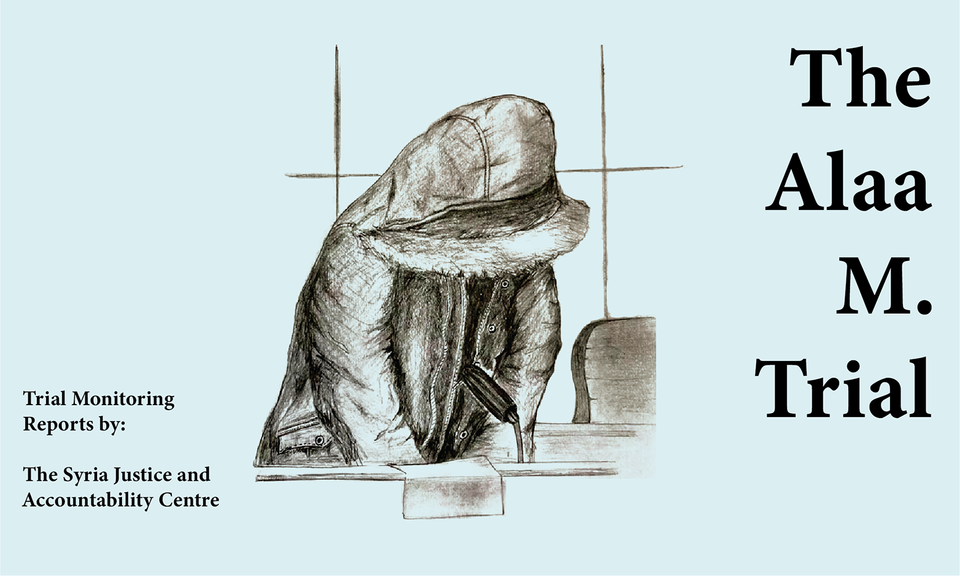
Before today’s session commenced, the Accused entered the courtroom with his head covered by a jacket, then lowered his head onto the table before him, keeping it down and concealed until the session began and the press photographers and cameramen departed. Thereafter, Plaintiff [redacted name], P4, entered the courtroom, who had waited until the press exited before joining the other two Plaintiffs, [redacted name] P1, and [redacted name] P8, sitting beside their Counsels
The Senate then entered the courtroom, with the audience rising. Presiding Judge Koller opened the final hearing of this trial by announcing the judgment and sentence. He read out:
In the name of the people, the following judgment is delivered: The Accused, Alaa M., is found guilty of committing two killings, of which one constitutes crimes against humanity by killing and one war crimes by murder, in conjunction with crimes against humanity by torture, eight cases of crimes against humanity, in conjunction with two cases of crimes against humanity by deprivation of the ability to reproduce. The Accused is sentenced to life imprisonment as a cumulative sentence. The particular gravity of guilt was established and the placement in preventive detention after imprisonment is ordered. The convicted shall bear the costs of the proceedings, including the expenses of the Plaintiffs.
After the Presiding Judge concluded reading the judgment, some individuals in the audience began to applaud. He reprimanded them, indicating that anyone who repeated such behavior would be asked to leave the courtroom.
Presiding Judge Koller then noted that the arrest order issued on June 19, 2020 until January 19, 2021 was now extended.
Preliminary Considerations
The Presiding Judge continued with the Court’s findings: the Accused had personally inflicted serious physical and psychological harm to nine individuals, he killed two persons, and was part of the regime of injustice under Bashar Al-Assad since early 2011. The Assad regime suppressed demonstrations seeking freedom mercilessly, and Assad supporters followed orders from higher authorities. Judge Koller explained that crimes against humanity differ from other crimes in that they are not merely committed against individuals, but against entire peoples and the international community as a whole, representing grave violations of human rights and invoking Germany’s responsibility.
Before the fall of the Assad regime, Judge Koller continued, it attempted to influence the Court; information about the trial, not disclosed in the hearings, was leaked, and relatives and friends of certain witnesses were threatened, necessitating their protection. The Court was obliged to take all of this into account and to verify what had transpired, a task that was arduous and demanding. As international courts bear the responsibility of prosecuting such cases, it was incumbent upon the Court to ensure that the suffering of peoples is not forgotten. In its 1946 judgment, the Nuremberg Tribunal established that “crimes against international law are committed by men, not by abstract entities, and only by punishing individuals who commit such crimes can the provisions of international law be enforced.” Such trials are trials against those who have committed crimes against entire nations, even if they stand before a court in Frankfurt. No one can escape their responsibility.
The Presiding Judge affirmed that this judgment expresses the Court’s understanding of the suffering endured by the witnesses, recalling the words of one witness, [redacted name] P19: “I will never find peace of mind; all I seek is justice and freedom.” Judge Koller noted that the three Plaintiffs had declared their wish that the suffering of detainees not remain hidden, that the wounds of the past may heal, and that a free society may be built.
The Presiding Judge explained that the foundation of the proceedings was built upon the investigations conducted by the Office of the Public Prosecutor General (GBA) - represented by Senior Prosecutor Zabeck and Prosecutor Schlepp - as well as Unit [redacted information] of the German Federal Criminal Police Office (BKA), particularly Mr. Deußing, Mr. [redacted name] and Mr. [redacted name]. Judge Koller expressed his gratitude and appreciation for the crucial role of the Witness Protection Unit, [redacted information], noting that he was aware they preferred to remain unnamed.
The Presiding Judge then recalled the late Interpreter, Mr. Diyaa Farrag, whose sudden passing saddened the Court. He had devoted his linguistic expertise in Arabic not only to translating words, but also to conveying the intended meaning with clarity and understanding. His brother, Mr. Ahmad Farrag, succeeded him in this role, carrying the torch with equal excellence. Judge Koller also extended his thanks to Mr. Baracat, the Accused’s interpreter, for his diligent work and fulfilling the role of linguistic expert in Arabic and [redacted information]. Koller further expressed gratitude to the Defense and Plaintiffs’ Counsels.
Judge Koller gave special thanks to the witnesses, acknowledging the pain and harrowing experiences they had endured, and without whose courage, this trial would not have been possible. On behalf of the Judges, he thanked Plaintiffs [redacted name] P8, [redacted name] P1, and [redacted name] P4, noting that thanks to them and to other witnesses, the Court was able to ascertain the truth through their detailed testimonies across numerous sessions. The Court recognized how arduous it was for them to recount their ordeals; how they were unlawfully detained, tortured, and lived in constant fear that they might be next to die. Their testimonies, the Presiding Judge noted, carried great weight. Moreover, Judge Koller expressed, on behalf of the Court, his condolences to Plaintiff [redacted name] P8, for the loss of his brother [redacted name], wishing him and his family peace and comfort.
The Judgment’s Reasoning
The today forty-year-old Accused was born in Homs and raised in [redacted location], with his parents, in the Valley of Christians. His father was a tax consultant, his mother worked as a teacher. They were orthodox Christian. He has a younger brother and a younger sister – they had a happy childhood. He attended a private school in Homs and later enrolled at the university in [redacted location], where he began studying medicine in September 2003, planning eventually to work abroad. In pursuit of this goal, he studied English in Manchester, United Kingdom, in 2006. He graduated from the faculty of medicine at [redacted location] University in 2009. After graduation, he worked at Al-Ahli Specialized Hospital مشفى الأهلي التخصصي and began learning German with the intention of pursuing a medical career in Germany. Planning to specialize in Orthopedics, he applied to the Military Administration of Medical Services seeking medical training and obtained a position at Military Hospital 608 in Homs, known as Abdelkader Ash-Shaqfa Hospital مشفى عبد القادر الشقفة, in January 2010. Following the onset of the Arab Spring in 2011, the situation in Homs became increasingly difficult due to the conflict. Consequently, the Accused transferred to Military Hospital 601 in Al-Mazzeh, known as Youssef Al-Azmeh Hospital, to continue his medical specialization in Damascus, which was at first relatively safe. He also worked part-time in private hospitals. Crimes were committed in these hospitals during this time, which will be described below, Koller added.
Although he was working in Al-Mazzeh, the Accused maintained ties to Homs, where his now wife lived, visiting her regularly, and maintaining a long-distance relationship. In December 2012, he sustained a gunshot wound to his left lower leg and subsequently continued working as a civilian physician at a military hospital in Tartous, a predominantly Alawite city, distant from [redacted location], the hometown of his now wife. Following the wedding, Wadi An-Nasara became their residence.
In May 2014, the Accused returned to Damascus and worked at Tishreen Military Hospital, the capital’s largest military hospital. His wife did not accompany him. A few weeks later, he was informed that he was to be assigned to Harasta Military Hospital, which he refused, citing that Harasta was remote, an active combat zone, and that his wife was [redacted information] pregnant. As a result, the hospital’s director at the time, [redacted name], offered help, but could not prevent the relocation order. Alaa M. then took sick leave, did not go to work, until his employment was terminated due to unexcused absence from duty. During the summer of 2014, the Accused transitioned to work at Al-Mujtahed civilian hospital مشفى المجتهد, under the administration of the Ministry of Health, with his prior years of specialization duly recognized.
The Accused applied at the German embassy in Beirut for a visa. He completed his specialization in Orthopedics in April 2015, with grade Very Good, and obtained his medical license. He then traveled to Germany, while his wife remained in Syria. He settled in [redacted location], in the State of Saxony, where he studied German and attained Level C1 certification in and the license to practice medicine [German: Approbation] August 2015. Thereafter, he moved to [redacted location], in the State of Hesse, in February 2016. His wife joined him in November 2016, and their daughter was born in [redacted time] 2017.
Until March 2019, the Accused worked as a resident doctor in Hessisch Lichtenau. He planned to transfer to Göttingen to work as a resident doctor in the trauma surgery. Around that time, the news outlet Zaman Al-Wasl published a report on the Accused, alleging his involvement in violations committed at military hospitals. However, this did not affect him; in August 2019, he passed the medical license examination in the State of Saxony for trauma surgery, and in October 2019, he was formally recognized as a specialist in Orthopedics. His monthly salary ranged between 7,000 and 12,000 Euros net.
The media pressure on the Accused intensified in May 2020 following the publication of reports by Der Spiegel and Al-Jazeera concerning him. In this context, during the COVID-19 pandemic, the Accused contacted the Syrian Embassy in Germany, seeking opportunities to flee to his homeland. Consequently, the Federal Court of Justice issued an arrest warrant on the evening of June 19, 2020, and his detention order was later extended by the Court on June 19, 2022. The Accused has been in pre-trial detention since June 20, 2020 without interruption.
In light of these accusations, the State of Hesse suspended the Accused’s medical license on October 13, 2020, and his request to voluntarily relinquish the license was received in November 2020. On April 3, 2025, he sent a letter to Syria, declaring his wish to return his Syrian medical license, stating that he no longer desired to practice medicine. As of this date, the Accused had no criminal record in Germany.
The Development in Syria and the Military Hospitals
Before addressing the crimes attributed to the Accused, Presiding Judge Koller said, he wanted to clarify the context. Shortly after the outbreak of protests in Syria, the repressive regime established the Central Crisis Management Cell, comprising the heads of intelligence, security, and military agencies, tasked with issuing orders to suppress demonstrations. A new phase began on April 20, 2011, directed toward confronting those classified as terrorists. The army and intelligence services were mobilized to quell the protests; demonstrators were fired upon by snipers and beaten by security personnel. Raids were conducted in neighborhoods and towns such as Al-Rastan الرستن and Tal Kalakh تل كلخ.
This initial stage culminated in the outbreak of a civil war at the beginning of 2012. Military hospitals became centers of repression against dissidents, particularly Sunni Muslims, acts in which pro-regime physicians actively participated. In some instances, dissidents were killed or executed en masse by being injected with lethal substances. Some doctors despised these acts, yet they were powerless to intervene, fearing for their own safety, yet others participated.
With the onset of the uprising, the situation in military hospitals changed drastically. Wounded individuals brought in for treatment were immediately regarded with suspicion. The objective was not to heal. Any medical care provided served only the purpose of keeping the patients alive long enough for interrogation. [Sick patients] were killed to alleviate overcrowding in detention cells. They were taken to military hospitals either to be humiliated, be used as “training material” or disposed of [German: “Entsorgung”]. Corpses were left lying in the hospital’s courtyard, where they were collected, bureaucratically assigned numbers, and photographed, as in the familiar Caesar photos. Collectively, the corpses were stored within the hospital and at times were handed over to relatives in exchange for bribes.
Military hospitals became notorious for the fact that sick patients were mistreated as soon as they arrived at the emergency department - a special feature of the Military Hospitals. This mistreatment upon arrival, so-called “welcome rituals,” involved security personnel, medical staff, and cleaning staff. Blindfolded, the detainees were beaten and kicked. After being transferred to the patient wards, their fate was often death or further torture. They were sometimes taken to other wards, where they remained blindfolded, shackled to the beds.
Homs Military Hospital was a center of severe and arbitrary repression. After detainees were abused, they were sometimes transferred to a special area within the general surgery department, the basement, or the prison, where the hygienic conditions were particularly poor, aggravating infections and wounds. There were no limits on the methods of abuse; it depended solely on the discretion of individuals. A hematologist named Brigadier General [redacted name] served as a leader and liaison with Branch 261, the Military Security Intelligence Branch located near the Homs train station. [Redacted name] not only coordinated with the intelligence services but also oversaw access to the [prison and detainee wards], and was responsible for appointing pro-regime physicians to perform those tasks, including military operations and external missions - but he also mistreated himself. He bore responsibility for the injuries and deaths sustained by detainees. Those who aided him included [redacted name], [redacted name], and the Accused, who were known as an “elimination group.”
The Unlawful Acts of the Accused and the Subjective Elements
The Accused witnessed the transformations that took place in Syria, particularly in his own region, including the emergency treatment of gunshot victims. He endorsed the state violence against opponents and was considered part of the regime’s circle as a supporter of Bashar Al-Assad. Although Christian and not Alawite, the Accused regarded the Assad regime as the protective power of Christianity, and viewed Sunni Muslims as “cockroaches and terrorists” who deserved to be crushed and incinerated in ovens.
Particularly within Homs Military Hospital and Branch 261, the Accused demonstrated his solidarity with the Assad regime by torturing and exacerbating the humiliation of prisoners. His objective was to punish the detainees, viewing this as an opportunity to gratify his sadistic inclinations by exercising power over those below him. He exploited the fact that the prisoners were at his mercy, lacking physical confrontation. He was fully aware that they turned to him for protection, and that such protection constituted a duty incumbent upon him as a physician.
The Accused committed the following acts:
- Case 1: On a day in 2011, two soldiers brought a boy, aged 14 or 15, in his early puberty, to Homs Military Hospital. He was arrested, restrained, and ordered to face the wall. The Accused insulted him, causing him to cry and plead, saying, “Uncle.” The Accused remained unmoved and inflicted psychological and physical torture. After having brought alcohol, he asked the boy “are you pretending, you are a man?”, pulled down his pants, and poured the alcohol [on the genital area] and set it on fire. The boy became infertile, or at least suffered irreparable damage to his reproductive capacity. While the boy screamed, a soldier attempted to extinguish the fire and asked if the Accused wanted him to burn the room. The boy’s fate remains unknown.
- Case 2: Between July and November 2011, an injured prisoner was brought to the emergency department. Shortly after, the nursing and cleaning staff began beating him, and he was taken to the examination room. The Accused insulted the injured person, removed his pants, poured alcohol [on the genital area], and set it on fire. The prisoner lost the reproductive capacity. While the prisoner screamed, the fire was extinguished by the staff. Dressings were then applied to his perineal burns and his tissues became infected.
- Case 3: Between July and November 2011, an apparently uninjured prisoner, shackled and blindfolded, was brought and had to sit in a bed for a blood test, which was not medically indicated. The Accused struck him in the face. When the patients questioned why [he was struck], a nurse restrained him from behind, rendering him in a helpless position. The Accused then took a urinary catheter and struck the prisoner’s face with it. The patient turned away his face. The nurse repositioned the prisoner’s face, and the Accused struck him again with the catheter on the head. The Accused then insulted and humiliated the prisoner, saying “F**k your sister. Brother of a wh***” and punched him so forcefully that the Accused’s hand was bruised, commenting that the prisoner’s head was hard.
- Case 5: The Accused gave a patient a moderate punch, which caused swelling.
- Case 8 The Accused grabbed the genitals of a prisoner, including at least one testicle, and squeezed it while the prisoner screamed, as the Accused laughed.
- Case 11: In November 2011, a patient with a femoral fracture requiring fixation was admitted to Homs Military Hospital. Although the Accused was not qualified to perform the procedure alone, he saw it as an opportunity to gain experience and simultaneously torture the patient, whom he considered a “terrorist.” He performed the first part of the surgery without anesthesia, despite available anesthetics, causing the patient extreme pain until he lost consciousness. This continued without anesthesia until the fixation of the fracture was initiated, which required anesthesia. Shortly after, the Accused boasted in the doctors’ room about performing a surgery from A to Z without anesthesia.
- Case 12: On November 23, 2011, Military Security Forces arrested witness [redacted name] P8, his brother [redacted name], and their cousin [redacted name] P11 in [redacted location], [redacted information] Homs. P11 was falsely accused of harboring demonstrators and weapons. P8’s brother suffered from epilepsy; their mother attempted to provide a bag of his medication, but a soldier refused, saying that he and his brother, P8, would be returned soon. After a stop at the Military Security Branch in [redacted location], the detainees were taken to Branch 261 in Homs, where they were severely beaten, stripped, and confined in a ward with cells.
On November 24 or 25, [redacted name] suffered a seizure. P8 was made aware that doctors were visiting the prison and decided to inform them of his brother’s condition. The next morning, the Accused, accompanied by [redacted name] and two soldiers, entered the prison. P8 informed the Accused of his brother’s epilepsy. The Accused requested that P8 bring his brother, [redacted name], to the ward’s entrance. Instead of providing the brother with medical care, the Accused questioned P8 about his origin; when told he was from [redacted location], the Accused slapped [redacted name] with the hand, knocking him down, and shouted at P8 to return his brother to the cell. [Redacted name] later suffered multiple seizures. Therefore, P8 had no choice but to ask the doctor again for help.
The next day, P8 informed the Accused - who was accompanied by [redacted name] and a guard - that [redacted name]’ condition deteriorated. The Accused demanded that P8 bring his brother. When P8 asked about his brother’s medication, the Accused ignored the question, insulted them both, saying “Brothers of a wh***,” and claimed that [redacted name] was malingering, saying “just play the sick.” He struck [redacted name] in the face; P8 could not catch his brother who fell to the ground. At least once, the Accused then kicked [redacted name] in the head, who had an epileptic seizure, the Accused showed no concern, nevertheless. The Accused asked the guard to hand him a green tube, then started striking P8 and his brother, mocking [redacted name] by saying, “Here, you have your treatment.” P8 managed to pull his brother back into the cell.
After leaving the cell, the Accused resolved to kill [redacted name], viewing him only as a inconvenient burden and an opponent deserving death, and saw no reason to keep him in the Military Security Branch. The Accused brought a lethal pill and demanded that the patient be brought. P8 objected, stating it was not his brother’s medicine and refused to give it to him. The Accused administered the pill himself; [redacted name] swallowed it unconsciously. The Accused left the cell after ensuring that the patient took the pill. After approximately half an hour, the medication’s effect kicked in, rendering [redacted name] immobile. He could only respond to his brother, P8, by pressing his hand, and he eventually died. Either in the early morning or within the following two days, the corpse was transported to the entrance, where it was received by a prison employee, and later transferred to Homs Military Hospital on December 7, 2011 [where it was received by the family] subsequent to a bribe payment.
- Preliminary Remarks About Cases 16 to 18: At the end of September 2011, [redacted name] P4, who originated from the pro-opposition city of [redacted location], was arrested on charges of undermining national sentiment against the state. He ended up in Homs Central Prison in the first half of 2012. There, he met [redacted name] P1, also from [redacted location], who [in April 2012] had been arrested due to his origin and family background; after the defection of [redacted name] and [redacted name], a friend of Bashar Al-Assad. Also imprisoned was [redacted name], who originated from the pro-opposition city of [redacted location]. They were detained there in July 2012.
A revolt occurred in the prison during the month of Ramadan. Afterwards, prisoners, including P1, P4, and [redacted name], were transferred for interrogation to the Military Security Branch in Homs. In August or September 2012, they were transferred to Homs Military Hospital following medical complaints during detention and detained in a group room. The Accused was tasked with conducting rounds on the prisoners, in which he was interested not in providing care, but in torturing pro-opposition detainees. - Case 16: After [P1] had been repeatedly beaten at the cell entrance by a person named Ali علي, Ali took him and three or four other prisoners to a cell and began, along with his companions, beating them with batons. The remaining prisoners were taken away, leaving P1 behind. Subsequently, Ali suspended P1 from the ceiling by a chain. P1 was then beaten and his family was subjected to sexual insults until P1 lost consciousness. Eventually, P1 was lowered and untied, but his ordeal did not end. The Accused poured alcohol on P1’s arm and set it on fire. The Accused then shouted at someone to put out the fire and take this “dog” to the cell. Consequently, P1 suffered a painful burn on his left arm, which festered, and scarred.
- Case 17: Days later, the Accused decided to take revenge on those who had criticized the abuse and lack of care. Entering the cell with Ali, he turned to P4, insulted his origin, and accused him of being “Brother of a wh*** and that the people of [redacted location] are traitors.” The Accused then exposed P4’s right arm and said he would show [the prisoners] how wounds are treated. He ordered P4 to lie down and P4’s face was facing his right side. The Accused then stepped on P4’s arm until blood and pus oozed, poured alcohol on it, and set it on fire. The Accused started mocking that this was the ideal method to sterilize wounds. He instructed Ali to extinguish the fire, who kept stomping on it until it was put out. As a result, P4 insulted the Accused and his escort, which triggered the Accused to insult him by calling him a “pimp” and kick him in the mouth. P4 did not initially realize he had lost three teeth. After he was hit in the head, P4 lost consciousness. Before leaving, the Accused shouted to let P4 die until he rots. P4 suffered a six-centimeter scar on his arm and another one on his head.
- Case 18: The Accused entered a prisoners’ collective cell accompanied by two individuals, one of whom was Ali. P1 and P4 were still there. The Accused asked the prisoner [redacted name] about his origin; when he learned he was from [redacted location], the Accused insulted its people as “sons of wh***s.” [Redacted name] insulted Bashar Al-Assad in response. The Accused became enraged and told him that “he was [acting tough] and [the Accused] would break his head.” [Redacted name], who was a large man, was repeatedly struck by the Accused with a baton, punched, and kicked. [Redacted name] tried to defend himself and requested the Accused to untie him, but he fell to the ground exhausted. As the term was contextually understood, the Accused shouted, “Do you want freedom? Do you want the houris? I will send you to your fa**ot God,” then injected him. The Accused intended to demonstrate that even a strong man like [redacted name]was powerless before him and to intimidate regime opponents. He left [redacted name] tied, left, then returned with a lethal injection. The Accused crouched and injected [redacted name] in his upper left arm. Before the injection took effect, the Accused instructed [redacted name] to greet his god and tell him to reserve two houris for him. Afterwards, [redacted name] began to feel cold and shiver. He asked that his regards be sent to his mother, then lost consciousness, and discharges came out from his mouth. [Redacted name]’s pulse and breathing stopped, and his face turned yellow. Military Police staff arrived hours later, placed him in a plastic bag, and was taken away. [Redacted name] most likely died due to the injection.
- Cases 4, 6, 7, 9, 10, and 13-15, on the request of the Prosecution and through the court’s decision of May 20, 2025, were provisionally terminated, in accordance with Sect. 154 German Code of Criminal Procedure because these cases were not particularly significant compared to the other cases.
The Accused vehemently denied the crimes attributed to him. The Court heard the testimony of more than fifty witnesses and experts and examined hundreds of documents relating to these crimes. The Accused admitted that he had worked as a civilian doctor in Homs before moving to Damascus, but he denied participating in any abuse of patients or having witnessed patients abuse. He acknowledged having heard of death cases, which he attributed to mistreatment. Specifically, in Case 12 and 16 - 18, the Accused claimed that he was not in Homs at the time those crimes occurred, but that he was working at Al-Mazzeh Hospital in Damascus at that time and without interruption, and later moved to Tartous. For this reason, he claims he cannot be responsible for those crimes. Regarding P1 and P4, the Accused claimed that their accusations were influenced [by other people] and that they projected their experiences onto him. The Accused alleged that there was a conspiracy plotted by his former colleague, who fabricated these accusations against him out of revenge and that there had been disputes between him and his colleague, [redacted name], dating back to Ramadan in the summer of 2011. The Accused claimed that he had left the emergency room to smoke after an incident there, and his [redacted information] colleague [redacted name] reminded him that it was the fasting month and that smoking showed disregard for others and demonstrated disrespect. The Accused responded excessively to his colleague in a rude manner, but later apologized. According to the Accused, [redacted name] contacted him in April 2012 and requested assistance in treating injured opposition members at a field hospital. The Accused questioned whether his colleague had gone mad, and they exchanged insults during the call, including that his colleague said that all Christians are pigs. The Accused claimed that his colleague attributed these false allegations to him after that incident.
It must be pre-empted that this was the central Defense strategy. The issue of conspiracy, however, was freely invented, and during the main hearing, it was refuted because the statements of the Accused were not conclusive, and reconciliation between them was not possible. Why would a Sunni Muslim tell a Christian to adhere to Islamic teachings, which could itself be dangerous? As [redacted name] P49, testified, this place was sensitive, and even mere prayer would raise suspicion. This supports the fact that the Accused worked in Homs Military Hospital with [redacted name], who, if he were a Sunni inciting against the regime, would have endangered himself. Why would [redacted name] request the Accused to assist him in treating opposition members? This claim seems absurd when considering that the Accused was a supporter of the regime, which the Accused in fact admitted. This was also evident during the trial; for example, the Accused’s former colleague [redacted name] P38, testified that the Accused had a dinosaur-sized poster of Bashar Al-Assad on his car window. [Redacted name] P15 mentioned that the Accused used to park his car in the hospital courtyard and loudly play the song “We love you, O Great One” in praise of Bashar Al-Assad. It is certain that the Accused would have been the last person from whom [redacted name] would request help for members of the opposition. The Accused’s claim that [redacted name] was a terrorist is inconsistent with his statements. In particular, the burning incidents, [redacted name] could not have fabricated. Channel 4 published a report on March 6, 2012, in which someone accused a person of setting fire to a boy’s genitals. The Accused denied witnessing that incident.
Had these allegations been fabrications, [redacted name] would have had to coordinate a whole web of false testimonies with [redacted name] P15, [redacted name] P18, [redacted name] P12, and [redacted name] P25, not to mention the anonymized witness Z10 [namely, P45]. This would require years of work to produce coordinated, plotted false testimonies and prepare proxy witnesses. However, the Accused failed to explain this collective fabrication, citing that they all agreed against him and that they said he was from [redacted location], despite being from [redacted location]. When [redacted name] mentioned [redacted location], it may have been because it is the central area with the university and therefore chose its name instead of [redacted location].
In his conduct, there was no indication of deliberate coordination between [redacted name] and other witnesses; rather, the opposite. In his conversations with P49 in summer 2020, [redacted name] did not appear to coach or instruct him what to say. Instead, he acknowledged the regime’s crimes and added in a voice message: “I hope you testify and describe the crimes. If there is no danger to you, provide your testimony against the regime’s crimes. But, you know best.”
Similarly, in his chat conversation with [redacted name] P52, in 2019, [redacted name] did not show a will to incriminate [German: mangelnde Belastungstendenz]. [Redacted name] told him that he would contact his acquaintances to inquire about relevant information. In that conversation, [redacted name] referred to corpses and names of those who were killing and torturing, focusing not on the Accused but on [redacted name], and mentioned [redacted name], [redacted name], and then the Accused. Had [redacted name] been monitoring the proceedings closely and wanted revenge, he would have focused on the Accused in his conversation with P52. However, [redacted name] only mentioned the story of a shepherd who appeared healthy but died in the operating room with [redacted name], which also speaks against the focus on the Accused. He did not mention the Accused until later in other reports. This is a failed defense strategy based on false claims.
Assessment of the Crimes
Cases 1 and 2: It is evident from what [redacted name] said and from other reports that the statements are accurate. Although no witness personally saw the burning of the genitalia, the incident is considered credible, as P15 testified that he treated burns in the perineal area, and the Accused’s colleagues reported that the Accused was the perpetrator. Although it was not possible to question [redacted name], his claims are credible and corroborated by those of [redacted name] P15. [Redacted name] also mentioned the incidents of setting persons on fire when they spoke in [redacted location]. Even P18 mentioned the incident, testifying that the Accused set fire to the patient’s genital area and said that the rebels must be crushed.
This was also supported by the testimony of witness P45, who spoke of the Accused burning a patient’s genitalia. The Court does not consider these two conflicting accounts but distinguishes between them: [Redacted name] described an adult, whereas P45 described a boy of 14 or 15 years at most, whose pubic hair was not visible, and who was restrained to the wall. As such, the testimonies did not refer to two recollections of a single incident, but two distinct cases, involving two victims. P45’s testimony was credible; he worked in the emergency department. He described that the Accused was angry at the boy who was trying to free himself. The Accused poured alcohol on the boy’s sensitive area and set it on fire. P45 did not only describe the scene vividly, but he also became emotional and was overcome with tears during his testimony, recounting the incident and experiencing internal conflict because he was powerless to help the boy.
Cases 3, 5 and 8: P45 reported that the Accused struck patients with a urinary catheter and grabbed their testicles. His testimony was credible, even if he could not provide details about Cases 5 and 8, because abuse of patients in the emergency department occurred daily. This was corroborated by P15, who testified that such acts were routine. P45 could not provide details of incidents, as in Case 6, which was provisionally terminated. He had no memory, though he could have claimed otherwise, which underscores his credibility.
Case 11: Performing a femoral fracture extension without anesthesia. The Accused boasted in the doctors’ room before his colleagues about carrying out a femoral fracture extension procedure from A to Z without anesthesia. The relevant testimonies were decisive; witness P15 left the scene in shock, staring at his other colleague in disbelief. This assumption is plausible, and supported by the testimony of P18: Although the Accused claimed that performing the procedure was impossible without anesthesia, Professor Dr. Rothschild asserted that performing the first part of the operation in absence of anesthesia was possible. It is true that the patient would scream [in pain] in that case, but it was possible. However, fixation of the fracture requires the patient to remain completely still.
Case 12: The case of the mistreatment of [redacted name] P8, and his brother [redacted name], who later died. The Court relied on the testimony of at least three witnesses, the first being P8, who throughout the trial sought to recall the details carefully. The Court does not forget how he refused to acknowledge his brother’s death, still dressing him by putting his own socks on his brother’s feet and telling other detainees that his brother would return.
The Court noted inconsistencies between the witness’s statements to the police and his in-court testimony; however, these were insignificant: whether he was struck with a hose in the first or second encounter, whether the brother was kicked in the head. The core issue is the killing of [redacted name]. Regarding this event, if there were no gaps and full consistency [German: völlige Widerspruchsfreiheit] across all questionings - after 12 years had passed – that would have raised the Court’s skepticism. In addition, the testimonies were in line with the events recounted by [redacted name] P11.
Regarding discrepancies about [redacted name]’s abuse before receiving the medicine, the Defense argued that there were contradictions between the testimonies of P8 and P11 regarding whether abuse occurred the first or second encounter. This can be resolved by considering P11’s position in the cell; he only witnessed abuse when he [went out to] the group cell.
The account of [redacted name] P19, was consistent with P8’s testimony, especially concerning the death. Although he did not provide details, he mentioned that someone was dead and his corpse was in the cell with a person who had endured severe torture and complained that his epileptic brother had been killed. The Court has no doubt that this was [redacted name]’s body and that the person was P8. The Court disregards the fact that P19 stated previously that the person was from the [redacted name] family or was influenced by media reports, as P19 was there at the same time and met the same person.
The Court has no doubt that the Accused committed these crimes and he lacked an alibi. The witnesses identified him and he did not object to that or to mentioning that two nurses had indicated his and [redacted name]’s names and origins. P8 noted down their names and origins on a paper; he did not claim to have written it himself, rather asked his wife to do that and renewed the paper after it became worn. P19’s testimony was considered confirmation because he witnessed abuse from [redacted name], “doctor Alaa,” and Abu Sayfo أبو سيفو, the cell officer, even before being transferred [to the group cell]. After having been transferred later, someone informed him through the cell door’s hole that this doctor was from “our Christian brothers and is called Alaa M.”
P12 also heard about a group of doctors, including the Accused, being taken to an external prison. Although the stated purpose was to treat prisoners, they entertained themselves by torturing them.
The Accused has no credible alibi. Due to the bureaucracy of the regime, Branch 261 issued a list of detainees, including [redacted name], P8, and P11 [who testified to the police that they were arrested] in October. According to a document from the Commission for International Justice and Accountability (CIJA) and other documents, they were detained on November 23, 2011. The documents read that the three persons were arrested because weapons were found in the house. [The Court holds that] the abuse occurred on November 25, 2011 and that [redacted name] died on November 26, 2011. The Accused testified to this [Einlassung] and claimed he was not in Homs at the time but in Al-Mazzeh. Specifically, the Accused admitted that on November 23, 2011, he took a document from the Administration of Medical Services in Homs and went to Al-Mazzeh, where he introduced himself to the chief physician. A human resources employee told him he had until November 27, 2011 [to submit certain documents]. The Accused stayed with his colleague [in Damascus] and began work on November 28, 2011 until the end of 2012. To prove this, the Accused provided documents from the Administration of Medical Services dated November 28, 2011, the date he worked in Al-Mazzeh and transferred from Homs, stating he left Homs on November 23, 2011 and moved to Al-Mazzeh.
However, the Court considers this a false statement [Note: the trial monitor noticed the Accused bowing his head in the courtroom], as the Accused could have obtained these documents with the help of [redacted name], his best man’s father, and Ammar Suleiman عمار سليمان, a friend of Bashar Al-Assad. Thus, there is no independent evidence of the authenticity of these documents. The Accused emphasized that he moved at the end of November 2011, did not commit crimes against the [redacted name] brothers, and provided the timing of his workplace transfer precisely.
The Accused obtained a job at the Al-Ahli Hospital and worked from November 8, 2012 for a period of ten days. It is even possible that the Accused was not in Damascus on November 28, 2012 during the relevant period, rather in Homs. Linguistic expert Mr. Farrag told the Court that the expression could allow a one or two-day window, i.e., during the period of committing the crime. This does not exclude the Accused’s trips back to Homs, as he claimed he returned to obtain a missing document. The Accused’s statements contradict his work at Al-Ahli Hospital, likewise the chat messages, which he did not mention as part of the time incriminating him, only upon confrontation by the court, thus he simply concealed his time in Homs.
The Subjective Elements [Subjektive Tatseite]: The Administration of the Pill
Case 12: The Presiding Judge went on to say: “Let me explain Case 12 and what concerns the medicine pill.” [Redacted name] was subjected to severe violence and presented to the Accused on two days. His terrible condition was apparent even to the layman. On the second day, the Accused and the guard were informed that [redacted name] was having epileptic seizures. The Accused saw him as a vulnerable person and delivered more blows. Knowing the effects of violence, and the Accused had admitted having basic knowledge of epilepsy, he acted at least with conditional intent [bedingter Vorsatz] to kill – later with second degree of intent [unbedingter Vorsatz], realized through the medicine pill, and in temporal connection between the administration of the pill and the death. Although the Court could not determine the substance, its effect began after approximately 15 – 30 minutes, leading to death. It can be excluded that the Accused gave a painkiller, because his behavior was not characterized by patient care, rather hostility and hatred. It turned out that he gave [redacted name] the medicine pill after his brother had refused and noticed that [redacted name] swallowed it. It seemed that the Accused was annoyed by the patient’s repeated complaints and considered him an opponent and terrorist. In the totality of facts, the Court concluded that the Accused acted with intent to kill.
Case 16 and 18: [redacted name] P1 and [redacted name] P4, and the killing of [redacted name]. The Court heard the testimonies regarding their mistreatment and the killing of [redacted name]. The testimonies were detailed and sequenced, minor discrepancies with P4’s police statement surfaced, yet were not pivotal. The witness testified coherently that he was mistreated in front of other prisoners, and it is understood from his police statement that this occurred in front of the cell. However, this is a relative discrepancy, as he may have been brought in front of the cell, which should have been visible to his cellmates to serve as a warning to others. The witness did not show an inordinate will to incriminate the Accused; had he been eager to do so, he would not have downplayed his statements but rather exaggerated them. For instance, he testified that when he was burnt, it was on fire for a short period of time. Or that the humiliation of his cellmates was more severe than the beatings. The Court has no serious doubts regarding the credibility of P4.
What was done on TikTok is not attributable to the regime; these were private interactions with his family in [redacted location]. On the contrary, other messages were relevant to the matter, stating: “We know it is over, but we will not leave you. You will regret entering and leaving the court. And if a doctor is lost, we have a thousand others.”
The Court also deliberated on the reasons that could have prompted P4 to fabricate his account and recalled that he was outside Germany and not obliged to appear before the Court. Additionally, documents submitted by the Defense Team pertaining to criminal offenses P4 allegedly committed were deemed not credible [Note: the trial monitor noticed Al-Agi bowing his head and supporting it with his hand], and the method through which Counsel Al-Agi obtained those documents was suspicious. Al-Agi was heard in court as a witness, where he admitted having discussed [P4’s] matter with other parties, such as lawyer Anton Azar, claimed he did not know who sent him the documents, asserted their authenticity, and claimed strict penalties in Syria for document forgery. Al-Agi contradicted his statements before the Federal Court’s investigative judge, stating that he had received [those documents] from Syrian authorities. This fit into the manipulative behavior of Alaa M. The late linguistic expert, Diaa Farraj, evaluated those documents and identified linguistic and personal errors, after which the Accused later urged him, saying: “Do not correct too much.” Regarding the aforementioned witness’s fingerprints on the documents, they can be explained by the fact that he was forced to give his fingerprints [on blank papers during detention] in order to be used by the regime to forge documents. [Former] prisoners confirmed these claims, such as P8 and P11, who were also forced to give their fingerprints.
When evaluating P4’s testimony, P1’s vivid and credible testimony should not be forgotten. P1 clearly described the collective beatings, being hung from the ceiling, and being burned. Regarding [redacted name]’s killing, both P1 and P4 described the situation from their own perspectives. However, there was no explicit contradiction between P1’s previous statements and his court testimony; there were linguistic difficulties during his questioning, as the interpreter used an Iraqi [dialect] and her [redacted information] was self-taught. Given this context, complications could not be ruled out. P1’s accounts were corroborated through other ways, as he mentioned being beaten in the basement of the main building, where there was a telecommunication room and the detainees’ room. [Redacted name] in [redacted location] stated that detainees were held in the basement.
The Court is convinced that Alaa M. committed the crimes detailed in Cases 16 to 18. P1 and P4 undoubtedly identified the Accused and were not influenced. This was not a screenplay to take revenge on the regime. P4 saw a photo array of three people and confirmed that one of them was the Accused with 80–90% certainty. When he was shown a photo array of eight people, he took the Accused’s photo, kissed it, and said he could not forget it. [Meanwhile,] the Accused was detained in Germany. P4 also said he identified doctor [redacted name], who appeared in the cell but did not beat anyone. Comparing this with P1’s statements, it is notable that he mentioned some doctors who tortured detainees while others showed empathy. P1 stated [in a prior interview] he was 70% certain of the Accused but testified he recognized him in court. When the Accused objected to the translation, P1 further claimed that he recognized his voice. There was no evidence that P1 was influenced by what circulated in the media. On the contrary, when shown a photo falsely attributed to the Accused, he noted that it included Asmaa Al-Assad and [redacted name].
During the period of the crimes in Cases 16 and 18, the Accused worked at Al-Mazzeh Military Hospital. However, this does not exclude his participation in those crimes, as he had a long-distance relationship with his now wife and returned to Homs several times. This aligns with the testimony of his friend, [redacted name], P26, who testified in court that the Accused traveled frequently to Homs. [Redacted name] P34, also reported that the Accused repeatedly went to Homs. [Redacted name] P40, and [redacted name] P41, confirmed the same. The Accused claimed these trips took six hours, but witnesses estimated two to two and a half hours, with possible delays in individual cases due to the war. Thus, the Accused had opportunities to visit the hospital; he claimed he had no authority, but he knew [redacted name] and other colleagues such as [redacted name], who, along with the Accused, formed a “liquidation group,” as testified by witness [redacted name] P51, who refrained from incriminating the Accused. For the Accused, these were opportunities to engage with peers like him, inflict pain on others - especially the despicable and insignificant opponents, in his view - and participate in state torture.
Closing the Evaluation of Evidence: Evaluation of [redacted name] P57’s, testimony:
The Accused’s behavior was conscienceless and involved the killing of [redacted name]. P57, a former officer, refused service, and after an injury, was taken to Sednaya Prison and then to Tishreen Military Hospital. Instead of receiving treatment, he was beaten with metal rods and remained detained with other prisoners on mattresses soaked with their excrement. A person wearing a white coat came in, took a syringe from a bag, and injected prisoners who soon died. Their bodies were placed in bags and taken away. P57 identified who injected the patients even though he did not know him; his hair was shorter, he had a birthmark on his face, and his limp was evident while walking. This fact aligns with sequela of a gunshot wound in the Accused’s leg in December 2012. P34, the Accused’s friend, said he helped the Accused at that time, noting the limp. The descriptions referring to Tishreen or Al-Mazzeh hospitals are irrelevant, as Tishreen was the superordinate hospital and transfers to Tishreen were possible for short periods, and pro-regime doctors were requested to carry out prisoner executions.
Legal Assessment
Based on the charges, in Cases 12 and 18, the Accused is guilty of committing crimes against humanity by intentional killing [redacted name] and [redacted name] as part of a systematic and widespread attack against civilians according to Sect. 7 (1)(1) of the German Code of Crimes Against International Law (CCAIL).
In Cases 12, 1, 2, 3, 5, 17, and 16, the Accused committed crimes against humanity by the torture of prisoners in his custody according to Sect. 7 (1)(5) CCAIL. There is no doubt about the severity of the mistreatment, particularly its nature, and the true extent must be assessed. Permanent harm to health is not required.
Case 3 was also severe: The Accused severely mistreated a patient by beating him with his hand and with a urinary catheter; the prisoner was blindfolded and restrained, meaning he was defenseless. Verbal abuse was also taken into account.
Case 3: A blow to the head which was so severe that it caused injury to the [Accused’s] hand.
Cases 1 and 2: Setting fire to the genitalia, which may have caused infertility, constitutes attempted crimes against humanity by depriving a person of the ability to reproduce under Sect. 7 (1)(6) CCAIL and Sect. 22 German Criminal Code (GCC) in conjunction with crimes against humanity by torture under Sect. 7 (1)(5) CCAIL.
Three cases constitute both war crimes and crimes against humanity: The Accused committed a war crime against persons to the detriment of [redacted name] according to Sect. 8 (1)(1) CCAIL, and in cases 16 and 17, according to Sect. 8 (1)(3) CCAIL. These individuals were protected under international humanitarian law, they were wounded and sick. They were targeted because of their origin from [redacted location], their religion as Sunni Muslims, and their political opinion. It was sufficient that they were Sunni and opposing Al-Assad, without necessarily having incited against [Assad’s regime]. Because P1 was a Sunni opponent of Al-Assad and due to his origin and family, he was imprisoned for political reasons and transferred to the Military Security Branch. P4 was imprisoned due to his Sunni background and origin from [redacted location] or rural Homs, and undermining the status of the state. Regarding [redacted name], the cause [of his killing] was his origin and sympathy [with prisoners].
In Case 18, the Accused is further criminally liable for murder according to Sect. 211 of the German Criminal Code (GCC). The boastful killing of [redacted name] was to deter rebellion against the oppressive regime, using him as an example, satisfying the requirement of base motives under Section 211.
Sentencing
- In Cases 12 and 18, life imprisonment is mandated under Sect. 7 (1)(1) CCAIL and Sect. 211 GCC.
- Other cases under Sect. 7 (1)(5) CCAIL carry a sentence of 5 to 15 years imprisonment.
- Accepting less serious cases under Section 7 (2) CCAIL, is far from the Court’s consideration: This includes Cases 3, 5, and 8, involving beating with a urinary catheter, squeezing the testicles, and punching. Although the Accused had no prior criminal record in Germany. He admitted having worked in military hospitals and, in a later stage, admitted being pro-Assad. The Court acknowledged that he assisted his colleagues [i.e. cellmates in Germany]. Additionally, his name and picture were circulating in the media, leading to prejudgment against him. However, in the totality of the findings, considered in their context, no less serious cases were established. The cases carry a sentence of six years.
- In Cases 1 and 2, the sentence for the single act amounts to 12 years, in particular due to the humiliation, as attempted crimes against humanity by depriving a person of the ability to reproduce under Sect. 7 (1)(6) CCAIL and Sect. 22 GCC.
- Case 11: Performing femoral fracture extension without anesthesia amounts to 10 years for causing severe pain.
- Cases 16 and 17 to the detriment of the Plaintiffs: burning P1 and P4 reflects criminal energy; because P1 was initially hung, beaten, then burned; P4’s arm was stepped on until pus oozed. The Accused acted with aggravated criminality and a high degree of illegality, amounting to 11 years as crimes against humanity under Sect. 7 (1)(5) CCAIL and war crimes according to Sect. 8 (1)(3) CCAIL.
Aggregate Sentence:
In cases of several combined sentences of life imprisonment and determinate sentences, the law mandates the imposition of life sentence as aggregate sentence.
Particular Gravity of Guilt:
Generally, Sect. 57 (a) GCC applies. However, if the particular gravity of guilt is established, a suspension of the remainder of the sentence after 15 years does not apply, and the Court must take appropriate long-term measures. Two offences involving killings, one of which also constitutes a war crime under Sect. 8 (1) CCAIL committed by one act, and one murder under Sect. 211 GCC, and eight other acts, justify the particular gravity of guilt. In addition, taking P57’s testimony into account, the cases of killing patients in lingering illness in Tishreen – although not part of the indictment – were of significant weight in the totality of the findings.
Preventive Detention:
The Court decided to order preventive detention according to Sect. 66 GCC, taking into account Dr. Berger’s expert testimony on the Accused’s tendency to commit the most severe crimes and his sadistic inclinations. The expert report was deemed comprehensible and highlighted the danger of re-offending. Other factors that led the Court to this conclusion included that [the Accused committed] the most serious acts of violence, and the Defense did not challenge his propensity for such crimes.
In this context, the Court did not lose sight of the fact that the Accused did no re-offend since entering Germany. However, that did not change the Court’s negative prognosis of persistent danger. The Court believed that the Accused was occupied with obtaining a medical license in Germany. Expert Berger said that sadistic tendencies can be suppressed for a long period of time, but persists if untreated. Despite relinquishing his medical license, the Court believes that being a doctor enables the Accused to exercise these tendencies. Given the seriousness, preventive detention in conjunction with life imprisonment is essential, the Court believes. It further highlights that the Accused must be supported during his term of imprisonment, in particular with socio-therapeutic treatment according to Sect. 66 (c)(2) GCC.
Disqualification from Exercising Profession:
The Court refrained from ordering the disqualification from exercising his profession according to Sect. 70 (1) GCC- Imposing the ban was not deemed necessary as the Accused had relinquished his medical license and an early release from life imprisonment does not apply.
Legal information:
The Accused may appeal this judgment within one week through his Defense Counsels, and the grounds for the appeal must be submitted within one month following the announcement of the judgment.
Decision:
The Court orders the continuation of the detention of the Accused. The Accused may file a complaint against the decision [Haftbeschwerde]. He may also, at all times, request the review of the detention [Haftprüfung].
Before closing the hearing, Judge Koller asked whether the parties of the proceedings may give a statement. All parties denied, and Judge Koller concluded: “The hearing is concluded.”
The proceedings were concluded at 1:18 PM.
With the conclusion of this session, curtains come down on this trial, representing the culmination of proceedings lasting over three and a half years and efforts extending even beyond that.
[Note: The Accused filed an appeal against the judgment. The judgment is therefore not yet final.]
___________________________
For more information or to provide feedback, please contact SJAC at [email protected] and follow us on Facebook and Twitter. Subscribe to SJAC’s newsletter for updates on our work