Inside the Al-Yarmouk Trial of Jihad et al. #6: A Crucial Witness Testimony
TRIAL OF JIHAD A., MAHMOUD A., MAZHAR J., SAMEER S., AND WAEL S.
Higher Regional Court - Koblenz, Germany
Trial Monitoring Summary #6
Hearing Date: January 14 & 15, 2026
CAUTION: Some testimony may include graphic descriptions of torture, rape or other violent acts.
Note that this summary is not a verbatim transcript of the trial; it is merely an unofficial summary of the proceedings.
Throughout this summary, [information located in brackets are notes from our trial monitor] and “information placed in quotes are statements made by the witness, judges or counsel.” The names and identifying information of witnesses have been redacted.
[Note: SJAC provides a summary of the proceedings while redacting certain details to protect witness privacy and to preserve the integrity of the trial.]
Trial Monitoring reports of the Jihad A., Mahmoud A., Mazhar J., Sameer S., and Wael S. trial are a result of a partnership between the Syria Justice and Accountability Centre and the Center for Victims of Torture (CVT).
SJAC’s 6th trial monitoring report details days 10 and 11 of the trial of Jihad A., Mahmoud A., Mazhar J., Sameer S., and Wael S. in Koblenz, Germany. On the first day of this week, the Court heard the testimony of a protected witness, W5, who was examined on his background and provided detailed evidence concerning the events in Yarmouk Camp on July 13, 2012, in particular the actions of security forces and affiliated armed actors, the use of live ammunition against civilians, and his own role in assisting the wounded and deceased.
On the second day this week, the examination of witness W5 continued, focusing on his knowledge of individuals from the Yarmouk camp and his difficulty recalling names due to the large number of injured and deceased persons he had handled. The witness gave detailed testimony on demonstrations, shopkeeper strikes, and violence in mid-2012, particularly the events of July 13, 2012, including shootings at an ambulance. Moreover, the Court rejected several motions filed by the Defense.
Day 10 – January 14, 2026
At the beginning of the hearing, Presiding Judge Dr. Kerber confirmed the presence of all parties. Witness [redacted name], W5, was escorted into the courtroom under heightened police security, instructed on his duty to testify truthfully, and questioned regarding his personal details. In response to the witness’s claim that he was a joint plaintiff, the Court clarified that no formal admission as a civil party had taken place to date.
Upon questioning by the Court, the witness outlined his personal and professional background. He testified that he had lived in Yarmouk Camp until 2013, completed training in the [redacted information], and worked for several years as an [redacted information] at the [redacted name] Hospital. Following the destruction of the hospital, he continued to provide medical assistance on an informal humanitarian basis. He further referred to previous civilian employment for a [redacted information], which he testified he terminated at the beginning of the uprising, as well as his activities as a [redacted information].
The questioning then turned to the events of July 13, 2012. The witness described the beginning of a large demonstration following Friday prayers at the Palestine Mosque. He testified that he did not participate as a demonstrator but became involved in his capacity as a medic after learning that live ammunition had been used against civilians.
He described a gradual escalation by armed actors, beginning with warning shots and culminating in targeted gunfire directed at the crowd. The witness reported conducting multiple ambulance runs to transport wounded and deceased individuals and explained that he himself came under fire despite clearly identifying as medical personnel. According to his account, shots were predominantly aimed at the upper body, and many of the victims were minors.
After a break, the witness addressed the presence of various armed actors. He distinguished between regular security forces and secret service agents and the Shabiha militias from the Free Palestine Movement (FPM), wearing civilian clothing and described their weapons, vehicles, and tactical positioning. He recalled that he recognized several Accused as well as additional individuals at the scene. He differentiated between persons he personally observed firing and those whom he saw armed but did not observe shooting.
During photo identification procedures, the witness recognized some individuals but expressed uncertainty in many instances, repeatedly referring to the significant passage of time since the events.
The witness subsequently described the circumstances surrounding the rescue operations. He referred to chaotic conditions, fear of arrests at hospitals, and the deliberate removal of injured persons by family members. He remembered that he compiled lists of injured and deceased individuals and shared information between medical facilities. He corrected earlier statements regarding the number of victims he personally transported and emphasized remaining uncertainties.
Particular attention was given to the death of a minor cousin of the witness, whose identity was only established at a later stage.
[67-minutes-break]
Following the lunch break, the Court asked the witness to describe the events based on satellite imagery. The witness reconstructed the positions of demonstrators, armed actors, and vehicles, as well as his own routes of movement. The Court posed detailed questions regarding distances, lines of sight, and temporal sequences.
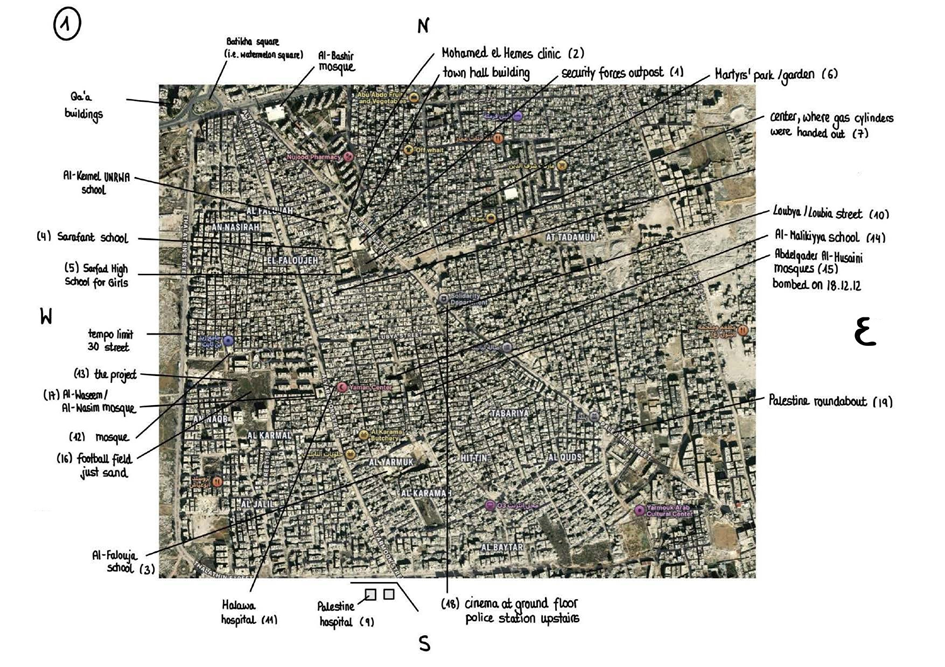
Toward the end of the taking of evidence, the witness was confronted with prior statements given in investigations conducted in the partner trial in Sweden and in Germany. The Court addressed discrepancies, in particular concerning the identification of individuals and the attribution of gunfire. While acknowledging uncertainties, the witness maintained his core account of the events.
Following the dismissal of the witness for the day, the Defense submitted a statement pursuant to Section 257 of the German Code of Criminal Procedure (GCCP). It challenged the testimony, among other reasons, due to the lack of unequivocal identification of one Accused and the insufficient distinction between armed presence and actual shooting. Before closing the hearing, additional procedural issues were addressed concerning the handling and distribution of satellite imagery used during the hearing.
The proceedings were adjourned at 4:15 PM.
The next trial day will be on January 15, 2026, at 9:00 AM.
Day 11 – January 15, 2026
Today, the Court resumed the questioning of witness, W5, who testified the previous day. At the beginning, the witness was asked whether he recognized any persons seated in the courtroom. He looked around and remarked that Jihad (A.) had changed the most in appearance.
He explained that he had transported more than three or four persons at a time, helped many injured individuals, and buried approximately [redacted information] deceased persons. Due to air strikes, bombardments, and the passage of time, it was difficult for him to remember names precisely. Upon questioning, he testified that the evidence shown was not recent but dated back several years. He explained that he had brought handwritten notes to avoid forgetting names.
When asked when and how he first knew certain persons, including Sameer S., the witness recalled that he had known him for more than twenty years. They knew each other from the [Yarmouk] camp as young men and greeted each other, though they were not close friends. They shared some mutual acquaintances. According to the witness, he became more familiar with Sameer S. after the incidents began which he dated to mid-2012 when bombs and rockets hit the camp. During that period, a group was formed, consisting of approximately twelve persons. According to the witness, all persons present in court belonged to this group along with others. W5 recalled that the leader of the group was "the biggest criminal." Before the revolution, the witness greeted him, but after the revolution began, he cut off contact with persons who maintained ties with the regime.
The witness explained that he knew certain names because some individuals lived opposite the hospital and regularly stood outside. When asked whether he would immediately recognize someone by sight, W5 noted that he had attended school with one of the persons mentioned and had known him since childhood. He denied having spoken personally with him in Syria. Regarding Sameer S., the witness explained that they were not in the same school year as he himself was older.
When asked since when he had known Sameer S. and when he first associated a name with his face, the witness remembered that there was a group in the camp that caused problems, including knife attacks. These individuals later became known as troublemakers. W5 added that members of the S. family had worked for the regime. [Redacted name], F19, and one more person [name unclear] were killed. Sameer S. came from the same family. The witness further recalled that F19 was a cousin on the paternal side, but he was unsure whether their fathers were brothers. He explained that he had no personal contact with F19.
Upon questioning, the witness denied having fought or worked together with Sameer S. He testified that he only knew that Sameer S. lived on a small street near [location unclear] and that he might have worked at an institution related to electricity, but W5 was not certain. He did not know S.’s occupation. Regarding his own schooling, the witness explained that he attended primary and middle school beginning in [redacted time], later followed by [redacted information]. None of the persons mentioned had attended university. He recalled that Sameer S. attended the same schools but was [redacted information]. Due to repeated school years, the exact age difference remained unclear.
The witness was then asked about the Accused Mazhar J. W5 recalled that he had known him since childhood, and that Mazhar J. was closely [redacted information]. According to the witness, Mazhar J. frequently ate, drank, and slept at his [redacted information]’s house. W5 also knew his sister and father. He recounted that Mazhar J. worked near the courthouse at a table placed next to the entrance, assisting people with forms, complaints and written statements, similar to persons currently working outside courts. According to the witness, Mazhar J. filled out forms, attached fee stamps, and was later taken into custody for falsification. W5 remembered that he personally observed this activity. He dated this period to approximately [redacted time] and added that it continued until he left Yarmouk on [redacted time]. He denied that Mazhar J. had any other profession or that he worked as an actor.
The witness further testified that he became acquainted with Mahmoud A. after the incidents had begun. He recalled that before the first air attack, popular committees distributed weapons to people, including untrained individuals, allegedly to defend the camp. Each group had a leader. He explained that at the hospital, armed men were present, wearing military or field uniforms and magazine vests. They stayed on the roof and at the entrance. According to the witness, an officer slept, ate, and stayed at the hospital, which belonged to a Palestinian institution. Certain individuals visited this captain. At that time, according to the witness, they were patrolling but had not yet killed anyone.
***
[13-minutes-break]
After the break, a Defense Counsel raised concerns that the witness might have fallen asleep, and he was questioned whether he was tired. The interpreter confirmed that he translated the witness's testimony word for word. The witness added that he was taking medication, including paracetamol, blood pressure medication, and blood thinners, but denied that these caused fatigue.
The questioning then resumed, and the witness described events related to demonstrations and violence. He recalled that the demonstration on July 13, 2012, was the largest tragedy the camp had experienced. Civilians and children were killed, and it was a traumatic event for families. He described a burial of a person [name unclear] and remembered that it was the largest funeral in the camp, visible on YouTube, with more than (...) participants. He recounted that this was the first day the population openly spoke out against Assad. W5 added that the death certificate [of the person killed] read that death occurred on July 13, due to cardiac and respiratory failure.
He further described a strike by shopkeepers prior to July 13, approximately one month earlier. He remembered that calls to close shops were shared via social media, including Facebook. Those who resisted had their shops destroyed, goods damaged, and were beaten. He recalled that armed individuals arrived wearing field uniforms and carrying magazines. According to W5, civilians were terrorized. He recalled that approximately eight to ten persons participated in these acts, including the Accused. He described assaults against shopkeepers and passersby, including beatings with sticks, rifle butts, and metal tools. Approximately ten persons were injured, sustaining injuries such as broken arms, facial bruises, and head injuries. W5 testified that firearms were not fired during the strike, but weapons were used to beat people.
The witness then testified regarding shootings on July 13, 2012. He recounted that he was shot at multiple times while driving an ambulance. He described reversing out of a side street into Al-Quds Street and changing direction to escape. He recalled that shots were fired from more than four rifles. He confirmed markings he had made on a map and referred to previous statements given in Sweden.
***
[11-minutes-break]
Further questioning concerned handwritten notes containing names of deceased persons. The witness explained that he wrote these notes to avoid forgetting anyone. He added that the names were collected from his memory, from telephone calls and later from internet research and social media pages related to Yarmouk camp. He testified that he normally did not use social media and therefore used his [redacted information]’s phone. He estimated that he provided approximately ten names. He further explained that there were older and newer notes and that he used older notes to verify accuracy.
Questions were raised regarding psychological treatment, alcohol, and drug use. W5 denied current addiction and declined to answer questions regarding earlier periods. The witness was further questioned about his use of TikTok after it was noted that interviews and similar content had been uploaded. He testified that he did use the application but explained that he had not mentioned it earlier because he did not consider TikTok to be a social media platform, describing it instead as an app used "for fun." After deliberation, further questioning on this topic was limited.
Following the questioning, motions filed by the Defense, including objections concerning alleged contradictions, were rejected by the Presiding Judge.
The witness was then dismissed, and the Court noted that he might not need to return.
The proceedings were adjourned at 4:45 PM.
The next trial day will be on January 28, 2026, at 10:00 AM.
___________________________
For more information or to provide feedback, please contact SJAC at [email protected] and follow us on Facebook and Twitter. Subscribe to SJAC’s newsletter for updates on our work