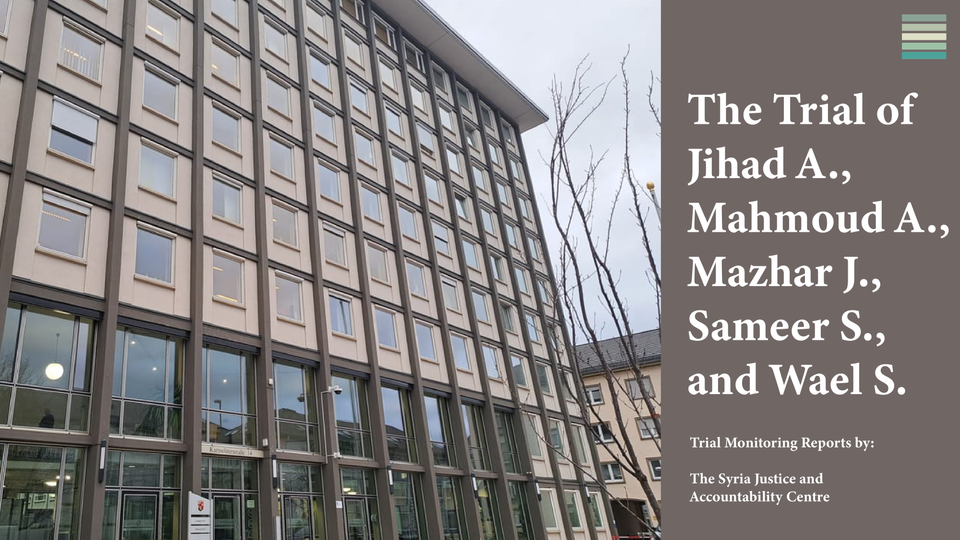
Inside the Al-Yarmouk Trial of Jihad et al. #5: The Drummer of Yarmouk
TRIAL OF JIHAD A., MAHMOUD A., MAZHAR J., SAMEER S. AND WAEL S.
Higher Regional Court - Koblenz, Germany
Trial Monitoring Summary #5
Hearing Date: January 7 and 8, 2026
CAUTION: Some testimony may include graphic descriptions of torture, rape or other violent acts.
Note that this summary is not a verbatim transcript of the trial; it is merely an unofficial summary of the proceedings.
Throughout this summary, [information located in brackets are notes from our trial monitor] and “information placed in quotes are statements made by the witness, judges or counsel.” The names and identifying information of witnesses have been redacted.
[Note: SJAC provides a summary of the proceedings while redacting certain details to protect witness privacy and to preserve the integrity of the trial.]
SJAC’s 5th trial monitoring report details days 8 and 9 of the trial of Jihad A., Mahmoud A., Mazhar J., Sameer S., and Wael S. in Koblenz, Germany. On the first day this week, W4 was questioned as a witness who testified about his experience from the demonstrations in Yarmouk in 2012. As a member of the [redacted information] and a drummer at the July 13, 2012 demonstration, he claimed to have witnessed the shootings firsthand.
On the second trial day this week, the questioning of W4 resumed. The witness was questioned about his experience in Yarmouk and his involvement in the demonstrations. He was further asked whether he suffered from mistreatment. W4 testified that he was first imprisoned in a school, and later in the Palestine Branch. He had not told the police about the torture in Palestine Branch because had not been asked. He testified that following four to five months in the old school, he was detained for one month in the Palestine Branch where he was tortured. Immediately after the Court dismissed the witness, the Defense Counsels then made statements to challenge his credibility.
Day 8 – January 7, 2026
On this trial day, the Presiding Judge opened proceedings at 10:00 AM. The Court confirmed the presence of all parties and approved Counsel Rienhoff as an additional Defense Counsel for the Accused Mazhar J.
The Defense then filed a motion pursuant to Section 257 of the German Code of Criminal Procedure (GCCP) regarding the witness [redacted name], W1, who was heard in court on December 17 and 18, 2025 [note: for the details of the testimony, see Trial Report #4]. The Defense criticized that W1 was summoned to court as a witness just because of a TikTok video. The Defense recalled that she was incapable of giving concrete information on the time and place of the demonstration. Furthermore, she did not bring specific information on the Accused. The Defense concluded that her testimony should not be considered in this case..
The Presiding Judge then announced the program of the day that consisted of the questioning of Mr. [redacted name], W4.
Upon request, W4 explained that he is a Syrian citizen, emphasizing, “They are Palestinians, I am Syrian,” gesturing to the Accused. He was born in [redacted location], and his family had lived there since the [redacted time]’s. W4 said clearly, “In Yarmouk, we did not differentiate between Palestinians and Syrians.” In [redacted time], he served his [redacted information] for [redacted information] months. In November [redacted time], he married, and one week later there were the first demonstrations in the Tadamon quarter next to Al-Yarmouk. “Unfortunately, since the beginning of the demonstrations, there were people who worked against us and joined the Shabiha and the Secret Service.”
In June 2012, the regions around Al-Yarmouk were freed by the Free Syrian Army (FSA). Following that, committees were founded and weapons were distributed to members of the Shabiha and the Secret Service. W4 recalled Jumbas [nickname for the Accused Jihad A.] specifically: “He was at a checkpoint where a lot of atrocities took place. He was a leading person of the Free Palestine Movement (FPM) and the General Command (GC).”
In December 2012, when Al-Yarmouk was freed, W4 testified that some of them [members of armed groups] rediscovered their humanity and joined the demonstrators again. It was at that time that the United Nations sent humanitarian supplies. [Redacted name], F13 was responsible for the supplies at that time, but they were not well managed, as the armed groups wanted to continue their cruelties, and their raping. 180 people died of hunger in Al-Yarmouk due to the retaining of the supplies.
The hearing proceeded with questioning by the Judges.
W4 did not know the Accused personally, but he remembered having seen them sometimes at checkpoints or on the streets. At first, W4 worked at the market with humanitarian supplies and later in the statistical bureau. When shown a picture of an Accused, he recognized Mazhar J. but could not name him. He said, “He was armed and part of the General Command. He stood at the Checkpoint.” He also recognized Moafak D. as being a member of the GC. Generally, “I make no distinction between Shabiha and the General Command.”
W4 further explained that with the revolution, one knew such names, as the fear of what would happen if caught spread very quickly. He also recalled that the names of Mazhar J., Mohammed A. and Moafak D. were told to him by a friend with whom he passed the checkpoints to distribute humanitarian supplies.
W4 explained that most of the demonstrations started on Friday after the evening prayer. Activists coordinated them and previously chose the locations. All the demonstrations were peaceful but varied in size. Only the militias were armed with weapons. The biggest demonstration was on July 13, 2012; W4 was certain of this due to the anniversary date of his daughter having not been long before. The demonstrators were attacked while walking from the Palestine Circle in the direction of the biscuit factory. That day, W4 was carrying the drums and walking in front. [Redacted name], F7, and others died a martyr’s death, W4 said. Hearing the shots, W4 then ran into a side street, leaving his drum at a friend’s place. W4 recalled that Mazhar J. and Mahmoud A. were present this day, and that one of his friends had pointed them out standing in the front line of the attackers: “The Shabiha were soldiers that the government hired to kill us. They were always on the front lines.” W4 explained that the official militaries were behind the Shabiha next to the biscuit factory. W4 testified that the attackers did not wear masks.
After the demonstrations, the participants also met and talked about what happened and who they saw. The armed people had motorcycles to pursue fleeing people. [Redacted name], F14, was responsible for the security in the region at that time. The attackers all had weapons pointed forward and ready to shoot, only waiting for the order. Here, W4 explained the attackers were standing at a distance of 200-300 meters, or from the back door of the Court to the desk of the Presiding Judge. The Presiding Judge told W4 that the distance is 12 meters in that case, and W4 replied, “I’m bad with numbers.”
Upon further request of one Judge regarding this specific demonstration on July 13, 2012, W4 answered he was the founding member of a committee that organized demonstrations. That day, he went to the mosque and he picked up friends. They wanted to meet at the Palestine Circle. W4 also recalled that at the preparatory meeting, people from all the neighboring quarters took part. There was no particular reason for this demonstration. Around 1,500 people joined the demonstrations. One line shouted in general was “One, One, Syria and Palestine are One.” W4 precisely described the route, and that at the Abou Hassan bus stop next to the biscuit factory was where he fled. Moreover, the distribution of humanitarian supplies took place in a restaurant at the Layalina hall, at the other end of the biscuit factory.
***
[86-minute-break]
***
The Judges continued their questioning. After W4 came back to where the demonstration took place, he saw people giving first aid. W4 recalled that after the demonstration, they started following the whole thing, exchanging pictures and videos. W4 added that must have been in mid-2013, at the start of the distribution of aid supplies.
The Court then displayed an aerial view of Yarmouk. W4 drew on the aerial photograph and confidently marked the various locations: The Palestine roundabout, the biscuit factory, the bus stop, the police station/Tadamon cinema, where the shooting took place, the last position of the demonstration, his own address, and a restaurant called Abu Abdo. The witness added numbers to each location on the map. W4 also testified that they had martyrs’ deaths close to every day.
Upon questioning, W4 answered that F7 worked with the demonstration leaders and participated enthusiastically in this demonstration. When W4 and his colleagues coordinated the demonstrations, they exchanged sensitive information among trusted individuals. W4 had seen F7 before, also at demonstrations, in the Damascus neighborhood. W4 believed he had seen and greeted him, and that F7 walked in the front that day. W4 then saw him being carried away, and learned the next day that he had died a martyr’s death. The witness recalled F7’s father, [redacted name], F15. W4 added that his father's cousin, [redacted name], F16, was a Shabiha member.
Shown more pictures, W4 recognized Mazhar J. but did not know his name. He said, “I saw him at the demonstration as a shooter, later on at checkpoints.”
Asked about Jihad A., W4 responded, “I know him; he was supposed to oversee a checkpoint. He was armed and always caused trouble. Furthermore, he was known for his contacts with the General Command. I had already seen a picture of him in Berlin at the D. [Moafak D.] trial.” W4 then reaffirmed that “F14 and F13 were armed at the front. I heard from over 50 people from Syria that Jihad A. was there this day.” The Court then asked if he was contacted from [redacted location]. He responded, "Yes, they called me and said Jihad A. hadn't done anything bad, the opposite was true, that he helped. That was before the trial, before I was summoned as a witness, but it was already clear that I might still be questioned about this.”
W4 was then questioned about the people in the room. He recognized Mahmoud A. but could not tell his name.
***
[15-minute break]
Questioned about F7, W4 responded that he saw him injured during the shooting. He had blood on his T-shirt. Later, W4 learned that he died. [Redacted name], F17, now located in [redacted location], gathered more detailed visual documentation and names on the demonstrations.
W4 marked the presumed location of the body on the map. Then, the Presiding Judge displayed two videos. W4 confirmed that the videos were made in Yarmouk.
Asked in general on the FPM, W4 answered that the FPM split off from the GC, financed by [redacted name], F18. There was a lot of support, and a lot of money, and so many split off from the GC and other groups and joined the FPM. The FSA was in charge within the camp. The FPM and the GC controlled the camp from the inside. The GC had been present since the revolution. The FPM only came later, around 2014, according to the witness.
Asked on the uprising of shopkeepers, W4 answered that it got interrupted at some point and the Shabiha forced them to reopen their shops, otherwise there would have been no more food for them.
Asked by the Representative of the Attorney General on [redacted name], F5, W4 responded that F5 was in a leading position at the GC. When W4 left the camp, he was handed over to him. W4 then said: "That was the first and last time I faced this criminal.” W4 explained that this took place at the ceramics market, which was a hub for the Security Services. W4 pinpointed that he was handed over to the Palestine Branch. “After paying a lot of money, they keep you for 2-3 months. What happens in the Palestine Branch should be known by all of you.”, W4 added. He further detailed that there were all kinds of torture: “The Shabiha are those who have sided with those who have slaughtered the Syrian people.”
Being part of the Shabiha and the General Command allowed one to pass the checkpoints easily, without having to pay, be searched or being harassed, W4 testified. Passing, members of those groups were saluted, W4 further explained.
W4 also said one could obtain a certificate to pass through checkpoints. The only requirement was to pay a lot of money. W4 concluded: “In one word: corruption.” W4 had a friend with such a certificate, and was also offered a certificate. There was only a distinction between a certificate for civilians and armed people.
W4 concluded his testimony for the day with the words, “With money, you get everything in this country.”
The proceedings were adjourned at 4:08 PM.
The next trial day will be on January 8, 2024, at 9:00 AM.
Day 9 - January 8, 2026
In the second session this week, the questioning of W4, [redacted name], resumed following a change in counsel for Mazhar J. like on the previous day.
The Presiding Judge asked W4 whether he was tortured in prison, which he affirmed. The Judge then read from his previous witness interview with the police, in which he had testified that while he was imprisoned in an old school, near the Yarmouk market, everyone was very respectful towards him, even allowing him to keep his mobile phone. “It was like a hotel; we were fattened like sheep.” He later explained that this was due to an agreement between the FSA and the Syrian army to create a buffer zone in Yarmouk.
The Judge noted that, previously, he had explicitly said that he had not been tortured, which W4 confirmed in person. W4 testified, contrary to his prior statement, that this concerned his first imprisonment in the school, not the later part in the Palestine Branch. He had not recounted this in his police interview because he had not been asked. He had spent four to five months in the old school followed by one month in the Palestine Branch where he was tortured. After he was let go after Eid of 2014, he fled to [redacted location]. He managed to exit Yarmouk after paying money. The Defense Counsel confronted him again with his police interview, where, upon questioning whether he had ever been hit, he had said “No, never” to which W4 claimed this to be accurate during his four to five month stay at the school, not after he got out: He had been re-summoned and interned another month in the Palestine Branch, he added to his response. “Everyone who was summoned to the Palestine Branch, they might get out after an hour, or they might die there”, he recalled.
The Defense for Jihad A. expressed its distrust of W4’s testimony due to multiple inconsistencies within his prior statement. Upon further questioning by the Defense, W4 recounted that he had found out his name was up for execution by ISIS and had wanted to leave the camp, but could not, unless he brought a firearm to the checkpoint, which he bought from a local dealer. Although he was married, his wife had often stayed with his parents for weeks, who had gotten out of the camp after the first bombardment of Tadamon. W4 had not spoken with either about his planned escape. The Defense questioned how W4’s wife was able to come and go as she pleased, while he was held in camp. W4 responded that he had moved to Yarmouk from Tadamon, because their house had been destroyed. His wife could leave as she pleased, for she was not an [redacted information]. W4 had worked for an [redacted information] and explained that those were particularly targeted. When he had gone to the checkpoint with the pistol however, he could not leave and was interned in the school. When he was called back later, he had no choice but to report to the Palestine Branch, because he could not leave without a passport. Later, his father borrowed money for him and his family to pay a smuggler to get them to [redacted location].
Upon further questioning, W4 said that he did not fight for the FSA. While he had served in the Syrian army as an [redacted information] and had thus gone through basic training, he did not want to have anything to do with weapons. Instead, he performed auxiliary roles in [redacted information]. The FSA, whom he called the “sons of the exploited nation” had left him the choice in that matter. The Defense Counsels subsequently voiced their disbelief and reminded him of his obligation to testify truthfully.
Some time was then spent ascertaining whether W4 had been in contact with other witnesses in the trial which he confirmed but denied having talked about his testimony. He was then asked whether he was a member of Aknaf Bait al-Maqdis, who are affiliated with Hamas, which he denied. While he and volunteers with the Palestinian Peoples Movement cooperated with everyone in order to render humanitarian aid, he did not want to join any group. W4 was asked whether he recognized any of the Accused from the TV show “The birth from the flank.” He testified that while he had watched some of the show, he had not paid particular attention to its actors. If he ever met any of the Accused in Yarmouk, it could not have been often. The Defense shifted the questioning to a TV interview that W4 had given during the prior day’s lunch break. He said that an old friend of his who was now a prominent Syrian journalist had been in the nearby city of [redacted location] on unrelated business. After hearing of the trial, he had shown up and asked for an interview. W4 had stated on television that he was a witness in a trial for murderers of Syria and that he wished such trials were also conducted there but gave no further details.
***
[15-minutes-break]
***
Upon further questioning following a break, W4 testified that he had entered [redacted location] in [redacted time]. He had answered questions relating to his torture in Yarmouk but could not recall his answers. The German [Asylum] authorities did not believe him, and he did not receive full protection. Upon questioning, how he was tortured, W4 said that the siege of Yarmouk itself was torture and forced him to eat cats. In the Palestine Branch, he was tortured “physically, all over the body,” but did not give more detailed explanation. The questioning then turned to the demonstrations W4 had partaken in. He testified that he had been present at many, “at least 20.” While he had not filmed anything due to fear of retribution in case videos were to be discovered when passing a checkpoint, he usually carried his large drum. He also testified that shots were fired “at all [demonstrations],” the first time at one in Tadamon: W4 was never wounded, nor arrested. He asserted, however, that his various ailments stemmed from mental trauma during the siege.
The Court recalled that W4 had identified Mahmoud A. the day before from a picture from the internet. Today, W4 could not confirm he had ever seen him in Yarmouk. He had seen his picture on social media, where he followed various channels pertaining to Yarmouk and the Syrian armed conflict. His own online presence had only begun in [redacted location]. When asked why he never left Yarmouk, W4 said that the Palestinian cause was similar to his own and that Yarmouk is symbolic for Palestinians. He could not abandon his cause. According to W4, the FSA and the Syrian army took turns bombing Yarmouk in order to destroy the camp as of 2012, sometime after the demonstration of July 13, at which he had also been present.
The Defense then asked whether W4 considered himself as plaintiff or as witness, to which he answered that he is a witness concerning that which he saw and heard but he was also damaged by his experiences in Yarmouk and personally held the Accused responsible for “at least one percent” of his pain and suffering. They had instigated altercations and thus prevented the distribution of aid packages.
[73-minutes-break]
After the lunch break, several pictures were shown to W4. On many, he recognized [redacted name], F5, as well as Mahmoud A., although he could not name the latter.
Subsequently, the questioning concerning W4’s social media presence resumed. W4 testified that he regularly communicated with others about the Yarmouk-complex, about what happened and how thankful he was, that he was able to help, but also personally. When trials like this one were concerned, he expressed his hope that justice would be served. He expressly denied communicating about the content of trials. He had, however, posted the TV interview of the day before to his private channels. He was always posting things about Syria because he loves his country and feels honored to be able to help justice be served in this case.
The Defense asked him to recount the usual process of these demonstrations, upon which W4 reiterated most of his testimony from the day before. The protests usually went similarly, he repeated. When asked, how he could be certain that he saw Mahmoud A. at this specific demonstration when he had earlier said that he barely remembered it, W4 claimed that he had a good memory for details: He had stood close to Moafak D., but he did not know who shot specifically. Upon being informed by the Defense that this contradicted his testimony from the day before, he instead said that Mahmoud A. did point his gun at the protesters and shot. He had seen Mahmoud A. immediately after the first shots were fired but could not recall where he stood. Upon further questioning, he conceded that he did not see shots fired at people.
The Defense Counsel of Jihad A. asked, referring to W4’s earlier naming of himself as an [redacted information], whether one could also call him a [redacted information]. W4 responded: “With certainty.” The liberators were those who fought, but he was a helper according to his conscience before Allah. The revolution in Syria is still not over, it is always ongoing, while the new state is being built, the witness concluded, before the Presiding Judge thanked W4 for his time, and dismissed him.
The Defense Counsels then made statements in accordance with Sect. 257 of the German Code of Criminal Procedure: The Defense for Sameer S. argued that W4 could not present concrete information as to time, place, and situations of relevance to this case. The Defense argued that W4 also confirmed that he did not know Sameer S., nor any other of the Accused by name. The Counsel claimed that the witness was untrustworthy. W4 attempted to present himself as a victim but gave contradictory statements during different interviews. His description of his own torture in particular is not credible.
The Defense for Jihad A. requested that the testimony of “a man who calls himself a [redacted information]” to be considered accordingly. The Defense for Wael S. argued that the parts of the testimony that remain credible are that W4 lived in Yarmouk and participated in some form at the demonstration of July 13, 2012, and that he did not know Wael S.
Finally, the Presiding Judge denied the motion prohibiting NGOs from using of electronic devices for their note-taking, arguing it was not warranted [for the motion filed by the Defense, particularly aimed at prohibiting SJAC’s monitors to bring electronic devices, see Trial Report #3].
The proceedings were adjourned at 4:01 PM.
The next trial day will be on January 14, 2026, at 10:00 AM.
___________________________
For more information or to provide feedback, please contact SJAC at [email protected] and follow us on Facebook and Twitter. Subscribe to SJAC’s newsletter for updates on our work