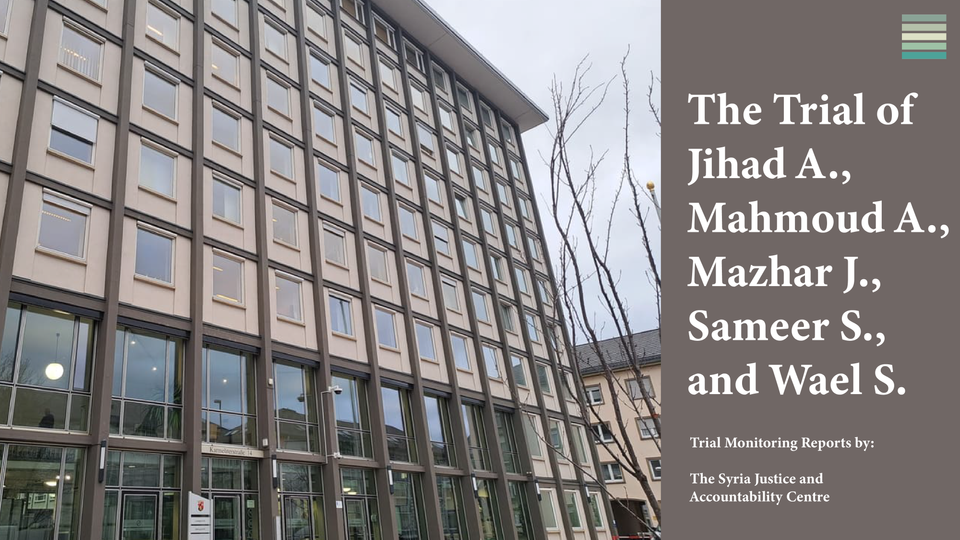
Inside the Al-Yarmouk Trial of Jihad et al. #3: SJAC Under Attack
TRIAL OF JIHAD A., MAHMOUD A., MAZHAR J., SAMEER S. AND WAEL S.
Higher Regional Court - Koblenz, Germany
Trial Monitoring Summary #3
Hearing Date: December 10 and 11, 2025
CAUTION: Some testimony may include graphic descriptions of torture, rape or other violent acts.
Note that this summary is not a verbatim transcript of the trial; it is merely an unofficial summary of the proceedings.
Throughout this summary, [information located in brackets are notes from our trial monitor] and “information placed in quotes are statements made by the witness, judges or counsel.” The names and identifying information of witnesses have been redacted.
[Note: SJAC provides a summary of the proceedings while redacting certain details to protect witness privacy and to preserve the integrity of the trial.]
Trial Monitoring reports of the Jihad A., Mahmoud A., Mazhar J., Sameer S., and Wael S. trial are a result of a partnership between the Syria Justice and Accountability Centre and the Center for Victims of Torture (CVT).
SJAC’s 3rd trial monitoring report details days 4 and 5 of the trial of Jihad A., Mahmoud A., Mazhar J., Sameer S., and Wael S. in Koblenz, Germany. On the fourth trial day, W3, a German Federal Criminal Police Officer (BKA) testified about his questioning of a potential direct witness of demonstrations that took place in Yarmouk in 2012 and which were violently repressed. W3 recalled details with direct links to the five Accused. Moreover, the Defense addressed SJAC’s trial monitor, arguing that he should not be permitted to take notes as a press representative and urging the Court to prohibit note-taking for him and the entire trial monitoring team, if necessary. The Defense also raised several accusations against SJAC.
On the fifth trial day, SJAC’s monitor was initially not allowed to bring her digital tools, but was later given her laptop to take notes. Proceedings continued with the questioning of W3, and his information on a potential direct witness of demonstrations.
Day 4 – December 10, 2025
Presiding Judge commenced proceedings at 10:15 AM. The Court confirmed the presence of all parties and approved a change in Defense Counsel for one Accused. The Presiding Judge then announced the agenda, which consisted of the questioning of witness [redacted name], W3.
First, Defense Counsel Hedrich claimed that direct testimonies from Syria were possible online via the embassy of Beirut, making the reliance on W3’s testimony unnecessary. The Representative of the Federal Prosecutor General's Office replied that there was no possible cooperation with Syria at the moment.
W3 was instructed of his obligations as a witness by the Presiding Judge. He and his colleague, [redacted name], W2, from the BKA Rheinland-Pfalz, had questioned the witness [redacted name], F1, in [redacted location] on August 20 and 21, 2025 in the presence of the Federal Prosecutor General. F1 had previously been questioned in [redacted location] in 2023. Defense Counsel asked if F1 was questioned only to complete the questioning of Austrian officers or for a completely new interview. W3 referred to his duty of confidentiality. Defense Counsel requested the Court to order the witness to answer the question.
***
[10-minutes-break]
***
The Court decided that W3 can refer to his duty of confidentiality. Defense Counsel Leymann requested that W3 pursue an authorization of disclosure. Due to too many interruptions, the Presiding Judge muted Defense Counsel Dr. Flintrop’s microphone. W3 recalled that F1 was instructed in accordance with the German code of criminal procedure in the presence of an interpreter accepted by F1. [The entire Austrian and German protocols were available for the Defense Counsel, Judges, and Plaintiffs.] Upon the Judge’s questioning, W3 explained that the questioning was about the demonstration in Yarmouk on July 13, 2012. F1, who worked in a beverage store then, said he was sitting in a Palestinian café and saw the demonstration that went in the direction of the Palestinian traffic circle and the Palestinian mosque. He claimed to have assisted in shooting people he knew, [redacted name], F2 being one of them. W3 further recalled that F1 saw [redacted name], F6, an ambulance driver he knew from the camp, picking up corpses in a van and bringing them to a hospital nearby. F1 recognized [redacted name], F3 and [redacted name], F4, whom he also knew from the camp, bloodied in their faces. The ambulance was not shot, probably because it was linked with the government. W3 recalled F1 telling him that he thinks the father of [redacted name], F7, made an accusation at court in a previous trial.
In response to a Judge’s question, W3 said F1 already knew the Accused Mahmoud A. was a problematic person who had gained a lot of importance during the revolution in the Free Palestine Movement. People from this organization manned the checkpoints. F1 had recounted that they wore a mix of civil and military clothes, but all were armed with Kalashnikovs and other weapons. They directed the weapons at unarmed people demonstrating and clapping.
W3 explained that F1 could not tell exactly who fired shots. Some shots were isolated, while others were in bursts. F1 saw the Accused Jihad A. at the checkpoint, who was known as “Jumbas” and lived nearby in the [redacted location]. Upon questioning, W3 also recalled that members of the [redacted name] family had their own checkpoint on the crossing point between the “[redacted name]” and “[redacted name].” F1 was passing by and saw someone trying to cross by motorcycle get stopped, his motorcycle get taken away, and getting beaten. F1 saw the Accused Sameer S. there as well as other family members.
W3 added that F1 also assisted in arrests at the “Reija place” after the air raid during the embargo. This place was a distribution station for food, but only women could get closer than 50 meters, as men were often beaten. F1 remembered [redacted name], F8, a longtime friend, [redacted name], F9, and [redacted name], F10 being arrested. They were beaten, their sweatshirts put over their heads and then taken into a minivan. When F1 went to jail, he met F10. He had mange, and the conditions were very poor. F1 said that the fear of the [redacted name] [street name] Shabiha was very strong, and even a resident of the camp did not open one’s mouth out of fear of being arrested.
W3 did not have a map of Yarmouk during the questioning but recalled that F1 drew one in Sweden. F1’s position had been about 200 meters from the checkpoint, and he also walked with the demonstrators a bit. W3 recalled that F1 detailed that the people at the checkpoint weren’t from the military but from the General Command and there were around 8 people coming and going. F1 had identified several people at the checkpoint, including the Accused Mahmoud A., but had not been able to see which specific individuals fired shots. The German report on the investigation was shown on the big screen. F1 had identified the Accused Mahmoud A. out of 8 profiles, 7 being fakes. F1 also showed pictures of Mahmoud A. on his phone, but the source was unclear. W3 recalled that Mahmoud A.’s role was to suppress and terrorize demonstrators at checkpoints. He was from the Shabiha.
Defense Counsel Leymann interrupted, wanting to know why a person with a laptop was authorized to monitor the process. Judge Dr. Kerber explained that SJAC is allowed to monitor and bring laptops. Defense Counsel Hedrich claimed that SJAC could be linked to the Anwar al-Bunni's organization, and that SJAC supported witnesses and was therefore not engaged in journalist activities. Presiding Judge Dr. Kerber mentioned SJAC’s monitoring the year before. Nevertheless, the Defense proposed that the Court revoke SJAC’s permissions. The Defense pled for the Accused’s protection in light of an incident on the first trial day, when the Plaintiff P1 allegedly took photographs of the Accused using a tablet. Defense Counsel Flintrop claimed the pictures were later published on Facebook. Defense Counsel Dr. Baumgart confirmed that a photo taken in the courtroom appears to have been published on Facebook and wanted to submit it to the Senate. The Defense proposed a pause in proceedings until a decision was made, saying, “No facts should be created that cannot be reversed later.”
***
[60-minutes-break]
***
W3’s questioning resumed. He explained the [redacted name] [S.] family owned a cell phone store and were tile layers. W3 remembered F1 describing Wael S. as tall and skinny. F1 recalled having seen Sameer S. at the motorcycle incident during the police interview. More generally, the [redacted name] [S.] took money from people at the checkpoint.
The Court displayed a new set of pictures. W3 then said that Jihad A., also known as “Jumbas,” was also part of a brutal armed group called [redacted name] [a militia group names after F5] Jihad A. then came to Germany. Back then, Jihad A. lived in the Maghreb quarter, only 100 meters away from the checkpoint. The Judge read from the protocol, “Always when demonstrations took place in Yarmouk everybody knew it. The state called the checkpoint the “people’s committee,” and Jumbas stood at the “Palestine turning point” in front of a hospital.” The Judge read from the protocol that F1 had seen Jumbas at the first and the second checkpoint, near the place where the 3 corpses were found. W3 added that the shooters stood in a formation in order to not shoot themselves.
The Court displayed another set of pictures F1 had been pretty sure that Jihad A. did not know him. Jumbas was a Shabiha, he was with F5’s, [redacted name]’s group. W3 recalled that F1 did not see Mazhar J. during the conflict at all but had said that he collaborated with the secret service, talked badly, and wrote bad reports about others. W3 recalled a comparison between the F1 and Mazhar J.’s hair, and that F1 said Mazhar J. had bad teeth. The Judge cited page 50 of the report, a description of Mazhar J.: small, skinny, little hair and bad teeth.
The Court displayed a new set of pictures (WLV 84534 276-283). F1 had recognized the person on picture 7. The Judge quoted F1’s response from the investigation: “No, I did not see him during the entire conflict, but is there something worse than to sell the son of your own brother to the government?” W3 recalled that F1 had no pictures of the shot but had recounted it from his memory. Responding to a question from the Defense, W3 answered that he personally did not notice any signs of conscious lies, only remarks on the long gap between the events and the interview. Asked about his personal opinion of F1, W3 said, “I could see that F1 went through something in Syria and that one could perceive that it was not the first hearing, as people are normally overwhelmed by the bureaucracy, are unstructured, very emotional and have the urge to tell everything.” He also recalled that a few hundred demonstrators were present that day.
Defense Counsel Baumgart displayed a picture on his phone on the big screen, claiming that the picture showed F1 armed. W3 referred to the Sweden 2023 protocol from the questioning of F1 concerning F1’s biography and potential act-taking in the armed groups. In response to the Defense’s question of why he specifically went to Austria, W3 answered he already was involved in the matter, as was his colleague [redacted name], W2, and the Prosecutor. As a trio, they hadn’t worked together before but had known each other. W3 also explained that the missing criteria that are typical for homicide cases was missing, because nobody told them to put it in the protocol. W3 had already investigated other homicide and international law cases but did not know F1 before. W3 refused to answer refused to answer Defense Counsel Flintrop’s question if they had a question catalogue. During the questioning in [redacted location], W3 had not confronted F1 with contradicting information he gave in the Swedish hearing. The Defense put forth a contradiction concerning Jihad A.: the first day, F1 said he was not there at all, then he accused Jihad A. of murder. W3 denied any remarkable incidents regarding the translation of the questioning in [redacted location]. W3 said that after having questioned other witnesses on the Yarmouk matter, many details could be clarified and no contradictions came up. To Defense Counsel Leymann’s question on German-Swedish collaboration, W3 only said that they cooperated closely.
Presiding Judge Dr. Kerber said that the questioning of W3 will continue the next day, and that W3 should provide an extended disclosure authorization from his superior.
The proceedings were adjourned at 4:30 PM.
The next trial day will be on December 11, 2025, at 9 AM.
Day 5 – December 11, 2025
The Presiding Judge commenced the proceedings. She temporarily replaced one Defence Counsel for an Accused.
Defence Counsel Leymann, referring to the previous day’s discussion, started to comment on SJAC’s status as a press organization in the trial. He accused SJAC of trying to get press status under false pretences. The Judge accepted the motion.
Afterwards, Defense Counsel Fratzky wanted to add a motion. He demanded the interdiction of trial monitoring by NGOs such as SJAC, Anwar al-Bunni, Mazen Darwish, the Syrian Center for Media and Freedom of Expression and the Ceasar File’s Group.
He said that SJAC itself records witness statements and conducts investigations. It had to be considered that the protocols SJAC produces of the hearings were read and used by the entire SJAC organization and Plaintiffs. SJAC’s main work is searching for possible suspects, Defense Counsel Fratzky claimed. He reasoned that creating transcripts was in conflict with the duty to truthfulness and due process.
Prosecutor Grätsch commented that this was mere speculation. The decisive factor would be a press status. The continuous current reporting created a “field of tension” that had to be dealt with for the time being.
Defence Council Fratzky then referred to another incident, in which a witness had been possibly impaired by a photo presented by Anwar Al-Bunni before testifying in front of the court.
The Presiding Judge then permitted the taking of notes. She reasoned, thus far, that the argumentation had been mere speculation.
She declared, “The Presiding Judge reserves the right, in the event that the evidentiary activities of the aforementioned organizations impair the Senate’s ascertainment of the truth, to amend the Court’s procedural order governing courtroom conduct, up to and including a complete prohibition of note-taking.”
Defence Counsel Flintrop and all other Defence Counsels supported the motion of Defence Counsel Fratzky. The trial paused for around five minutes to deliberate. The Senate afterwards confirmed the Presiding Judge’s decision.
The Judge called upon yesterday’s witness, BKA officer [redacted name], W3. The Presiding Judge confirmed that W3’s personal details remain unchanged. The Judge established the topic of the questioning as two possible victims of violence F1 had discussed with W3.
F1 had watched the detention of a friend, [redacted name], F8. He had watched the process from a distance of about 50 meters and had named [redacted name], F11, and Jihad A. as involved persons. F8 had had a pullover pulled over him, had been restrained and hit. At last, he had been brought in a minivan. F1 had not seen his friend again after that detention. F1 had not distinguished who had hit him. He had mentioned another detention on the same day. W3 explained that the hits were executed with fists and the butts of rifles.
F1 had not left the camp, and thus had never been at the integration and passport office. The detentions had been carried out mostly by another person and not Mahmoud A. F1 had mentioned that the checkpoints of the Free Palestine Movement had been a catastrophe, according to the BKA officer.
Mostly women had been victims of violence at food distribution stations, W3 explained, as men did generally not approach those distributions out of fear of detention.
F1 had been detained in Syria for 7 months. At first, F1 had been in the Amatilla section [name unclear], and after 20-30 days was transferred to the Palestine section of the prison. The detention document had been produced by the Prosecutor General at the court for terrorism cases. F1 had been accused of membership in a terrorist organization, weapon ownership, and violence. The document indicated the prosecuting authority as Branch 235 of the Syrian secret service. The exact dates on the document were not conclusive; the translators suspected that F1 had been convicted between July 2014 and January 2015. F1 had given no further information on this document.
F1 had been living on [redacted location]. He had watched as the Shabiha had driven into the camp, had tried to open up striking stores with tools and had hit store owners. W3 was unable to say whether Mahmoud A., [redacted name], F12 Sameer S. or Wael S. had been implicated in every incident, as there were several strikes. F1 had watched at least three violent reactions to strikes.
The witness was then questioned by the Defense.
W3 told the Court that F1 had been tortured, leading to an eye injury and chronic toe pain. W3 had not expected the witness to leave the country; he could not have done more than to ask him to come testify and did not know how to reach out to him. F1 had also identified persons in a checkpoint from 120 meters away. W3 did not recall F1 wearing vision aids for the investigation. W3 confirmed that F1 still had family members living in [redacted location].
F1 had not named his source each time he talked about information he had acquired through hearsay. W3 did not remember if he had informed F1 about the possibility of him becoming a plaintiff in this trial. F1 had been aware that Mahmoud A. went [redacted information] before the revolution. W3 had not noticed any addiction problem of F1’s. F1 knew where Jihad A. had lived.
The Presiding Judge then closed the questioning.
The Defense said that even if W3 was credible, the content of his testimony was not, as it was a result of hearsay. The Defense put forward a motion to exclude the evidence.
The proceedings were adjourned at 12:10 PM.
The next trial day will be on December 17, 2025, at 10:00 AM.
___________________________
For more information or to provide feedback, please contact SJAC at [email protected] and follow us on Facebook and Twitter. Subscribe to SJAC’s newsletter for updates on our work