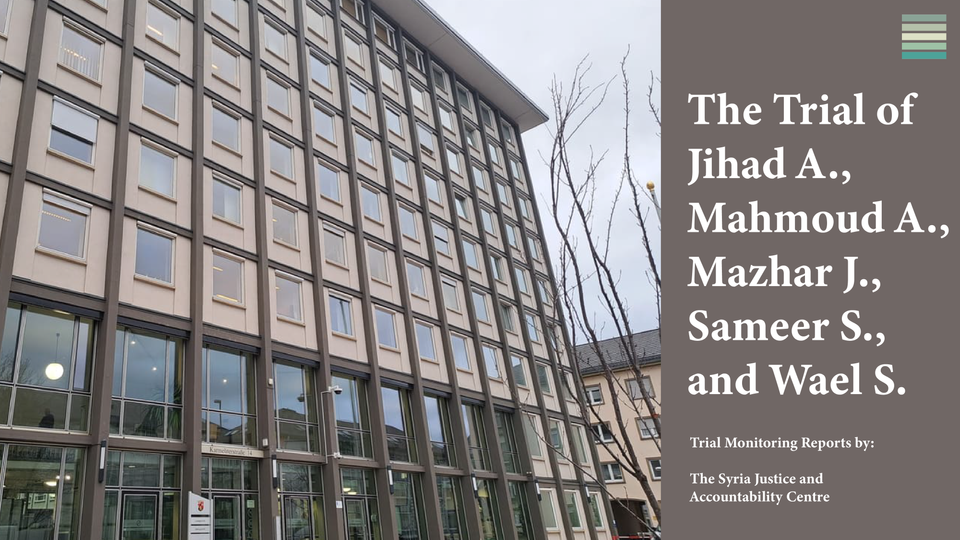
Inside the Al-Yarmouk Trial of Jihad et al. #1: A Witness Who Witnessed Nothing or a Potential Precedent?
TRIAL OF Jihad A., Mahmoud A., Mazhar J., Sameer S., and Wael S.
Higher Regional Court – Koblenz, Germany
Trial Monitoring Summary #1
Hearing Date: November 19, 2025
CAUTION: Some testimony may include graphic descriptions of torture, rape or other violent acts.
Note that this summary is not a verbatim transcript of the trial; it is merely an unofficial summary of the proceedings.
Throughout this summary, [information located in brackets are notes from our trial monitor] and “information placed in quotes are statements made by the witness, Judges or counsel.” The names and identifying information of witnesses have been redacted.
[Note: SJAC continues to provide a summary of the proceedings while redacting certain details to protect witness privacy and to preserve the integrity of the trial.]
Trial Monitoring reports of the Jihad A., Mahmoud A., Mazhar J., Sameer S., and Wael S. trial are a result of a partnership between the Syria Justice and Accountability Centre and the Center for Victims of Torture (CVT).
SJAC’s 1st trial monitoring report details the opening day of the trial of Jihad A., Mahmoud A., Mazhar J., Sameer S., and Wael S. in Koblenz, Germany. In this trial day, the Prosecutor read out the indictment, listing the charges against each of the Accused. The charges included the starvation of civilians in Al-Yarmouk camp, a charge in the Syrian context that made its first appearance in trials under universal jurisdiction taking place in the German courts. Defense Counsel Baumgart read out his motion, requesting the termination of the proceedings against his client. Another Defense Counsel, Mr. Grassel, requested in his motion that the proceedings be documented by audio and video recording. The rest of the Defense Counsel supported Grassel’s motion while the Prosecutor rejected the arguments.
Day 1 – November 19, 2025
The opening session of the trial today was crowded with spectators and press representatives. Before the session began, the Accused, handcuffed, and their Defense Counsel arrived gradually in the courtroom. As one of the guards unlocked the handcuffs of one of the Accused, the latter stared at the Plaintiff, Mr. [redacted name], P1, who was sitting next to his Counsel, smiled, and then remarked, “A witness who witnessed nothing.”
After the bench of judges, presided by Judge Dr. Kerber arrived in the courtroom, Judge Kerber confirmed the presence of the parties to the proceedings and the interpreters were sworn in. She then asked the Accused to state their names and dates and places of birth. Defense Counsel Baumgart objected, demanding an interruption of the proceedings as he intended to file a motion to terminate the charges against his client, Sameer S., but the Presiding Judge opted to postpone his request. The Accused then began stating their personal information one after the other: Wael S., born [redacted time], in [redacted location]; Sameer S., born [redacted time], in [redacted location]; Mazhar J., born [redacted time], in [redacted location]; Mahmoud A., born [redacted time], in [redacted location]; Jihad A., born [redacted time], in [redacted location].
Following this, the Presiding Judge allowed Counsel Baumgart to read his motion. The motion consisted of two parts: 1) A request not to read the indictment, 2) a request to terminate the charges against Sameer S. due to a procedural impediment. Presiding Judge Kerber told Baumgart to read only the requests. Baumgart started reading his motion, demanding the termination of the proceedings against Sameer S. and that the charges leveled against him in the indictment not be read, acknowledging that this was not a typical motion, yet necessary in the present case. Baumgart justified his motion by asserting that, from the Defense's perspective regarding Section 243 (3) of the German Code of Criminal Procedure [which pertains to the reading of the indictment], the Defense Counsel observes a procedural impediment, and that the Court should not read the indictment and must terminate the proceedings in accordance with Section 206 (a) of the aforementioned code. The Counsel indicated that the Court lacks the necessary jurisdiction to proceed with this trial and that the indictment was inconsistent.
Presiding Judge Kerber ordered the rejection of the motion not to read the indictment, noting that reading out the charges was a mandatory procedural step according to Section 243 (3) of the German Code of Criminal Procedure. This is indispensable even if grounds apply that justify the termination of the proceedings by ruling of the court. This must be invoked after the indictment has been read out. Regarding the assertion that the Koblenz Court lacks the necessary jurisdiction, Kerber stated that this claim was incorrect. Following another intervention, by Defense Counsel Grassel, indicating that he intends to submit a motion to audio and video record the proceedings, Presiding Judge Kerber informed him, too, that he must wait until the reading of the indictment is complete, after which he may submit his motion. The Presiding Judge then gave the floor to the representative of the Public Prosecutor General, Prosecutor Grätsch, to read the indictment.
The Prosecutor began reading the indictment:
I. Wael S.... As part of a widespread and systematic attack on civilians, acts that resulted in the death of a human being. Five counts of attacks on civilians. The killing of a human being on three counts within a non-international armed conflict. The death of a human being protected under international law. Three counts of killing a human being protected under international law. The death of a human being using means that pose a danger to society and on base motives in five counts. Three counts of attacks on civilians resulting in the killing of a human being. At a later point in time, on July 13, 2012, five cases of murder as crimes against humanity through the same act, torture, murder and attempted murder joined concurrently (concurrence of offenses), within the context of a non-international armed conflict. Five counts within a non-international armed conflict that resulted in the killing of a human being protected under international law. Three counts of using means that pose a danger to society and for base motives.
II. In June 2012, and within a widespread and systematic attack on civilians, the Accused tortured a person in their custody, inflicting psychological and physical pain that was not entirely the result of international punishments in the context of a widespread and systematic attack, and they deprived a person of their liberty - a total of eight cases. In the context of a non-international armed conflict, they subjected a human being who must be protected to cruel treatment, either by torturing or mutilating them – a total of eight cases.
III. On a day between December 2012 and July 2013, they tortured a human being in their custody, inflicting psychological and physical pain that was not entirely the result of international punishments. In the context of a non-international armed conflict, they violated international humanitarian law by subjecting a human being who must be protected to cruel treatment, either by torturing or mutilating him.
IV. Jihad A.... On August 19, 2012, and within a widespread and systematic attack on civilians, a person died in the attack in two cases through the same acts. In the context of an international conflict, he attempted to kill a human being who must be protected and personally/directly caused the death of a human being.
V. Mahmoud A....
1. Around mid-2012, and in four counts of attacks on civilians, he tortured a human being and inflicted psychological and physical pain that was not entirely the result of international punishments. In four concurrently joined counts, he subjected a human being who must be protected to cruel treatment, either by torturing or mutilating him.
2. In early 2013, likely in February, and as part of a widespread or systematic attack against civilians, he tortured a human being and inflicted psychological and physical pain that was not entirely the result of international punishments, and he deprived a human being of liberty. In the context of a non-international armed conflict, he subjected a protected human being to cruel treatment, either by torturing or mutilating him.
3. At an unspecified time in April 2013, and within a widespread and systematic attack on civilians, he violated international law by depriving a human being of liberty and causing his death.
4. At an unspecified time in April 2013, within a widespread and systematic attack on civilians, he deprived a human being of liberty and caused his death. In another count of an attack on civilians, he tortured a human being and inflicted severe psychological and physical pain. He subjected a protected human being to cruel treatment, either by torturing or mutilating him.
5. In April or May 2013, and within a widespread and systematic attack on civilians, he severely deprived a person of their liberty and in three cases he subjected a human being protected under international law to cruel treatment, either by torturing or mutilating him.
6. At an unspecified time between January and July 2013, and within a widespread and systematic attack on civilians, he tortured a human being in his custody and inflicted psychological and physical pain that was not entirely the result of international punishments. In four counts of a non-international armed conflict, he subjected a protected human being to cruel treatment, either by torturing or mutilating him.
VI. Mazhar J....
1. Between December 17, 2012 and January 2014, and within a widespread and systematic attack on civilians, he tortured a human being in his custody and inflicted psychological and physical pain that was not entirely the result of international punishments. In the same act, he violated international humanitarian law by committing severe deprivation of liberty and subjecting a protected human being to cruel treatment, either by torturing or mutilating him.
2. At an unspecified time in February 2013, and within a widespread and systematic attack on civilians, he violated the liberty of a human being and caused his death, and he tortured a human being and inflicted psychological and physical pain that was not entirely the result of international punishments. In the same act, he subjected a protected human being to cruel treatment, either by torturing or mutilating him.
3. At another time in February 2013, and within a widespread and systematic attack on civilians, he violated international humanitarian law by severe deprivation of liberty. By the same act, and within a widespread and systematic attack on civilians, he tortured a human being and inflicted psychological and physical pain that was not entirely the result of international punishments. In the context of a non-international armed conflict, he subjected a protected human being to cruel treatment, either by torturing or mutilating him.
4- In the first half of the year 2013, he violated international humanitarian law by deprivation of liberty; deprivation of liberty causing death; torture, aiding the torture of a protected person in a non-international armed conflict.
5- At a time between September and October 2013, in two concurrently joined counts, he severely deprived a human being of liberty and caused his death. In the same two counts, he aided in the torture of a human being in custody and inflicted psychological and physical pain that was not entirely the result of international punishments. In the same two counts, he aided in the cruel treatment of a human being who must be protected, either by torturing or mutilating him.
6- At a later time on the same day between September and October 2013, and within a widespread and systematic attack on civilians, he severely deprived a person of their liberty and causing the death of a human being, and he aided in the torture of a human being and the infliction of psychological and physical pain that was not entirely the result of international punishments. In the same act, and within the context of a non-international armed conflict, he aided in the cruel treatment of a human being who must be protected, either by torturing or mutilating him.
VII. Wael S., acting alone. In December 2016, as part of a widespread and systematic attack against civilians, he tortured a human being in his custody and inflicted severe psychological and physical pain that was not entirely the result of international punishments. By the same act, he subjected a protected human being to cruel treatment, either by torturing or mutilating him.
VIII. Mahmoud A., acting alone. In two cases at two different times in 2014, in two concurrently joined counts, and within a widespread and systematic attack on civilians, he tortured a human being in his custody and inflicted psychological and physical pain that was not entirely the result of international punishments. In each instance, he subjected a human being who must be protected to cruel treatment, either by torturing or mutilating him. And two counts, by the same act, and within the context of a non-international armed conflict – the Syrian armed conflict against the opposition - he caused the starvation of civilians by obstructing the access of relief materials.
The Public Prosecutor then presented a summary of the history of the Syrian uprising and the emergence of the armed conflict within it, focusing on the history and conditions of the Yarmouk camp. She explained the role of the Syrian Intelligence Services and the militias Popular Front for the Liberation of Palestine – General Command (PFLP-GC) and Free Palestine Movement (FPM) in controlling the camp, and the siege of the Yarmouk district. She detailed the events that occurred in each case mentioned in the indictment. She concluded by reading the relevant Sections of the charges against the Accused:
[Note: This is only a summary and has been done to the best of the knowledge of the SJAC trial monitors, but there may be slight divergences.]
Wael S.: Section 7 and 8 GCCAIL; Section 211 (1) and (2); GCC, Section 22, 23, and 25 (2) GCC; Section 52 and 53 GCC.
Sameer S.: Section 7 (1)(1), (5) and (9), Section 8 (1)(1) and (3) GCCAIL. Section 221 (1) and (2) Variant 4 and 7 GCC, Section 22, 23 GCC, Section25 (2), 52, and 53 GCC.
Mazhar J.: Section 7 (1)(1), (5) and (9), and 7 (3), Section 8 (1)(1) and (3), and 8 (6)(2) GCCAIL; Section 211 (1) and (2) Variant 4 and 7 GCC, Section 18, 22, 23 (1), 25 (2), 27 (1), 52, and 53 GCC.
Mahmoud A.: Section 7 (1)(1), (5) and (9), and 7 (3). Section 8 (1)(1) and (3), and 8 (6)(2) GCCAIL; Section 211 (1) and (2) Variant 4 and 7 GCC, Section 18, 22, 23, 25 (1) and (2), 52, 53 GCC.
Jihad A.: Section 7 (1)(1), (5) and (9) and 7 (3). Section 8 (1)(1) and (3), and 8 (6)(2) GCCAIL, Section 211 (1) and (2) Varian 4 and 7 GCC, Section 22, 23, 25, 52, and 53 GCC.
After the Public Prosecutor finished reading the indictment, the Presiding Judge thanked her, noted that the charges were admitted and the main proceedings opened. She then announced a lunch recess.
***
[75-minute break]
***
After the break, the Presiding Judge gave the floor to Defense Counsel Baumgart to read his motion. The Defense Counsel argued that the indictment did not satisfy the content requirements of Section 200 (1) of the German Code of Criminal Procedure (GCCP), as it must describe when, where, and how the Accused committed the crime, and none of these elements should be omitted.
He then contended that the Court lacked jurisdiction to proceed with this trial, arguing that it is impossible to prove the existence of a widespread and systematic attack on civilians in Yarmouk, nor a non-international armed conflict, unlike in Palestine, for example, where Benjamin Netanyahu killed more than 30,000 children in the Gaza Strip, which was documented by satellite imagery and corroborated by witnesses and international organizations. He argued that the legal requirements were not met in the present case.
The Counsel immersed himself in reading his motion for about two and a half hours, repeatedly making the same points. He argued that his client, Sameer S., was not armed, did not use a weapon, did not hit anyone, and was not a member of an armed militia, and that there was no evidence of this despite the fact that many video clips and reports were available online. While it was true that his client possessed a pass card for crossing checkpoints, the Defense Counsel claimed, it was given by the Accused’s uncle — who was a member of the organization — and did not constitute proof of the Accused's own membership. According to Counsel Baumgart, the Court must, in all cases, prove his Client’s personal participation in the crimes, not merely his membership in the militia. The Counsel argued for a limited importance of a certain witness's testimony by pointing out that the witness was an alcoholic. The Counsel stated that Germany should not appoint itself as the guardian of international law, and that the European Court is the one qualified to do so. He indicated that the Syrian state — now after the fall of Al-Assad — could hold such trials itself. He further highlighted that there was no systematic and widespread attack against civilians, highlighting that both element (widespread and systematic) must be met. He also argued that crimes against humanity required the multiple commission of acts, which would not be satisfied by his client’s alleged individual act. Due to the lack of an armed conflict as required by the sections in the indictment, the entire proceedings are in question since international criminal law was not applicable, according to the Defense Counsel. The Defense Counsel demanded the termination of the charges against his client, citing a Stockholm court decision to release the Accused in the very same facts presented here.
***
[10-minute break]
***
After a brief break, Judge Kerber allowed Defense Counsel Grassel to read his motion. In his motion, Grassel requested that the proceedings be documented by audio and video recording and that these recordings be delivered to the parties of the proceedings on a weekly basis. Grassel justified his request with two points. First, due to the importance the case holds, since it could be used for academic and legal purposes, and for its historical significance to Germany and the Arab countries. Germany has a pioneering and important role in these trials. He argued that these records would be preserved in the German archive for future generations to draw upon. Second, to improve the process of searching for the truth. He cited parts of a draft bill on "digital documentation of criminal proceedings" initiated by the previous Federal Government. Although the bill was never adopted, the court should nonetheless record these proceedings based on the spirit of the bill. Counsel Grassel argued that no objective protocol of the trials is currently at the disposal of the parties to the proceedings. Differences in opinions could lead to further protraction of the criminal proceedings. By taking the draft bill as a basis and then refining it, this would facilitate and solidify the process of searching for the truth and simplify the appeal process. Such documentation can be used in the German states according to Section 120 (6) of the German Courts Constitution Act (GCCA), specifically in matters of state security through “borrowed administration” [German: Organleihe].
After Counsel Grassel finished reading his motion, the rest of the Defense Counsels joined him in support of his request. Baumgart added that this would improve the fair trial rights. The Public Prosecutor responded that she did not support the motion. She pointed out that a relevant provision existed, namely Section 169 GCCA, but argued that the current case did not meet the standards of historical and scientific importance, that the Syrian conflict had already been subject to many academic studies, and that these Accused did not hold high-ranking positions. She added that the recordings would not change anything regarding the considerations for appeal. Presiding Judge Kerber then indicated that the Court would respond to this motion in the session scheduled on December 3, 2025.
The proceedings were adjourned at 4:30PM.
The next trial day will be on December 3, 2025, at 10AM.
___________________________
For more information or to provide feedback, please contact SJAC at [email protected] and follow us on Facebook and Twitter. Subscribe to SJAC’s newsletter for updates on our work