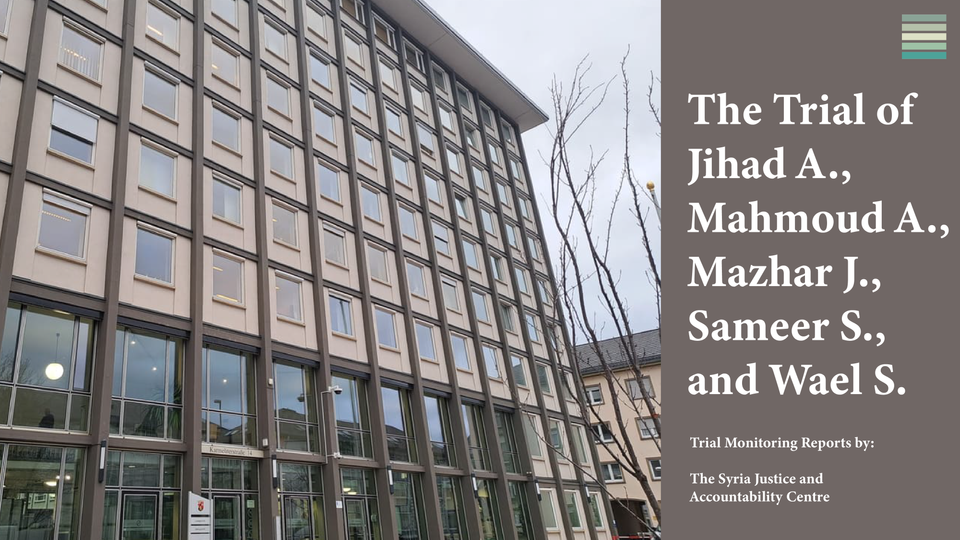
Inside the Al-Yarmouk Trial of Jihad A. et al. #4: Children of the General Command
TRIAL OF JIHAD A., MAHMOUD A., MAZHAR J., SAMEER S., AND WAEL S.
Higher Regional Court - Koblenz, Germany
Trial Monitoring Summary #4
Hearing Date: December 17 & 18, 2025
CAUTION: Some testimony may include graphic descriptions of torture, rape or other violent acts.
Note that this summary is not a verbatim transcript of the trial; it is merely an unofficial summary of the proceedings.
Throughout this summary, [information located in brackets are notes from our trial monitor] and “information placed in quotes are statements made by the witness, judges or counsel.” The names and identifying information of witnesses have been redacted.
[Note: SJAC provides a summary of the proceedings while redacting certain details to protect witness privacy and to preserve the integrity of the trial.]
SJAC’s 4th trial monitoring report details days 6 and 7 of the trial of Jihad A., Mahmoud A., Mazhar J., Sameer S., and Wael S. in Koblenz, Germany. On this trial day, witness W1, whose recorded statement was previously heard, appeared before the Court, her testimony heavily incriminating Jihad A., who resorted to cursing her with Allah’s wrath. Another motion by the Defense requesting the prohibition of note-taking for all NGO representatives, in particular SJAC’s trial monitors, was rejected by the Presiding Judge with reference to case law of the German Federal Court of Justice.
On the second day of the week, witness W1 concluded her testimony and was questioned predominantly about her prior statements to the police. Three specific incidents that took place in the camp were scrutinized, and W1 explained the geographical locations of the situations that allegedly took place in 2012. W1 was questioned by the Judges, the State Prosecutor, and the Defense Counsels about the General Command (GC) in Yarmouk and her connections to certain people and organizations.
Day 6 – December 17, 2025
[Today, six people attended the trial in public gallery, with some apparently familiar with one another. At least two were directly acknowledged by Jihad A. prior to the trial’s beginning.]
Trial proceedings began with another motion submitted by a Defense Counsel, seconded by all other Defense Counsels. He requested that note-taking should be prohibited for all representatives of NGOs. The Counsel argued that in prior trials, witness names were not properly redacted, and photos of court proceedings were taken without permission. Furthermore, witnesses were influenced by the trial reports which also included factual inconsistencies [note: during the reading, Jihad A. gestured at the trial monitor, conveying his pending exclusion from trial proceedings.] The Presiding Judge rejected the motion, citing precedence from the German Federal Court: The prohibition of note-taking is only necessary if they were actively used to influence witnesses. Prior infractions were not committed by representatives of the SJAC - the only NGO present. Until reasonable suspicion of attempts to impede the truth-finding process by SJAC arises, it acts as a media representative, and its representatives may continue taking notes, the Judge held. She added that the Defense was entitled to a counter statement, however, after the witness examination.
The first witness, [redacted name], W1, was then brought in and some time was taken for W1 to be given access to the translation. The Presiding Judge thanked W1 for coming and reminded her of her obligation to truthfulness before the court [note: The Court previously heard W1’s video statement. For the details, see Trial Report #2].
W1, an elderly woman, who was born and raised in Yarmouk is the aunt by marriage of Jihad A. To begin, she was asked to inspect about two dozen portrait photos showing Arabic-looking men. She recognized most by sight, if not by name. One image left her very agitated and nearly in tears. The Presiding Judge then asked for background information pertaining to Yarmouk. W1 described being happy in Yarmouk until “the events” took place, she had worked at a refugee organization. The Court then spent some time localizing W1’s house in Yarmouk as well as surrounding landmarks with the witness. Upon questioning, she explained that she had left Yarmouk after December 17, 2012, along with many others, after the first airstrike hit. She recalled that the city was then destroyed by the General Command (GC), an organization belonging to the Syrian intelligence agency. She also remembered that the young men of Yarmouk were killed and incarcerated. W1 testified that the GC had existed at least since her childhood. Its members were apparent by their weapons; they acted like guardsmen. After “the events,” they started shooting people. The first time they opened fire, was at a demonstration sometime in the summer of either 2011 or 2012 – the W1 was uncertain – after which the GC grew bolder in their crimes. Upon further questioning, W1 explained that the demonstration consisted of young people protesting for freedom. The GC blockaded them at the Palestine Roundabout and opened fire. About 15 people were killed. Upon being asked, which part she could factually confirm, W1 said that she only went to the demonstration because her son had gone who she had been afraid for. The demonstration had begun at a mosque, though she was unsure which. She then encountered the demonstration at the Palestine Roundabout. W1 was asked to show which route she took to the Palestine Roundabout on a map, which took some time due to W1 poor eyesight: She initially could not read the street names and continued to have difficulties after her glasses had been fetched by the court officers.
She was then asked to describe the situation at the Palestine Roundabout. W1 recounted having been with the demonstration for about 30 to 45 minutes before hearing shots and fleeing into neighboring quarters (the court translator later clarified this to mean blocks of houses), with the other protesters. The GC soldiers followed and shot at them. Upon being asked whether she had witnessed all of this herself, she said: “Yes, I also fled. We went into the neighboring quarters, and they followed us and shot at us.” She was then asked about checkpoints in the area of the roundabout. W1 placed one at the Palestine street corner of Safad street and potentially one on the road to Yalda, but denied the presence of one at the Palestine Roundabout at the time of the demonstration. The Presiding Judge then asked where she had been when shot at, which W1 could not locate on a map, although she described neighboring stores. W1 was then asked whether such demonstrations had happened before, which she denied. Through questioning by the Judges as well as the Defense Counsel, she described a demonstration of about 30 to 40 people that she encountered at the Palestine Roundabout. All around, there were many onlookers. The demonstration itself was surrounded by about 10 to 15 members of the GC, who were blocking the entrances to neighboring streets, according to the witness. She could recognize the men as belonging to the GC, because she knew one of them, “Jumbas”, and recognized another who had tried to detain her at some point. They also wore bulletproof vests with magazines over civilian clothing and carried firearms. After opening fire without warning, the GC also deployed tear gas. When the Presiding Judge asked whether she had personally witnessed “Jumbas” shooting, after initially testifying that she could not accurately recall, she said: “Yes, everyone raised their weapons and shot.” After some further questioning, she added: “No, I saw that they followed them into the quarters. They killed them there.”, creating confusing about the translation as she responded to a seemingly different question.
***
75-minutes-break
***
Following a break, the Presiding Judge asked W1 to detail her actions after the first shots. W1 recalled that she ran from the Palestine Roundabout to a place near the biscuit factory, where she hid. She was pursued by the armed men, but had not seen them, in part due to the tear gas. She only returned home late at night, where she met her sons, who had also been at demonstration, mourning the death of a friend at the demonstration. W1 said that she only personally saw one victim at the demonstration, a ten- or twelve-year-old boy, near the Palestine Roundabout.
Upon being asked, W1 said that “Jumbas” had been wearing a white t-shirt under a black vest and khaki trousers. She was then asked again whether she had personally seen “Jumbas” shoot, to which she responded that she had seen him shoot at another demonstration, but not at this one. The Judges then read her witness interview given at the police, in which she claimed to have seen Jihad “Jumbas” shoot at people. W1, upon being asked again, then confirmed that she had seen “Jumbas” shoot at them when he followed them into the quarters. The Judge then asked her to describe the situation in which “Jumbas” shot at her. W1 testified that there were many people, so she could not see clearly, but that “Jumbas” had shot at them from less than ten meters in a side street from the Palestine Street. He had been pursuing them, alternating between running and shooting. She had pressed herself against the walls when seeing him, but she saw a twelve-year-old boy go down during the shooting. She was then asked about her relationship with “Jumbas.” She claimed to have seen him three or four times in her life. She knew he leased motorcycles and maintained a stand selling cigarettes. She had first met him when he married her niece. She had first seen him armed and associated with the GC at a guard post in 2011 and later also saw him with [redacted name], F5, who is also her paternal cousin.
W1 testified that many of the fleeing had sought refuge in the biscuit factory. The GC had split up, and some followed. There were shots and tear gas was used as well. W1 also described a demonstration at a hospital after an air raid that the GC attacked, possibly using a bazooka, where “Jumbas” had been present as well. She hesitantly placed this demonstration around Ramadan of 2011.
W1, upon asking to be allowed to state something of her own, testified that on December 15, 2012, at a celebration, “Jumbas” approached the FSA, claiming to have defected from the GC. He subsequently photographed the men of the FSA and gave those pictures to the GC and F5. Later that day, “Jumbas” killed her son. “I just want to know why he killed him and who ordered him to.”, W1 said, bursting into tears. Sobbing, she continued the testimony: “That is my wish, I want to know why. I just want to ask why.”
After W1 had calmed down, the Presiding Judge asked her whether she recognized any of the Accused. W1 claimed to have seen all but Mahmoud A. at some point in Syria but could neither name them, nor could she say where exactly she knew them from. She did however name them all “children of the GC.” The Presiding Judge asked whether she recognized Jihad A., although she did not name him. W1 approached Jihad A. until she was standing face-to-face with him upon which she became visibly upset and shouted in Arabic “This is Jumbas, this is Jumbas! You killed my son!” Jihad A. stood up and responded: “May Allah exact his vengeance on you!” At this, a visitor [who Jihad. A. had previously acknowledged and his Defense Counsel had talked to] stood up and proclaimed loudly that W1’s son had been in the military and that she was lying about everything. Order in court broke down, and he was removed from the court to establish his personal details.
***
10-minutes-break
***
The spectator was identified and admonished by the Court. He shared Jihad A.’s last name.
Questioning on the matter of when and where W1 had seen the Accused resumed. She did not recognize any of the Accused apart from Jihad A., but upheld her claim that they all belonged to the GC.
W1 was then asked whether she knew the name Mahmoud A. Upon W1’s denial, she was confronted with her police questioning, where she had named and recognized him. She was then asked about the names Sameer S. and Wael S., which she recognized and identified as men of the GC but said that she had never seen either. She was then asked when she had last seen “Jumbas” in Syria, which she estimated at some time in 2015 when he had gotten money from F5 in order to leave the county. This matched her police interview. W1 was then presented with several photos. The first pictured streets, most of which W1 located in Yarmouk. Next came a group photo of young men, which W1 recognized as “F5’s gang” and named several, including “Jumbas” and F5 himself. She located the picture of F5 in the “main quarters”, defending the response even after being told that she had located it in a restaurant during her police interview. On the next picture, she identified Maofak D., who stood trial in Berlin and was convicted a few years ago, as well as F5.
Following the end of the questioning for the day, the Presiding Judge thanked W1 for her cooperation and dismissed the witness.
After a few formalities, the proceedings were adjourned at 4:11 PM.
The next trial day will be on December 18, 2025, at 9 AM.
Day 7 – December 18, 2025
To start off the second trial day of the week, the Presiding Judge responded to the Accused’ motions. The Judge accepted a change in Defense Counsel for one of the Accused, and a substitution in the Plaintiff’s Counsel.
Then, the prior day’s witness, W1, entered the courtroom, visibly suffering from health problems. Acknowledging this, the Judge reiterated to W1 that she may stop the testimony whenever she desires if her health problems worsen. W1 replied that she would still like to try to give a testimony.
The Judges then asked W1 several questions, the first of which regarded a sketched drawing of the situation previously described by the witness as a violent end to a demonstration on Palestine Street and at the Palestine Roundabout in the camp in 2012. W1 was asked what exactly she saw that day. She described that the demonstration took place from the Palestine Roundabout towards Palestine Street, but that the General Command (GC) began shooting, causing the death of 15 people, including a little boy. W1 said that she does not know this as an eyewitness, but because it was talked about later - she did, however, claim to see the little boy being carried away. The Judges asked about the distance from the Palestine Roundabout to the biscuit factory. W1 recalled that it usually takes 10-15 minutes by foot, but that she ran that day and was there within 10 minutes. W1 was also asked about a second demonstration which also allegedly took place in 2012. Having identified Jihad A. the previous day, she now described him as having kneeled and shot at the protesters. However, W1 explained she did not know whether there were any wounded or even dead that day. The Judges noted that this was contrary to her statement to the police, in which W1 had indicated that there were multiple wounded and maybe even dead.
W1 was then asked about her motivation to publicize the video [which was not shown in court], in which she detailed incidents in the camp and accused people of violence perpetrated against people within the camp. She replied that she had previously been scared for her son - who was still imprisoned in Syria - but lost that fear after his death in 2018, which is why she began talking about the situation in the camp. Additionally, she was asked whether she had interacted with the Accused Jihad A. after having left the camp. She replied that she had confronted him in the “Street of Arabs” in Berlin because she knew that he was responsible for the imprisonment and subsequent death of her son but did not specify a reaction from the Accused. W1 also allegedly received personal threats from Jihad A.’s family through shared contacts in Germany.
W1 was also asked about general changes in Yarmouk in and after 2012. She replied that before 2012, there was enough food, the shops were running, and that life was very normal. Then, in 2010 or 2011, the General Command was allegedly subjected to some kind of attack, which led to the checkpoints being established and increased army control. W1 explained that she was a public official, so she could come and leave. However, she did not specify what job she had as an official and insisted on changing the subject. The camp was then shut off completely, and the checkpoints closed in December 2012. W1 and her family left the camp on December 17, 2012. She testified that she was allowed to return to the camp to visit her brother and nephew after 2012. W1 also recalled that after December 2012, humanitarian aid never reached the people in the camp because it was stolen on the way.
In the next part of the testimony, the witness was shown three WhatsApp videos. The first video showed an assembly of many people in a loud setting, and W1 was asked whether she recognized the place. W1 replied that she cannot see properly due to the many people but that she recognized the fountain in the video, which is the Fountain of Palestine. The second video depicted a large assembly of people and a man holding what seems to be a flag from the top of a construction site. W1 recognized the Palestine Mosque in the video and the “Safad street.” In the third and final video, shots are heard, and people are running towards the person holding the camera. W1 identified the Palestine Street as the street in the video, after a lengthy questioning by the Judges.
Subsequently, the Prosecutor questioned W1. First, the Prosecutor asked about the development of the General Command over the years W1 lived in the camp. W1 stated that she was born and raised in the camp and that the GC had always existed. In the beginning, the GC was a place with a kindergarten, doctors, and shops. After some time, around 2010, however, the GC had turned into a “gang,” and its members worked for Assad. This shift, she said, was noticed because young men began being killed and kidnapped. When asked what exactly the GC was doing in Yarmouk, W1 explained their establishment of the control posts and the beginning of arbitrary arrests but could not remember in which order these things had happened. W1 also explained the fate of a young man who was arrested for no apparent reason at the al Bashir control post after 2012. Though W1 had already left the camp in December 2012, she said she was in close contact with family that remained in the camp and found out about this young man through these channels. W1 was also asked if she knew where the group around her cousin from her father’s side (who was apparently collaborating or a member of the General Command) got their money from. W1 replied that this group stole money and demanded money from families who were asking for the bodies of their killed or kidnapped children. The witness then proceeded to name other members of the General Command who are to be charged in Sweden and explained witnessing a kidnapping at the al Bashir Mosque one time and knowing of other kidnappings from other people. Lastly, she was asked whether she knows more details about the Free Palestine Movement (FPM). W1 replied that her cousin got money directly from the Iranian Revolutionary Guard and that she was once in an office of someone she believes was the leader of the FPM at that time, but that the leader himself was not there and that she does not remember the name of the secretary who was present.
The Defense Counsel then questioned W1. Defense Counsel Hedrich asked who helped W1 while taking the TikTok videos she had posted about the situation in the Yarmouk camp. She replied that she had help from her neighbor and named him. Hedrich also asked whether she informed herself over TikTok and WhatsApp, which W1 denied, saying that she does not retrieve information over these platforms. Hedrich called a previous statement made by W1 into question, which detailed that Jihad A. came to her in Yarmouk to tell her that he was on her side now. W1 clarified that he meant that he was on her side of the street now and that he had stopped working for the General Command. Counsel Hedrich asked whether W1’s son [redacted name] was working for any group. W1 said she did not know, but that her son had been living with her brother, his uncle, after 2012 and that this uncle was in the Free Syrian Army (FSA).
Defense Counsel Leymann asked further questions about the alleged situations in 2012 involving Jihad A. When Counsel Leymann asked whether the videos showed demonstrations and where the other members of the General Command would have been during the shootings, W1 did not specify. She also did not specify where exactly she was standing, merely that she simply watched the situation unfold and then ran away from the violence. Defense Counsel Grassel asked W1 for her TikTok name, which she gave while explaining that she only downloaded TikTok after she arrived in Germany. W1 testified that multiple people have shown her how to use her accounts to post the videos in question.
***
[30-minutes-break]
***
Following the break, Defense Counsel Hedrich continued the questioning in a different direction. He asked whether W1 has also been summoned as a witness at the trial of Mahmoud S. in Sweden, to which W1 explained she was summoned and that she had given her witness testimony to Swedish police in [redacted location]. Defense Counsel Fratzky asked to see the summons and asked who ordered the Counsel for the witness of W1, both of which the Judge answered. The Judge explained that showing the summons from Sweden is unnecessary and that she herself ordered the witness’s counsel. Defense Counsel Hedrich then asked whether she knew SJAC and other NGOs, which she denied. He followed this question up by asking W1 about her relationship with Anwar al-Bunni. She explained that al-Bunni was also summoned as a witness in Sweden and that she was in contact with him to discuss logistics for that trial. W1 was extensively questioned about how exactly she came into contact with al-Bunni and whether they were in contact for purposes beyond the trial in Sweden. W1 explained that she came into contact with al-Bunni because his number was given to her by a court interpreter and that their contact was confined to a phone call and some messages regarding the trial in Sweden. W1 reiterated that she was not in contact with anyone outside of the police.
Following the end of the questioning by the Defense, W1 was dismissed.
The Presiding Judge then opened the floor for motions. Defense Counsel Grassel requested to submit a statement according to Section 257 German Code of Criminal Procedure, which allows for the Accused to make a statement after a witness is excused in order to evaluate the evidence taken. Defense Counsels Fratzky and Baumgart joined this motion.
The Judge also read two judicial orders. The first was regarding a motion from the December 10, 2025 hearing, in which the Accused Sameer S. called for further investigative measures regarding the witness that testified that day. The Judge rejected the motion. The Judge also rejected a second motion by judicial order, which requested that SJAC's trial monitor present in the courtroom be obligated to show his identity card. The Judge argued that the monitor had already done so when entering and had prior permission to be present during the trial. The Judge explained that she would make the email exchange between the Judges and SJAC’s representative available to the Counsels for full transparency, but that the identification of the trial monitor from the December 10 hearing would not be necessary.
Lastly, Defense Counsel Baumgart read a motion necessitating the confirmation of the decision of the Presiding Judge by the rest of the Judges for the first judicial order. All other Defense Counsels joined this motion. Defense Counsel Leymann filed a motion to do the same for the second judicial order, and all other Counsels joined the motion. The Judges proceeded to confirm the Presiding Judge’s decision. Defense Counsel Baumgart also reads a modified motion to prohibit NGOs from bringing digital devices into the courtroom. He recalled a case brought to the Federal Constitutional Court in 2008, in which the Court forbid the monitoring by digital means for the protection of freedom of information (Art. 5 of the Basic Law of Germany), defending this argument with the general permission to remove persons disturbing the order of the trial from the courtroom based on Section 177 German Courts Constitution Act. Defense Counsel Baumgart requested allowing only handwritten notes in the courtroom due to a lack of control of electronic devices. He argued that the possibility of illegal monitoring by audio recording and alike was too high and that other witnesses can potentially be influenced, which contradicts the right to a fair trial guaranteed in Art. 6 European Convention on Human Rights. The Judge asked the Counsel to submit his motion in writing and that in the future, the Defense Counsels should send the written motion in advance so that the interpreter can translate it accordingly. The Judge did not respond to the motion on this trial day and the hearing was closed.
The proceedings were adjourned at 12:00 PM.
The next trial day will be on January 7, 2026, at 10:00 AM.
___________________________
For more information or to provide feedback, please contact SJAC at [email protected] and follow us on Facebook and Twitter. Subscribe to SJAC’s newsletter for updates on our work