Inside the Al-Sheikh Trial #5: Pre-Trial Hearing
TRIAL OF SAMIR Al SHEIKH
U.S. District Court for the Central District of California
Trial Monitoring Summary #5
Hearing Date: February 19 and 20, 2026
CAUTION: Some testimony may include graphic descriptions of torture, rape or other violent acts.
Note that this summary is not a verbatim transcript of the trial; it is merely an unofficial summary of the proceedings.
Throughout this summary, [information located in brackets are notes from our trial monitor] and “information placed in quotes are statements made by the witness, judges or counsel.” The names and identifying information of witnesses have been redacted.
[Note: SJAC provides a summary of the proceedings while redacting certain details to protect witness privacy and to preserve the integrity of the trial.]
Trial Monitoring reports of the Samir Al Sheikh trial are a result of a partnership between the Syria Justice and Accountability Centre (SJAC) and the Loyola Justice for Atrocities Clinic (LJAC) at LMU Loyola Law School (Los Angeles). Apart from trial monitoring, SJAC also supports authorities seeking to prosecute atrocity crimes committed in Syria by conducting investigative work and connecting witnesses with prosecutors (“case building”). SJAC's trial monitoring team does not share information with SJAC's case building team. Therefore, the latter only has access to the published reports available to the general public.
SJAC’s 5th trial monitoring report details the pre-trial hearing of the trial of Samir AlSheikh in Los Angeles, USA. During the pre-trial hearing, District Court Judge Hernán D. Vera listened to arguments from both the Defendant and the U.S. Government on the final motions brought by both parties before the start of trial. These motions dealt with jury questionnaires, motions in limine to determine what evidence may be brought at trial, and the use of foreign law during the trial. The Court issued its decision on these motions on February 27, 2026.
Pre-Trial Hearing – February 19 and 20, 2026
I. INTRODUCTION
On Thursday, February 19, 2026, the pre-trial conference in the case of United States v. Samir Ousman Alsheikh was called before District Court Judge Hernán D. Vera of the United States District Court for the Central District of California [U.S. District Court for the Central District of California, Case No. CR 24-00483-HDV]. Due to the volume of the motions presented, the pre-trial conference was continued to Friday February 20, 2026. [LJAC observed the hearing in person on February 19 and on Zoom on February 20.]
On February 19, 2026, at 1:32 PM PST, the pre-trial conference began with Samir Ousman Alsheikh (“Defendant” or “Alsheikh”) present in the courtroom, along with an Arabic interpreter who spoke real-time to the Defendant through a headset. Nina Marino, Moriah Radin, Jennifer Lieser, and Collin Cate appeared on behalf of the Defendant. On February 20, 2026, the Defendant waived his right to appear, but all attorneys for the Defendant were present either in person or via the Court’s public Zoom link. [A portion of the proceedings was held in camera, at which point LJAC monitors logged off the Zoom.]
Joshua O. Mausner, Assistant United States Attorney and Chief of the Organized and Violent Crime Section of the U.S. Attorney’s Office for the Central District of California, as well as Patrick Jasperse, Trial Attorney with the Human Rights and Special Prosecutions Section of the U.S. Department of Justice Criminal Division, appeared on behalf of the United States (“Government” or “United States”) at the February 19, 2026 pre-trial conference. Only Mr. Mausner appeared on February 20, 2026.
At the pre-trial conference, the Court considered eleven motions in limine, four filed by the Defendant and seven filed by the Government. Additionally, the Court assessed questions regarding jury instructions and addressed the Government’s motion for a Request for Judicial Notice of Foreign Law. [Aside from LJAC, at least four persons appearing to be Mr. Alsheikh’s family members sat in the defense side of the court room.]
The Court issued its decision on February 27, 2025.
II. DESCRIPTION OF PROCEEDINGS
A. Jury Instructions
The Court began the pre-trial conference on February 19 by reviewing the parties’ proposed jury instructions. The Court commended both parties for coming to a consensus regarding the majority of the questions and indicated that it would determine whether to include the remaining approximately twenty questions about which the parties disagreed. The Court noted that it would extend the normal amount of time for jury questioning during voir dire from ten to thirty minutes.
B. Government’s Motions in Limine
The Court then heard arguments concerning the motions in limine. The Court indicated it would not rule from the bench but rather issue a subsequent written order.
- Government’s Motion in Limine #1 to Admit Co-Conspirator Statements
The Government filed this motion to seek permission to present statements at trial from individuals whom the Government alleged were engaged in a conspiracy to commit torture alongside Mr. Alsheikh, including other prison officials and prison guards, some of whom the Government alleged the Defendant deputized into position of authority within the prison and were members of and acted in furtherance of the conspiracy to commit torture. These statements would be introduced through witnesses who heard them or were told about them.
The Defendant argued that the Government did not meet foundational requirements to prove conspiracy because the Government did not identify the names of the alleged co-conspirators and relied solely on witness testimony about alleged co-conspirator statements instead of the direct testimony of any co-conspirators. The Defendant additionally argued that the Government’s use of such witness statements prevented the Defendant meaningful opportunity to cross-examine, because any such statements would be hearsay and inherently unreliable. The Defendant emphasized that employment alone did not equal a conspiracy, and that, for example, prison guards might rotate duties through different wings of the prison. The Defendant stressed that the Government’s request amounted to a premature blanket admission of all such statements without sufficient foundational showing of the declarants’ identities and conspiracy.
The Government, in rebuttal, pointed out that there were specific guards stationed in Wing 13, alleged to be the location where the Defendant and alleged co-conspirators engaged in torture, and that “anyone involved in torture and anyone in Wing 13 is part of the conspiracy.”
In its February 27 order, the Court denied this motion without prejudice, writing that it was “premature to issue a blanket ruling at this point without hearing the predicate testimony.” The Government would need to lay a foundation for the existence of a conspiracy before the admissibility question was decided.
- Government’s Motion in Limine #2 to Allow the Presentation of Torture Drawings as Illustrative Aids
In this motion, the Government requested that it be allowed to utilize certain illustrations of common torture devices or methods in Syrian prisons under the Assad regime. These illustrations came from a non-fiction book on Syrian prisons and consisted of simple linework on a sepia background.
At the pretrial conference, the Court noted a distinction between that could meaningfully assist the jury’s understanding of the torture methods described by witnesses and the government’s expert, such as the “Magic Carpet” method, the use of tires, and prisoner suspension with hands tied behind their backs, and those for which witness testimony was likely to be sufficient.
The Defendant argued that the drawings were overly prejudicial and were made by someone without specific knowledge of Adra Prison. Additionally, the Defendant noted that the government’s expert on the Syrian prison system under Bashar al-Assad, Dr. Reinoud Leenders, was also not present at Adra Prison and lacked firsthand knowledge. In the case of both the drawings and Dr. Leenders, the Defendant expressed concern about accuracy and veracity.
The Government agreed with the Court that many of these techniques were difficult to understand without visual aid, and agreed to only publish the illustrations to the jury if they lined up with witness testimony. The Government also noted that the illustrations were created by someone who had done a great number of interviews with survivors from Syrian prisons.
The Court granted this motion in part and denied it in part. It allowed the admission of the images of the Flying Carpet/Magic Carpet device, the person suspended by their arms, and the person placed in a tire, and denied the motion with respect to illustrations of a person being whipped by a cable, electro-shocked, and hit with a stick. The Court noted that the demonstrative aids could only be used after the Government had established, by witness testimony, that those methods were used at Adra while Defendant was in charge.
- Government’s Motion in Limine #3 to Preclude Impeachment of Non-Testifying Witnesses
The Government filed this motion to prevent Defendant from impeaching witnesses testifying for the Government by imputing to them an alleged bias of non-testifying witnesses. The Court indicated that a blanket preemptive ruling would be premature because there was not yet a sufficient factual basis on which to make a ruling.
In its February 27 order, the Court denied this motion without prejudice, stating that it would need to hear the Defendant’s questions on cross-examination before issuing a ruling.
- Government’s Motion in Limine #4 to Preclude Using Interview Reports to Impeach Witnesses
The Government filed this motion to preclude the Defendant from using law enforcement interview reports to impeach a witness. The Defendant noted that he intended to use the reports only if a witness contradicted something the report said. The parties agreed to meet and confer and/or request a sidebar during trial if needed so that the Court could determine the issue after prior testimony and full context.
The Court denied this motion without prejudice.
- Government’s Motion in Limine #5 to Preclude Jury Nullification and other Improper Defense Arguments
The Government filed this motion to prevent the Defendant from making arguments that would lead to jury nullification, such as arguments relating to the passage of time and the character of his family life in the United States, as he had made in previous applications for release on bond. The Court indicated that making a broad ruling without further information regarding the Defendant’s actual arguments at trial was difficult, and that it was broadly unlikely to exclude any portions of Alsheikh’s life experiences.
The Court denied this motion without prejudice.
- Government’s Motion in Limine #6 to Exclude Admission of Evidence of Bad Acts of Government Witnesses
The Government filed this motion to prevent the Defendant from using purported prior Syrian criminal records against government witnesses. The Defendant stated that the records would be primarily used for impeachment, and that it was still in the process of authenticating and verifying the documents. The Government noted its concern that there was only a short time before trial in order to do so.
While noting that the issue was still live, the Court denied this motion without prejudice.
- Government’s Motion in Limine #7 to Preclude Impeachment of Government Witness Jay Weselmann Related to Tang v. United States
Jay Weselmann, one of the Government’s expert witnesses, was found to have misstated facts in a different case (Tang), and thus the Government filed this motion to prevent Defendant from using the findings from Tang to impeach Mr. Weselmann’s credibility in this case. Although the Defendant argued that the findings in Tang indicated that the witness’s credibility and integrity were suspect, the Government argued that the factual errors found in Tang were minor and related to, for example, incorrect dates.
The Court denied this motion, ruling that Mr. Wesselmann’s errors in Tang could be relevant to his credibility.
C. Defendant’s Motions in Limine
- Defendant’s Motion in Limine to Exclude Evidence of General Prison Conditions
The Defendant filed this motion to prevent the Government from introducing evidence of the general prison conditions at Adra Prison, such as the temperature of the cells, whether the food was inedible, and infestations with vermin such as rats.
The Defendant argued such evidence was directly relevant to the question of whether Alsheikh had actual control over the conditions at the prison. He noted that the Syrian prison system was not under his control and that his supervisory status at Adra did not establish his responsibility for conditions there.
The Government argued that Alsheikh was a “micromanager” who exerted his will throughout Adra Prison. The Government stated it planned to focus on how the conditions exacerbated and were part and parcel of the alleged torture; for example, if a cell was freezing cold and a prisoner had a bucket of cold water poured on them, the fact that the cell was already cold was relevant. Additionally, the Government noted that there was a demonstrable difference in the quality of the conditions in Wing 13, where the torture allegedly occurred, and the rest of the prison. The Government argued that Alsheikh controlled who went where in the prison, which was relevant to his responsibility for the alleged torture.
The Court denied the motion on the basis that general prison conditions were inextricably linked with the overall conspiracy charge. Additionally, the Court noted that the Defendant could have moved to strike this allegation from the charges in the superseding indictment and did not.
- Defendant’s Motion in Limine to Preclude Testimony by Fact Witnesses About Matters of Law and Legal Conclusions, Including the Use of the Terms Torture and Fraud
Defendant filed this motion to prevent Government witnesses from using the words “torture” or “fraud” in their testimony. Additionally, Defendant sought to preclude the Government from using the word “victim” in its opening statement.
The Defendant argued that witnesses should not be allowed to use the words “torture” or “fraud” because it implied guilt before a verdict was given, and that “victim” implied there was a wrongdoer. The Government stated that they would instruct witnesses not to use the words “fraud” or “torture,” but argued they should be able to use the word “victim” in their opening statement.
The Court granted the motion as to the terms “torture” and “fraud” but denied the motion as to the term “victim.” The Court noted that “appropriate safeguards [were] in place to protect against unfair prejudice to Defendant.”
- Defendant’s Motion in Limine to Exclude Detailed Evidence of Alsheikh’s Position of Governor of Deir Ez-Zour and Position within the Political Security Branch
Defendant filed this motion to preclude the Government from introducing evidence regarding Alsheikh’s position as Governor of Deir Ez-Zour in Syria, which postdated his time at Adra Prison, and his position within the Policial Security Branch of the Syrian government, which predated his time at Adra Prison.
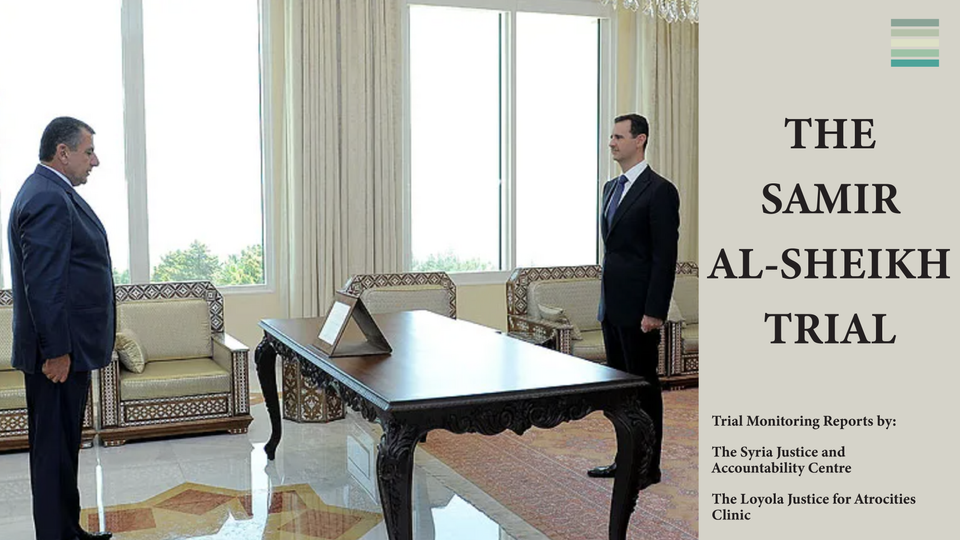
The Defendant argued that because the governorship of Deir Ez-Zour took place after he headed Adra, it was entirely irrelevant to show motive while at Adra. Similarly, the Defendant argued that a photo showing Alsheikh standing opposite to Bashar al-Assad in Assad’s office was overwhelmingly prejudicial and would turn the trial into a referendum on the Assad regime generally, rather than solely on Defendant’s actions and individual liability.
The Government argued that Alsheikh was a career Assad regime official, and that there was a relevant throughline: Alsheikh’s role in the Political Security Branch resulted in his promotion to head Adra Prison, while his role at Adra Prison, including the quashing of dissent, secured him the governorship.
The Court denied the motion.
- Defendant’s Motion in Limine to Preclude In-Court Identification by Government Witnesses Absent Special In-Court Identification Procedures
Defendant filed this motion to request that the Court’s Syrian language interpreters sit next to him at the Defense table, in order to ensure that Alsheikh was not the only Syrian man at the table in the event the Government asked witnesses to identify Alsheikh during trial.
The Court denied the motion.
D. Defendant’s Objection to Government’s Notice of Foreign Law
Lastly, the Court heard argument on the Government’s notice of foreign law. The Government had previously filed a request for the Court to take judicial notice of Syrian domestic law prohibiting torture during the time period when Defendant was the head of Adra Prison. However, at the January 6, 2026, status conference, the Court converted the request into a motion, to which Defendant objected. Thus, the Court heard argument on the motion at the final pretrial conference.
The Government’s position was that torture was prohibited under (1) the Syrian constitution and criminal code, as well as (2) international law such as Convention Against Torture (CAT) to which Syria was a party. Contrary to Defendant’s position, the mere fact that torture may have been routinely practiced in Syria during the relevant time period did not transform illegality into legality; whether a regime commonly violated its own laws was irrelevant to the legal definition of torture. Allowing Syrian emergency decrees or widespread practice to negate its treaty obligations, render international prohibitions meaningless, and eviscerate the U.S. torture statute, which domestically codified the CAT. Additionally, an executive decree did not have lawmaking power and thus did not change Syrian law forbidding torture, but rather was a means of avoiding enforcement of Syrian law by placing certain individuals beyond the reach of judicial accountability.
The Defendant argued that, pursuant to Executive Decree 51, Syria was under martial law at the time of Defendant’s alleged actions, and therefore both the Convention Against Torture and Syria’s domestic laws prohibiting torture were suspended. Thus, torture could not have been unlawful in Syria during the relevant time period. According to the Defendant, Assad never needed acts of parliament to do anything and the Government was arguing semantics, because “if you don’t enforce a law, it’s not a law anymore.”
As of March 1, 2026, the Court has not issued a ruling on this motion.
The next trial day will be on March 2, 2026.
___________________________
For more information or to provide feedback, please contact SJAC at [email protected] and follow us on Facebook and Twitter. Subscribe to SJAC’s newsletter for updates on our work